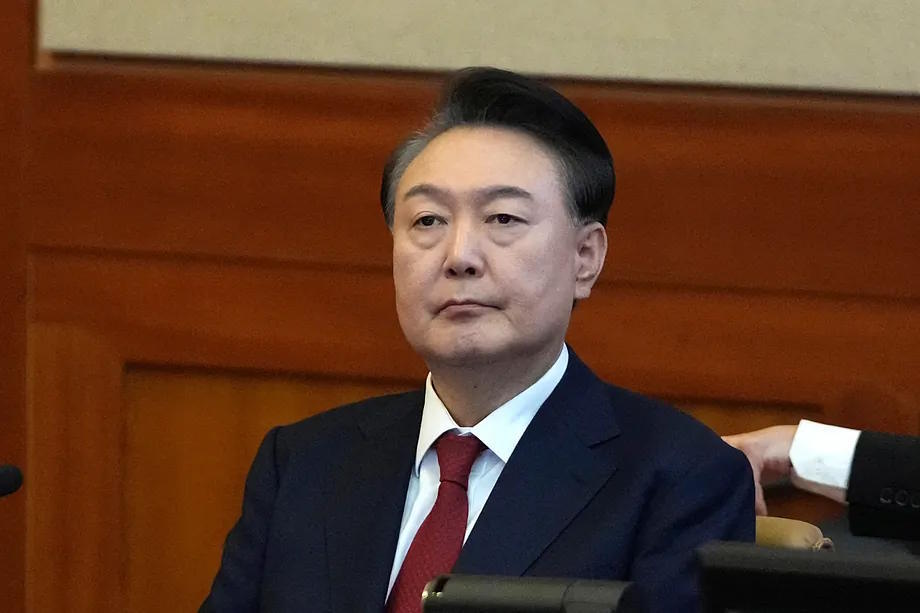
The fall of former South Korean President Yoon Suk Yeol has now a final verdict: life imprisonment for leading an insurrection after the brief declaration of martial law in December 2024. The verdict, issued on Thursday by a Seoul court, concludes one of the most tumultuous chapters in recent South Korean history and places the fourth largest economy in Asia in front of the mirror of its own democratic resilience.
Yoon (65 years old) was even facing the death penalty for his failed attempt to establish a military government. The court found that the then-president tried to subvert the constitutional order by activating a mechanism reserved for wartime or national emergencies without any real and imminent threat.
On December 3, 2024, in a televised appearance past midnight, Yoon denounced the presence of "anti-state forces" infiltrated in the opposition, whom he accused of sympathizing with North Korea. This marked the beginning of a crisis that, for hours, raised fears of a return to an authoritarian past.
The ensuing scene was etched in collective memory: military helicopters hovering over the National Assembly building (Parliament); soldiers descending with rifles to secure the chamber; lawmakers and workers barricaded; protesters blocking access with their bodies. All broadcasted live. The young but seasoned South Korean democracy stood resilient for all to see.
The Parliament ultimately managed to force a vote against the authoritarian decree, which was quickly declared unconstitutional by the Supreme Court. Yoon was removed from office and imprisoned weeks later. He has always maintained that everything he did was part of a plan to "restore democratic order," claiming that the country was under siege by the opposition and "anti-state forces."
However, the judges concluded that there was no factual basis for such measures and that the invocation of national security was a pretext to neutralize parliamentary opposition.
This trial marks a crucial moment in South Korea's relatively young democratic history. It dates back to 1987, after an uprising that overthrew the military regime of Chun Doo-hwan, who was sentenced to death in 1996 after being found guilty of similar charges of insurrection for seizing power during a coup in 1979. On appeal, the sentence was commuted to life imprisonment and later pardoned.
Last month, a Seoul court already sentenced Yoon to five years in prison for obstructing the execution of an arrest warrant, abuse of power, and fabrication and destruction of official documents. This case revolved around the former president's attempt to prevent his own arrest when investigators came to apprehend him in early 2025. Following the failed martial law, Yoon barricaded himself in his residential complex and ordered his bodyguards to prevent investigators from arresting him.
According to the accusation, Yoon ordered the Presidential Security Service to block the execution of the arrest warrant, using a state body as a personal shield. For the judges, this was not a defensive maneuver but a direct violation of the rule of law.
In total, Yoon faces eight legal proceedings including alleged corruption cases involving his family circle and the investigation into the death of a marine in 2023, an incident that also implicates his administration. The mosaic paints a picture of a presidency that, in just two years, shifted from promising a tough stance against corruption to being ensnared in its own legal maze.
Yoon's trial has been broadcast live while his supporters demonstrated outside the court. This is not the first time this has happened. In 2018, South Koreans could watch on television the sentences against former presidents Park Geun-hye and Lee Myung-bak, both convicted of corruption. Now, once again, cameras have followed every session of Yoon's trial, emphasizing the institutional will to exhibit transparency after successfully thwarting a military coup attempt.