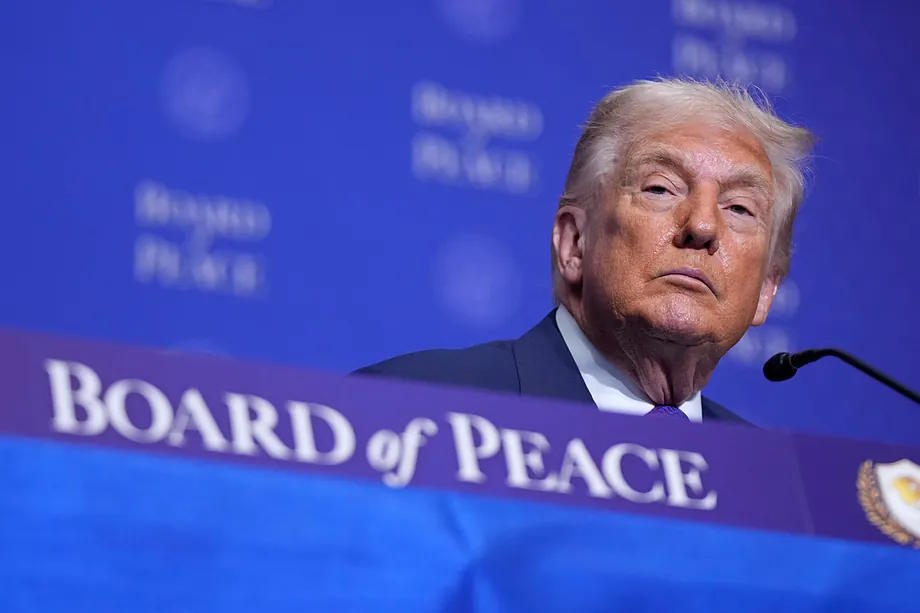
The Peace Board, initially designed by the team of Donald Trump to oversee the ceasefire and transition in the Gaza Strip, later transformed into an unprecedented and still undefined experiment to compete with the UN in conflict resolution worldwide, took its first steps this Thursday in Washington. It was done in pure Trump style, with an event with some world leaders, in front of cameras, with him as the master of ceremonies. Giving a speech in his own style, introducing each person present with jokes, displays of camaraderie, self-praise, praise for his cabinet, and his management. Talking about how he deserved the Nobel Peace Prize, his wife's movie, how he likes young women but dislikes handsome men or those who overshadow him. Gaza was the excuse, the display of power, and the submission of his counterparts, the backdrop.
The first information about the situation in the Strip was not heard until over an hour after the start, when the speeches of the main figures had ended. The first Arab voice, that of Ali Shaath, chosen as commissioner for reconstruction, was not heard until later, and only after Trump's negotiators had asked for applause and special recognition for Benjamin Netanyahu.
The idea, as explained by the president's son-in-law, was for everything to resemble a company's board meeting. "We can't change the past, but I believe what you are seeing today is that potentially we can change the future if we focus and do it correctly. We have tried to structure this meeting like a board meeting, as we do in the private sector, where we have all the preparation, gather the right people, and report on our challenges, opportunities, and approaches (...) If Jews and Muslims work together, Israelis and Palestinians with Americans, English, Bulgarians, and people from all over the world, we can unite in a common goal: peace and unity, and that is truly what we have achieved," stated Jared Kushner.
"Today is a great honor to welcome you to the United States Institute of Peace for the inaugural meeting of the Peace Board. It is a very important day. I believe it is the most important board, undoubtedly in terms of power and prestige. There has never been anything like it, because these are the most important world leaders. Almost all have been accepted, and those who haven't are trying to be nice. But that doesn't work, you can't be nice to me They are playing a bit, but everyone is coming together," boasted the president, highlighting his good relationships or how they have won elections thanks to his direct support. "He was a bit behind in the polls, but with my support, he won," he said, for example, about the Argentine Javier Milei.
The list of countries present is limited but striking, although not all sent their presidents or prime ministers: Albania, Germany, Saudi Arabia, Argentina, Armenia, Austria, Azerbaijan, Bahrain, Bulgaria, Cambodia, South Korea, Croatia, Cyprus, Czech Republic, United Arab Emirates, Egypt, El Salvador, Slovakia, Finland, Greece, Hungary, India, Indonesia, Israel, Italy, Japan, Jordan, Kazakhstan, Kosovo, Kuwait, Mexico, Mongolia, Morocco, Netherlands, Norway, Oman, Pakistan, Paraguay, Poland, Romania, Switzerland, Thailand, Turkey, Qatar, United Kingdom, Uzbekistan, or Vietnam. In addition to the European Union, represented by the Vice President of the European Commission, Dubravka uica.
The heterogeneity of the list reflects the many intersecting vectors. There are very close allies of the president, such as Nayib Bukele, Viktor Orban, or Javier Milei. There are those who have no choice out of fear of reprisals, like Mexico. There are those who do not play a significant role in international relations but seek their place. The Gulf countries that do not want to lose their privileged link and have learned that the best way to deal with the Administration is by opening their wallets. Those forced not to lose a historic place in alliances with Washington (Japan, Korea, UK). And then there are the European countries.
The presence of Hungary or Slovakia is not surprising due to ideological affinity. Orban is the European leader closest to Trump, and Marco Rubio met with the Slovak Fico just a few days ago. Greece is not surprising, as it cannot give up any forum where its great rival Turkey is present, intimidated by the possibility of being sidelined (just like India and Pakistan). But it is more difficult to explain Italy, Germany, Finland, or the Commission itself, something that has caused internal discomfort and complaints. There are 14 EU members, more than half, although many are only "observers". But legitimizing a body designed to Trump's measure. Where he, and not the United States or its government, has all the power, where Europeans will not have a say and accept a subsidiary role.
Trump, as the lifelong president of his Board, has absolute control, including the money, as he has auctioned off a permanent presence on the Board for one billion dollars. From designing the logo and composing the members, choosing who to invite or not, to the budget, schedule, and agenda. Having veto power and control of the body even when he is no longer the president of the United States. Countries know that it is a clear attempt to undermine the power and influence of the UN, an attempt to rewrite the international system, and an ad hoc mechanism for the enjoyment of the leader of the most powerful nation on the planet.
The president stated that the United States will contribute $10 billion to the Peace Board. And that Kazakhstan, Azerbaijan, United Arab Emirates, Morocco, Bahrain, Qatar, Saudi Arabia, Uzbekistan, and Kuwait have pledged an additional $7 billion for aid to Gaza. The commander of the international forces, General Jeffers, announced that five different sectors will be created in Gaza and peacekeeping troops will be deployed first in the Rafah sector. The long-term goal, he communicated, is to have 12,000 police officers and 20,000 security forces soldiers, with an Indonesian as the number two.
"It's beautiful. Everything is beautiful. Old wounds can heal. Our entire planet will be a better, safer, more beautiful, and more peaceful place for everyone. We will work very closely with the United Nations. We will reclaim them. I believe the United Nations has great potential, really great potential, but they have not lived up to it. Someday, I will no longer be here. The United Nations will be, I believe, much stronger, and the Peace Board will practically oversee the United Nations and ensure they function properly," said the president, openly expressing his intentions. "We will strengthen the United Nations. They need help, and we will help with that money, and we will ensure that the United Nations are viable," promised Trump, who spoke for 40 minutes.
The Republican barely mentioned Gaza. No reference to the current situation or the Palestinian deaths that continue to occur every day. To reconstruction or needs. Only generic references to how well everything will go under his leadership. But still, many countries are there. Out of fear of being left out of President Trump's orbit, or for fear that the space will be occupied by his rivals or direct enemies. For business opportunities, like Tony Blair, another who briefly spoke at the end of the event in a series of rapid interventions, limited to just over a minute.
All the staging was centered on the American and his closest advisors, including a cascade of praise in each intervention and propagandistic videos. Trump had the place of honor, surrounded by his vice president, JD Vance; the Secretary of State, Marco Rubio; his son-in-law, Jared Kushner; the UN ambassador, Mike Waltz; and his special envoy, Steve Witkoff. Trump did what he does every day: tell stories about each of them, joke about the relationship between Witkoff and Vladimir Putin, or about Vance's studies and how he met his wife in college. What was least talked about in the central part was precisely Gaza, which was theoretically the reason for the Board's existence.
"We have just begun. This is our first meeting, but every dollar spent is an investment in stability and the hope of a new and harmonious region. It is so important, so vibrant, it's incredible. The people are incredible, and we want to have a harmonious Middle East. The Middle East is incredible, there are so many friends, they are so smart. Sometimes they are too energetic," Trump pointed out.
"The Gaza crisis has been a very unique crisis that existing international institutions could not resolve or decipher. It required a very specific solution with the collaboration of all present nations (...) This situation in Gaza was impossible to resolve under existing orthodoxy and structures. So what we did was turn to the UN and obtain its approval to form this group and bring together these nations to find a very specific solution, solutions to a very unique and specific problem. We have a long way to go. There is much work to be done. It will require the contribution of all the nation-states represented here today, and we thank you for your participation. And I hope this serves as a model for other complex situations.
There is no plan B for Gaza. Plan B is to return to war. No one here wants that. Plan A. The only way forward is to rebuild Gaza with lasting and sustainable peace, where everyone can live there, side by side, without ever worrying about returning to conflict, war, human suffering, and destruction," Marco Rubio stated. Finally, the interventions of specialists, military, and civilians arrived. Those who must ensure peace, but also those who promised a logistical system "mimicking Amazon," those who spoke of exploiting the assets of the Strip in the language of start-ups, or those who sold "the incredible potential" of the real estate market in the reconstruction of millions of homes. "It's not a problem of money or collateral, it's just about peace. There are hundreds of billions of potential value to unlock," another said.