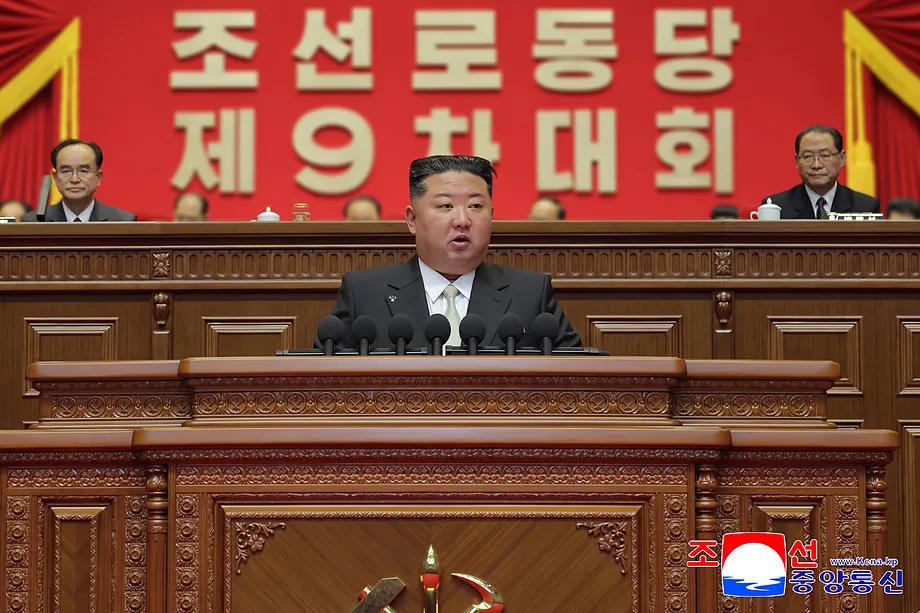
In the political liturgy of North Korea, the congresses of the ruling Workers' Party, held every five years, are not mere bureaucratic assemblies of a dictatorship. They are rituals of ideological reaffirmation and, above all, showcases of maximum adoration for the supreme leader.
This Thursday, in the heart of Pyongyang, the Ninth Congress of the party was inaugurated, the regime's most important political meeting since 2021, under the leadership of the omnipresent Kim Jong-un.
The state agency KCNA spoke, as usual, of an "splendid" opening in the "capital of the revolution". Behind the epic rhetoric lies a more prosaic reality: the North Korean leadership redefines its roadmap in defense, diplomacy, and economy every five years. And it does so at a particularly delicate moment, both on the military and economic fronts.
More than 5,000 delegates, including about 200 high-ranking officials from the central apparatus, are attending a meeting designed to showcase unity and discipline. Thousands of regional and military officials are also participating. A scenario in which everything converges on the figure of Kim, heir to a dynasty that has ruled with an iron fist since 1948.
In his inaugural speech, the leader avoided explicit references to South Korea and United States, traditionally singled out as existential enemies of Pyongyang. Kim focused his intervention on the economy.
"Our party faces heavy and urgent tasks to promote economic development, improve people's living standards, and transform all aspects of the country's social life as quickly as possible," he stated.
After years of international sanctions due to its nuclear program and the most hermetic border closure during the pandemic, the North Korean economy is suffocating in its own opacity. Assessing its real state is an almost impossible task.
But many observers point out that Pyongyang has achieved some relief after reactivating trade with China, its main lifeline, and increasing military cooperation with Moscow.
Vladimir Putin's war in Ukraine has opened a window of opportunity for Kim. North Korea has supplied large quantities of ammunition to Russia and deployed thousands of soldiers in support of Russian forces. In return, it receives currencies, fuel, and technological transfer in military matters. In a country where armament development is the backbone of the system, this assistance is crucial.
In the congress five years ago, headlines focused on Kim labeling Washington as the country's "greatest enemy," in the aftermath of failed diplomacy with President Donald Trump.
In 2019, both had an unusual encounter in the demilitarized zone between the two Koreas, when Trump briefly crossed into North Korean territory to shake hands with Kim. In recent months, the American has reiterated his willingness for a new meeting, but Kim has not commented, at least publicly.
Parallel to the congress, state media reported yesterday that Kim presided over the deployment ceremony of 50 new short-range missile launch vehicles with nuclear capability. These news reveal that the priority, above all, remains to enhance military muscle. Since the previous congress, North Koreans have accelerated tests of intercontinental ballistic missiles.
It is expected that, at the end of the congress, a large military parade will be held, always scrutinized to the millimeter by satellites and international analysts. On many occasions, these events have served to present new missiles, drones, and tactical systems.
Another issue surrounding the political conclave in Pyongyang is the upcoming succession of the Kim family. Seoul's intelligence services are closely monitoring any gestures that could consolidate the teenage daughter of the leader, Kim Ju-ae, as the visible heir of a fourth-generation dynasty. South Korean spies claimed last week that the youngest - believed to be 13 years old - will be the successor.