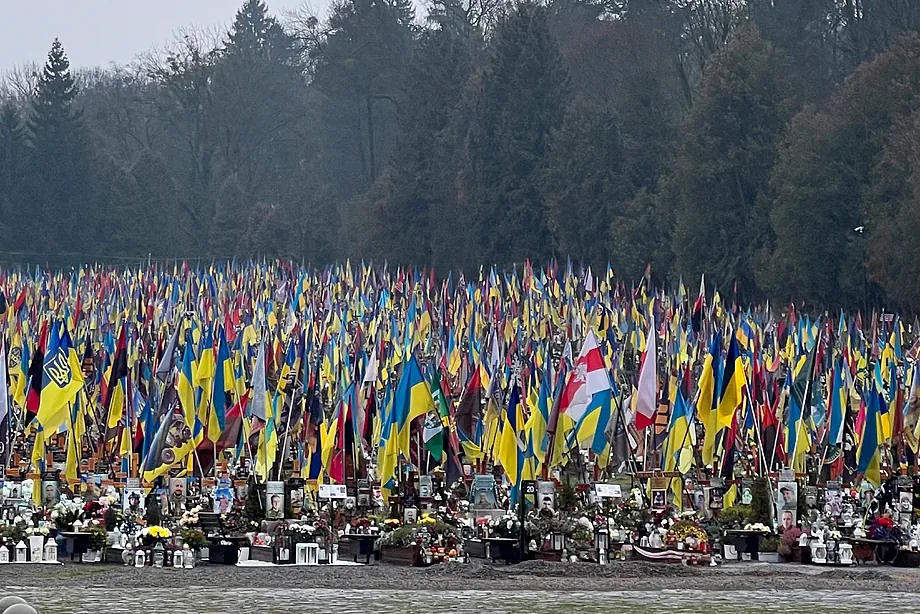
The "Field of Honor" in Lviv is an endless succession of rows of graves, adorned with portraits of young people. They were supposed to be the future of Ukraine but now are part of the troubled past the nation has had to face since Russia launched its general invasion in 2022.
The graves number in the hundreds, almost all topped with flags of the country or the military units in which the soldiers served.
The cemetery reflects the demographic hemorrhage that the war is causing for this nation. In fact, authorities announced that this space had reached its burial limit and had to open a new cemetery in a nearby area starting from December of the previous year. As a local publication wrote when announcing that the necropolis was full: "The price of Ukrainian freedom is measured in names, not just in kilometers."
For Irgna Farion, the name of her baby, Oleksander - one and a half months old - is a reminder of her husband, who died fighting against the Russians in the Donbas region.
"He was killed in Donbas. He was a unit commander and saved the life of one of his soldiers, but not his own," explains the woman as she arrives at Dr. Lyubov Mykhaylyshyin's clinic, carrying a bouquet of flowers.
She wants to offer it to the specialist, "in gratitude for giving me Oleksander," she says with her baby in her arms.
Irgna and her husband had started the in vitro treatment before the Russians launched their general offensive against Ukraine. Her husband's death in December 2022 halted the entire process. The Ukrainian had to emotionally recover for months.
"I only felt ready at the end of 2024 when I visited Oleksander's grave. There I understood that I was prepared," she recalls.
Lyubov Mykhaylyshyin shows the barrel-like compartments where she stores samples from the half a dozen patients who have frozen embryos at her medical center.
Mykhaylyshyin is one of the many assisted reproduction specialists available in Lviv. As Dr. Stefan Khmil expresses, whose center has frozen hundreds of sperm and embryo samples since the total war began four years ago, the city located in the west of the country has become "the Mecca of in vitro reproduction (IVF) in Ukraine."
Amid the shock caused by the Russian invasion, the central government established a program the following year that allowed men serving in the military to freeze their sperm for free, and their partners could keep it for at least three years if they died.
"Our soldiers defend our future and may lose their own, so we wanted to offer them this opportunity," explained Deputy Oksana Dmytrieva, the driving force behind that legislation, to a local media outlet.
"We perform about 300 cycles per year [referring to assisted reproduction processes]. But the number of soldiers who have taken advantage of this is very small," Mykhaylyshyin points out.
The "posthumous" birth of children of soldiers who died in the conflict is one of the consequences of the modification of local legislation for this purpose, which is part of the incentives established by Kyiv to promote childbirth, including assistance from before the baby is born until they are six years old, which can reach a maximum of 615,000 hryvnias (about 12,000 euros).
Last year in May, another Ukrainian, Natalia Hordiychuk, gave birth to a child conceived with her husband's sperm, who had died the previous year while fighting in Donetsk. In that case, the mother also gave the child the same name as her partner, Yuri.
The warning about the country's population decline has been repeated a thousand times in recent years by all experts.
In the first three decades of independence, the state saw its citizenship decrease from 51.5 million to the approximately 41 million it has now, according to UN figures.
In 2024, around 31 million Ukrainians lived in the territories controlled by Kyiv, another five million remained in the provinces occupied by Russia, and another five were abroad, according to estimates from the Center for Economic Strategy.
"The war is accelerating the demographic crisis," warns Lyubov Mykhaylyshyin. "It is a crisis predating the 2022 invasion. If in '91-'92 we recorded around 600,000 births per year, by 2022 there were only 200,000," she adds.
With one of the lowest birth rates in the world, the constant numerical hemorrhage caused by the war has led to the mortality rate almost tripling the number of births by mid-last year.
During a forum focused on this issue held in Kyiv, the capital, in April 2025, Minister of Social Policy Oksana Zholnovych estimated that if this trend continues, Ukraine's population could be reduced to 10 million by 2050, reaching a minimum of 25.2 million inhabitants.
Death is an absolute impediment to reproduction, but according to Dr. Khmil's data, 10% of severely wounded soldiers also see the legacy of those injuries leave them infertile.
"Stress or lack of sleep is a determining factor in reducing fertility, both in men and women. Analyses have confirmed that in most cases, there is a reduction in the quality of sperm in soldiers on the war front," Mykhaylyshyin explains.
Olena Yunko, 33, has served as a military instructor in her country's armed forces for a decade. She is another patient at Mykhaylyshyin's clinic, who has chosen to freeze her eggs under the new regulations.
Even she - determined to try to have a child through IVF - admits that if she lived in the eastern part of the country, "I would think twice about having a child. What can you do with a child if the Russians come?"
The military reflects on Ukraine's demographic future and, with a bowed head, faces the obvious, the horror that war implies. "The brightest ones are gone. Those with the best DNA are dead," she concludes.