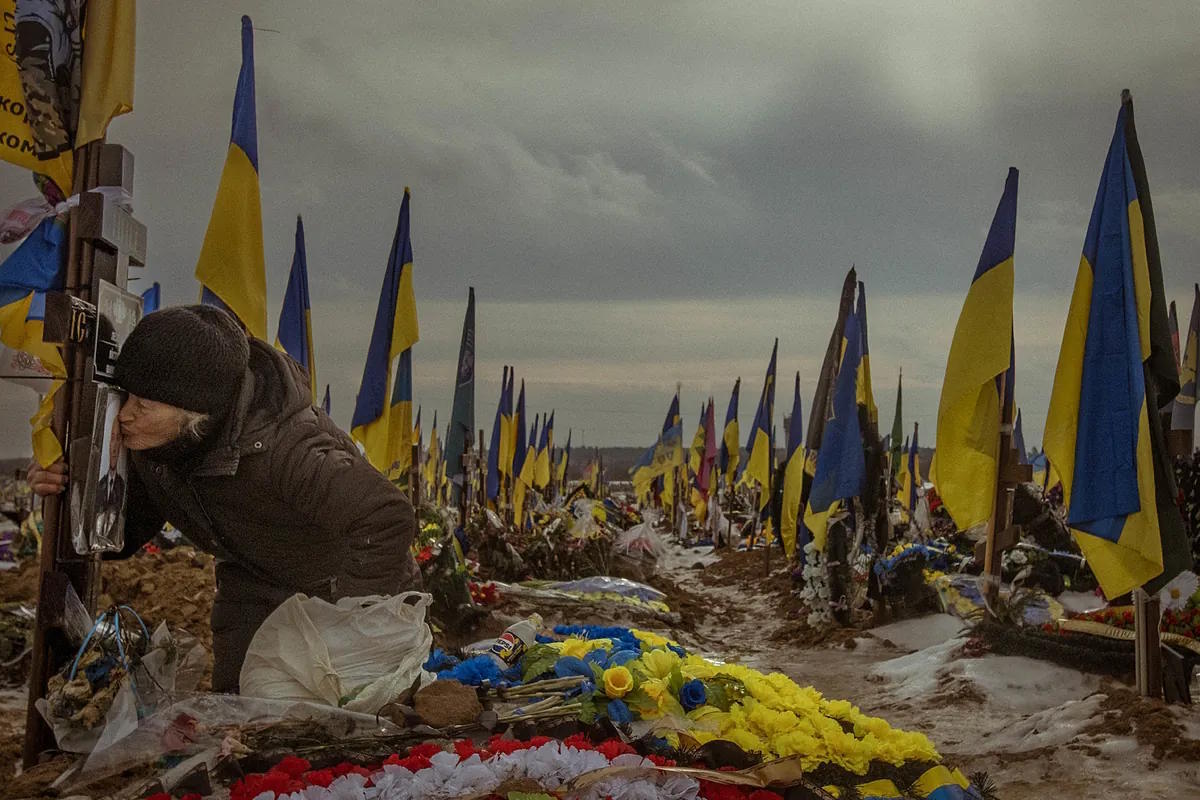
Mrs. Vita carefully cleans and kisses the photo of her son Viktor. At 82 years old, she comes to the Járkiv cemetery every day to do so, even when it's 10 degrees below zero and everything is frozen, as if time had stopped in that small gesture of humanity. Until 2024, she lived in the city of Vovchansk, on the border with Russia, now occupied by Z troops, where her house was destroyed, and the body of her other son, whom she couldn't even bury, remains. "I just want them to award Viktor the Hero of Ukraine medal, because he gave his whole life to fight for his country," says Vita, who is forced to live in a nursing home. Just then, a Shahed drone passes over us with its terrifying sound towards the city. Minutes later, we hear its detonation as it reaches its target.
Around Vita's son, an ocean of flags grows, one for each Ukrainian military grave in the war. It's Sunday, and several families and comrades have come to bring flowers. A mother leaves cigarettes and two cans of beer on her son's grave on his 27th birthday. There are recent graves, almost at ground level, according to Ukrainian tradition for the deceased's soul to decide whether to leave or stay in this world, and others deeper and more permanent, completed around a year after the first burial. Ukraine's finest generation rests in them. There are also empty ones, with freshly disturbed soil, waiting for their next occupants. No place better illustrates what war is and exemplifies what they call here "the price to pay," which is nothing but Ukraine's sacrifice in an existential war.
The "special military operation" that was supposed to last three days enters its fifth year of war this week, turned into a personal obsession of Vladimir Putin. There is no war rationale to sustain this prolonged carnage and criminality of one of the greatest military disasters in recent history. The reality is that, despite the efforts of its chorus of propagandists, the Kremlin has not achieved any of its objectives from February 24, 2022 despite boasting one of the world's most powerful armies. Ukraine still stands, and Zelenski remains in charge, exactly where he recorded the video on February 25, 2022, in which he declared, already dressed in military green: "The president is here."
Putin, stuck in the Donbass ice, is leading his country towards rampant economic degradation and reinforcing a descent into the most imperialistic totalitarianism. The data is clear: in the Great Patriotic War, from June 1941 to May 1945, the Red Army advanced 1,600 kilometers from Moscow to Berlin. In this war, which has already surpassed that one, Russian forces in Donetsk, their main stronghold, have advanced only 60 kilometers in four years. Since the beginning of this carnage, almost all analysts believed time was running against Ukraine and in favor of the Russian bear, but Kiev has resisted, and now, perhaps for the first time since 2022, Ukraine could be to Russia what Afghanistan was to the USSR.
Frontline soldiers have become moles living in underground shelters unable to move or go outside. To confirm this, we travel to Sloviansk, in the heart of Donbass, to meet probably the Ukrainian who has spent the most time in one of these holes. To get there, we have to travel on the road from Izium, completely covered by an anti-drone mesh, and do so at full speed. On both sides of the road, we see civilian cars burned by Russian drones, adding a touch of unease to the journey. Curiously, Sloviansk is where this confrontation began in that distant 2014, with the uprising of pro-Russian rebels, led by paramilitaries like Igor Girkin or Arseni Pavlov, known as Motorola.
The lightweight Sergiy Tyshchenko, from the 30th Mechanized Brigade, shakes our hand with fingers as rough as hemp. A veterinarian in civilian life, he received training in tactical medicine and was sent to one of the most advanced positions on the Donbass front to treat and evacuate his comrades. Due to the lack of doctors and the danger of rotation under the flight of thousands of enemy drones, he spent 471 days in a hand-dug shelter, sharing space with mouse plagues.
"I didn't see sunlight during that whole period," he admits. Both he and his comrades received "food, medicine, ammunition, and water transported by large drones, but sometimes the bottles broke from falling from that height," says Sergiy, acknowledging that the lack of water was his worst problem, along with the gradual deterioration of his health. "The shelter was so small we had to be on our knees, which has caused me injuries and lifelong pain. A colleague of mine smoked inside, so when we left, my lungs were even worse than his."
Isolated on the battlefield
But what tortured him the most was the isolation. "In that position, we had no internet connection with Starlink, which meant that every two weeks, one of our comrades had to risk his life and walk a few kilometers to meet another comrade leaving the base. Halfway, he handed over a pen drive with the military situation and video messages from our families. And that's what kept us alive," says Sergiy. "Sometimes the enemy attacked us, and we had to go outside and repel them. We killed many Russians, and they killed some of ours."
The closest example to this situation in military history is that of Japanese soldiers who were isolated fighting on Pacific islands when World War II had ended years earlier. "We didn't know if the war had ended, if the Russians had overrun our position, or if our own had forgotten about us," says Sergiy, who finally received the order to leave, walked back after 471 days buried alive, and went straight to the hospital to recover. There, he received the medal accrediting him as a "Hero of Ukraine".
The invasion of Ukraine is gradually disappearing from the news. It has almost become normalized and entrenched as a bleeding wound in global geopolitics, but we are at a time when more military and civilians are dying. The battlefield today is the deadliest in the history of armed conflicts. The robotization by land, sea, and air has turned this confrontation into a meat grinder that leaves hundreds dead and mutilated every 24 hours, sometimes thousands.
Consistent analyses estimate the total casualties at over a million Russian and perhaps around 700,000 Ukrainian. Additionally, Putin bombards Ukrainian cities from a distance, mistakenly believing that punishing civilians will break their morale and subdue them, but the Russian autocrat has shown he doesn't understand Ukrainians, despite his claims that Ukrainians and Russians are the same people. Since Trump returned to the White House, Russia's attacks have increased by 26%, contradicting their motto, "peace through strength," and their insistence on considering Joe Biden a "sleeping" president.
A Journey Back
Readers who have followed the war through the chronicles of this reporter have come across the story year after year of the three crew members of a T64 tank, nicknamed The Toad, belonging to the 92nd Mechanized Brigade, since the beginning of the invasion. One of them (Yevgeni) died at the age of 20 in the fall of 2022, and the other two are still alive. We met with them at the Dnipro front, where they are deployed. Andrii, who was the tank commander, is now a sergeant major. In these four years, he got married, had a child, was seriously injured by a Russian helicopter, recovered, and returned to fight. Viktor also fell in love, got married, had another child, but is now divorced and requested to leave the tanks due to drone attack panic, now he is a drone pilot himself.
- How do you see yourselves in the photos I took of you four years ago?
- There is very little left of us. In four years of war, we have aged 20.
- How do you feel? You are only 25 years old...
- We are always tired, without energy. I have vision and hearing problems due to brain concussions [Andrii]. I have back pain and migraines [Viktor].
There is something else that Viktor does not mention, something we never saw in previous interviews with him but is evident: the trembling of his body and hands, a symptom of hyperactivation of the nervous system after continuous exposure to combat, explosions, and constant threat.
"There are things that you can't get out of your head anymore," says Andrii. "For example, we were conducting an assault with armored vehicles on an enemy position and had 15 soldiers on our tank. The Russians fired a projectile at our tank that hit us directly. We survived because we were inside, but out of the 15 comrades who were on the outside, all but one died," he recounts. Viktor adds another memory from his personal catalog of horrors: "I can't forget the smell of the dead. For several days, we passed through an area with many Russian corpses with the tank. It was hot, and they smelled so much that that stench gets into your head."
There are few soldiers left who fight above the ground and not below it. Assault units, responsible for taking enemy positions, still do so, but their risks have multiplied in the so-called annihilation zones. We want to interview one of the leaders fighting in the Jartia Brigade, responsible for the recent liberation of the city of Kupiansk, but to our surprise, he is not Ukrainian but Peruvian. He is the sergeant major Chapa, his war name, a man of short stature but tough as granite, disciplined and efficient, showing a recent wound under his eye from shrapnel. "It is an honor to receive this promotion as a foreigner," he says, proudly.
- Are you here for the money?
- Not just for the money. If it were only an economic matter, I would be on the Russian side, which pays better, but I am aligned with the fight for the freedom of Ukraine.
To speak with Chapa, we had to travel a road full of craters, passing through several villages with all their buildings destroyed by the scourge of war.
Chapa spent years fighting "narcoterrorism" in his country, but he was missing a war on his resume. Now, he has been fighting for a year and a half, undergoing three operations to remove shrapnel from his body.
- You have faced Russian soldiers face to face. How would you describe them?
- Many of them are very undisciplined. The lack of discipline is what allows us to prevail over them. Many times they come out of their shelters to smoke without a vest or helmet, even throwing the pack anywhere. That gives us a clue as to where they are hiding to then assault their position. Sometimes they even drink vodka, making themselves easy targets for us.
Sitting next to Chapa is a doctor from his unit, Guajiros, a battalion of Spanish and Portuguese speakers, mostly from Brazil, like her. She goes by the name Pumaneyra. "I came here because I felt it was what God asked of me. In Brazil, I already knew tactical medicine, but in Ukraine, there have been profound changes. For example, since there are no longer evacuations in less than two hours, we try to place the tourniquet right over the wound and not where the arm or leg begins, as we assume it will need to be amputated, and we want the amputation not to be of the entire limb, but of the injured part," she says. This explains the legion of amputees one can see in the streets of major Ukrainian cities.
These volunteers highlight the international character of this phase of the war, where translators are increasingly in demand to communicate between units. Currently, thousands of Colombians, the most prevalent nationality among foreigners, are fighting on the front lines.
Alive, Dead, and Missing
After four years of war, the scars of bombs, drones, and missiles are everywhere. For this report, we tried to contact many people who at some point appeared in the chronicles of this reporter. Unfortunately, not all are alive. A photo taken in 2023 in Konstiantinivka shows three soldiers from the 80th Assault Brigade posing with their captain, Yuri Gagarin, named in honor of the first cosmonaut in history, upon their return from capturing the city of Klishivka. Captain Gagarin himself tells us today that one of them died, another disappeared in combat, and the third, himself, is still alive. The press officer who helped us that day, Katia, is now a drone pilot. Konstiantinivka, the place of the interview, has been reduced to ashes.
Others are still alive and standing: Yara Chornohuz, the warrior poet, still serves in the Ukrainian Marines and read her poems to European politicians last week in Munich. Olexander Ivantsov, the last Ukrainian to break the siege of Azovstal, continues to fight, as well as Captain Alina Mijailova and many others.
We could not find Mrs. Liudmila, who survived for years in her basement in the city of Liman (her husband, Viktor, called it the "Titanic cabin") and we do not know if she has died. The phone of Olexander Chukhil, the dentist from Saltivka who was losing his teeth due to hunger during the first weeks of the invasion, is no longer working, and we fear the worst. We also do not know if Katia, 68 years old, a blonde babushka (grandmother) with elegant manners we met in a shelter in Huliaipole (Zaporizhia), now turned into a war zone, is still alive... Unfortunately, the list is too long.
This reporter remembers a burial at the military cemetery in the city of Lviv in the early days of the invasion. There were dozens of recent graves with the sky blue and golden wheat flag. No one thought then that this savagery would last so long. Today there is a sea of thousands of graves. And the war continues.