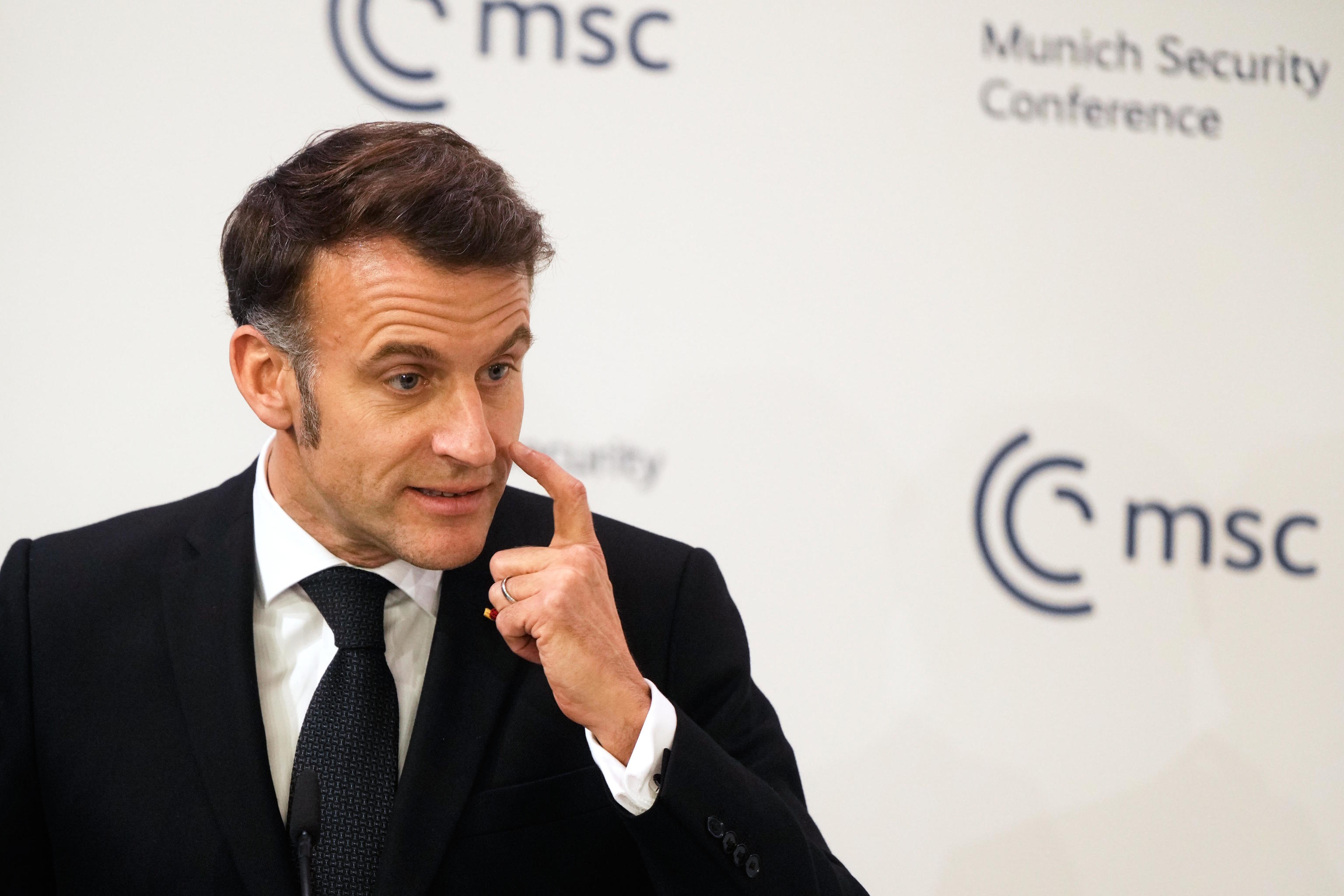
One of the billboards at the exit of Munich International Airport reads "European Defense." It is an advertisement for an agreement between the German companies Helsing and Hensoldt to manufacture an autonomous drone, which, according to the specialized U.S. international relations magazine Foreign Policy, is the best example of one of the underlying ideas of the recently held Munich Security Conference: the creation of a European and Canadian autonomous defense capability within NATO.
The image of Helsing and Hensoldt may be very evocative. But there is a problem: both companies are German. European countries still view their Defense sectors as exclusively national. Among continental countries, following the so-called Rhenish capitalism, with a much more pronounced state intervention in the economy, this is more visible. Therefore, the European Defense industry remains fragmented. And it will continue to be so because there does not seem to be a single authority to regulate and purchase its products.
26 years after the birth of the euro, the EU does not have a truly unified financial market, but 21: one per country. Even the energy market is integrated, but it cannot be said to be unified. Will something similar happen with the Defense industry at a time when Europe is threatened by Russian expansionism, U.S. isolationism, and chronic instability in the Middle East and Africa? It is true that "rearmament" has returned to European political vocabulary. The unanimous feeling is one of urgency. But the result is not greater efficiency, more consolidation. On the contrary.
The Defense sector is a monopsony, a market where there are many sellers but only one buyer: the State. However, the reality is that in Europe there is no, as in the United States, Department of Defense, but at least 29 (all EU plus the UK and Norway). That means 29 decision-making centers. And also, 29 national industries to protect. Because the Defense sector is too sensitive for national security to be left to the vagaries of the free market. Strategic autonomy requires industrial integration, but industrial integration requires the relinquishment of economic sovereignty. And the relinquishment of economic sovereignty entails a loss of political power for Governments.
In the EU, the sector is divided into four groups of companies. It is an informal classification, fiercely defended by Governments. The first group is the so-called Tier 1, whose members design and assemble large complete systems, act as prime contractors to Governments, and manage complex programs. Here are giants like the Franco-German (though more German than French) Airbus, the French companies Dassault and Thales; the British BAE Systems; the Swedish Saab, or the Italian Leonardo and Fincatieri. As the co-founder of a private equity fund specializing in the European Defense industry says, "with the possible exception of BAe, because the British are always more open to foreign investment, the other companies in that group are untouchable for mergers or acquisitions or even significant entries into their capital."
Then there are the Tier 2 (often specialized in critical systems, like the German Rheinmetall or the Spanish Indra), Tier 3 (often small and medium-sized companies with a high degree of sophistication but comparatively small), and the Tier 4 (which is essentially the industrial base).
With the technologization of Defense, companies in Tier 2 and some in Tier 3 have been shielded by Governments. No one can imagine, for example, a Spanish Government, regardless of its political orientation, giving up the Spanish identity of Indra. And even less so when there are countries like France, which generally consider their industry a closed shop to foreigners and have done everything possible to keep the UK out of SAFE, the EU program for financing community Defense, to avoid having a tough competitor at home. Allowing a military equipment company to become part of another foreign company is equivalent to unilateral disarmament.
Furthermore, the list of companies in Tier 1 continues to grow. The French Government vetoed the sale of the antenna division of the French company Eutelsat to the Swedish private equity fund EQT, citing the European need to compete with Starlink, from SpaceX - owned by the American and Donald Trump ally Elon Musk - even though Sweden is a member of NATO and the EU. Companies providing critical services are also untouchable.
The sector is thus divided at all levels in terms of supply and demand. This is striking because, since the mid-60s, the Old Continent has understood that the costs of developing new weapons systems are unsustainable for a single country. This is how the aircraft capable of launching atomic bombs Jaguar was born in 1968, initiating a series that continued with the passenger aircraft Concorde, which would have turned fifty this year. Cross-border coordination has expanded, but with very few mergers and always subject to political tensions.
Even in projects involving two or three countries, reaching an agreement is often almost impossible. The most current example is the Future Combat Air System (FCAS), between France (Dassault), Germany (Airbus), and Spain (Indra) to create a sixth-generation fighter-bomber, which has been on the verge of collapse for months. The reason is the inability of the two leaders - Dassault and Airbus Defence - to agree, mainly due to the insistence of the French company on imposing its criteria and Paris's demand that the aircraft have the capability to operate from its aircraft carrier Charles de Gaulle.
It is just a repetition of what happened in 1985 when Dassault also broke with Airbus, the Italian Leonardo, and the British BAE in another combat aircraft project. In the end, Paris produced the Rafale, of which India announced the purchase of 114 units for 33 billion euros on Thursday, despite the aircraft already serving in the Indian Air Force having a highly questionable performance in the armed clashes between India and Pakistan last year. Airbus, BAE, and Leonardo manufactured the Eurofighter Typhoon, which is used, among others, by the Spanish Air Force.
Additionally, in Europe, there is another project to manufacture a sixth-generation fighter-bomber: the Global Combat Air Program (GCAP), formed by the UK, Italy, and Japan, to which Germany could join if the FCAS breaks down and does not decide to go it alone. This implies that, at a minimum, the European arm of NATO will have by the mid-2040s - if all goes well - two fighter-bombers destined to do the same, just as it currently has the Rafale and the Eurofighter Typhoon.
The lack of coordination is not limited to combat aircraft. It extends to almost all systems. A case even more extreme than that of the FCAS is the Main Ground Combat System (MGCS), established between France and Germany nine years ago to find a replacement for their respective nationally manufactured tanks, the Leclerc and the Leopard 2, respectively. Being generous, it could be said that the MGCS is paralyzed.
However, if in the case of the fighter-bomber the blame falls unanimously on the French group Dassault, in the case of the tank, it goes to the German company Rheinmetall. The result is that the project is ten years behind schedule, and if it ever enters service, it will be around 2045, a date far enough in the future that no one knows what ground combat will be like, meaning that tanks as we know them may not be needed. Meanwhile, in July 2022, Poland decided to buy a thousand South Korean K-2 tanks, thus eliminating one of the natural export markets for the MGCS. With the threat from Russia, which has just invaded Ukraine, Warsaw could not afford to wait a quarter of a century for Paris and Berlin to resolve their business disputes.