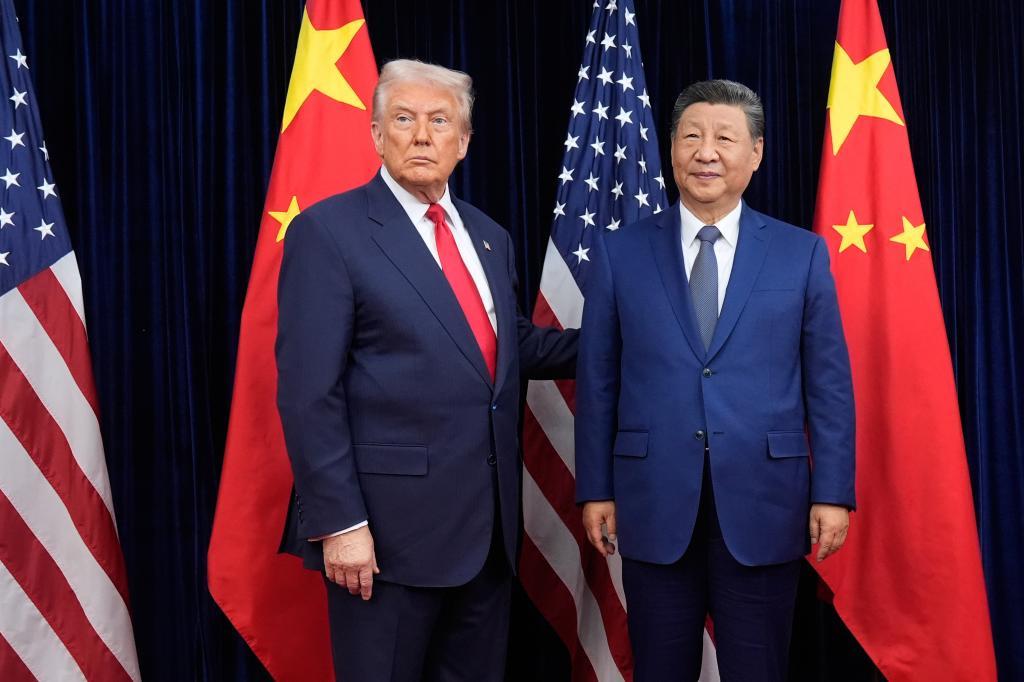
There was a time, not long ago, when landing in Beijing was not a top priority for Western leaders. China emerged as the world's factory, but it was an uncomfortable trade partner, more often mentioned in human rights reports than in top diplomatic issues. Official visits existed, but were sporadic. The photo in the Great Hall of the People did not make headlines, and many Western leaders, who looked with suspicion and some condescension, traveled to the Asian giant more out of economic obligation than strategic conviction.
United States has monopolized the international architecture for many decades, and the European Union has felt very comfortable under its umbrella. But the current landscape is radically different. Beijing has become a mandatory stop on the annual tours of world leaders. The same allies that once orbited seamlessly around Washington now knock on Xi Jinping's door without any complex.
The climax will be set by the U.S. President himself, Donald Trump, who is scheduled to travel to China in early April. A visit loaded with symbolism in the midst of strategic rivalry between two superpowers that have reduced their tensions, especially in trade, in recent months.
Just a couple of weeks after Trump's trip, Beijing will welcome the Spanish Prime Minister, Pedro Sánchez, who is facing his fourth official visit to the Asian country, an unusual frequency that illustrates how crucial this bilateral relationship is for the socialist government.
In recent years, the Spanish government has strengthened political and commercial ties with the world's second-largest economy, attracting Chinese investment in sectors such as renewable energies, automotive, or infrastructure, and establishing Spain as a gateway to Europe for Chinese companies. Sánchez has tried to maintain a delicate balance between his visible approach to Beijing and coordination with EU partners on sensitive issues like human rights. Unlike other European leaders, this matter is omitted by the Spanish leader during his trips to the East, always prioritizing the economic component of the agenda.
"It is normal to see an increasingly long list of Western leaders wanting to come to China. While Trump stirs up storms, Xi Jinping builds bridges and offers his guests great commercial opportunities," says a veteran Chinese diplomat involved in receiving foreign delegations.
The Xi government, according to internal and external observers, is adept at reading the changes in the geopolitical landscape. Against Trump, who continues to create divisions in the transatlantic alliance (tariff threats, pressure on defense spending, and disdain for multilateral institutions), Beijing presents itself as a predictable trade partner. Additionally, its soft power is advancing at an unprecedented pace.
In the cultural realm, more and more Chinese brands are expanding into Western markets, from electric vehicles to the global phenomenon of Labubu dolls, whose manufacturing company, Pop Mart, saw a 400% increase in its stock price in 2025. A survey conducted by The Economist at the end of last year showed that China's global image is rapidly improving. The study, based on 32,000 interviews in 32 countries, revealed a significant increase in the percentage of people who would prefer China as the leading power (reaching 33%, up by 11 percentage points), while support for the United States has declined.
The charm offensive also translates into tangible investments. Under the Belt and Road Initiative, the mega-project of global infrastructure, China has financed ports, roads, trains, and power plants inAsia, Africa, and Latin America, creating a network of economic ties that reinforce its political influence. Many analysts highlight that this physical presence, combined with the old narrative of non-interference in other countries' internal affairs and "unconditional political conditions" cooperation, enhances its image as a pragmatic alternative to a perceived volatile United States.
"China has chosen to position itself as a responsible global player, and this has strengthened its position especially among countries in the Global South. But the recent series of trips by European leaders to Beijing demonstrates that the Global North is also paying attention," analyzes John Gong, Economics professor at the Beijing International Business University.
"China is always a trade partner, not a rival", stated Chinese Vice Premier He Lifeng in his speech in January at the Davos forum. While Trump told world leaders that Washington had become "the most attractive country in the world" thanks to tariff revenues, and that Europe "would do much better" if it followed the American example, Li emphasized China's continued support for multilateralism and free trade.
During the past weekend, at the Munich Security Conference, Foreign Minister Wang Yi doubled down: "China and Europe should jointly reject unilateral practices, safeguard free trade, and oppose bloc confrontation." China presents itself as a "strong force for peace and reliable for stability," in Wang's words.
These speeches are part of a broader strategy in which Beijing promotes its own international architecture - strengthening groups like the BRICS - with the aim of eroding the primacy of institutions led by Washington and promoting an order more in line with its interests and that does not question its authoritarian vein.
Europe plays a central role in this equation. Chinese state media have emphasized in many editorials that the old continent is a strategic pole that should not automatically align with the United States in containing China. Therefore, in this context, the parade of leaders in Beijing can be understood as a symptom of a profound readjustment. In an increasingly fragmented world, many of Washington's allies seek to protect their economies and gain maneuvering room. And China, aware of that need, offers markets, investments, and a more amiable narrative.
With a market of over 1.4 billion consumers and key supply chains in sectors such as electric batteries, solar panels, or rare earths, there is no country more attractive than China in terms of trade alliances. This continues to add to an increasingly large trade surplus that worries some European leaders, as Macron expressed during the Davos forum. "Faced with China's competition, massive overcapacity and distorting practices threaten to saturate industrial and commercial sectors," the Frenchman pointed out.
For Canadian leader Carney, the first leader of his country to visit Beijing since 2017, his trip resulted in the reactivation of several economic channels that had been frozen after years of diplomatic frictions. Ottawa managed to lift restrictions on certain agricultural products and make progress in agreements to facilitate investments in clean energy and critical minerals, strategic sectors for Canada's energy transition.
Carney, who stated during his visit that "the global order is at a breaking point", set the tone for the new relationships of many Western countries with China. "Canada is forging a new strategic alliance with China," he declared. "It is necessary to build a more sophisticated relationship with a vital player on the global stage," emphasized British Starmer, who sought in Beijing support for the financial and technological sectors of London.
In a gesture laden with diplomatic calculation, Starmer presented Xi with the official ball from a match between Manchester United and Arsenal, knowing the Chinese leader's fondness for football and the symbolic power of the Premier League as a global British brand. Diplomacy, in these times, also plays out on an emotional level. And in Beijing, those details are highly appreciated.
During Irish Prime Minister Micheál Martin's visit, it was Xi Jinping who took the initiative, confessing that one of his favorite books as a teenager was *The Gadfly* by Irish writer Ethel Voynich, a novel set in revolutionary 19th-century Italy. The conversation turned into an unexpected literary exchange that, as Martin later recounted, ended with both of them discussing the book's personal impact. "It was unusual that we ended up talking about *The Gadfly* and how it affected us, but that's how things are these days," the Irishman explained.
Amid soccer balls, literary confidences, and trade agreements, traditional US allies are vying for a place on Xi Jinping's agenda, aware that they need the Chinese market, its supply chains, and its capital. And while this parade continues, Beijing's propaganda has long been conveying the same message: the center of gravity of global power is no longer in a single place.