It was pure chance that Óscar Martínez was in Madrid in February 2024. The Salvadoran reporter made a brief stop in Spain on his way to a literary festival he had been invited to in Norway. As usual when passing through the capital, he stopped by a bar near Tirso de Molina square - always the same one - to browse through the newspapers. Those days, the news was about the death of two civil guards after being run over by a narco boat in the port of Barbate. In the midst of social commotion, the waiter at the place felt compelled to share his point of view out loud.
"These politicians are all wimps! What we need is a tough guy to put this scourge in line. Do you know who? Like that Bukele guy. He's got guts," Martínez heard. Of course, the waiter didn't know that among his customers was the editor-in-chief of the digital newspaper El Faro, the media outlet most despised by Bukele himself. In reality, he didn't have much of an idea who the guy demanding testicular fortitude in the face of drug traffickers' impunity on the Cadiz coast was, as confirmed by the journalist himself.
-From there, from Ecuador or something like that.
-On TV, he's everywhere...
Now that Bukele is mentioned in discussions on any channel with the same infallible tone. Now that Bukele seems about to participate in a rally at the Vistalegre Palace. Now that Bukele tickles the hypothalamus of right-wing voters who probably don't know that not long ago Bukele ran in elections under left-wing symbols. Right now, Óscar Martínez publishes Bukele, the naked king (ed. Anagrama).
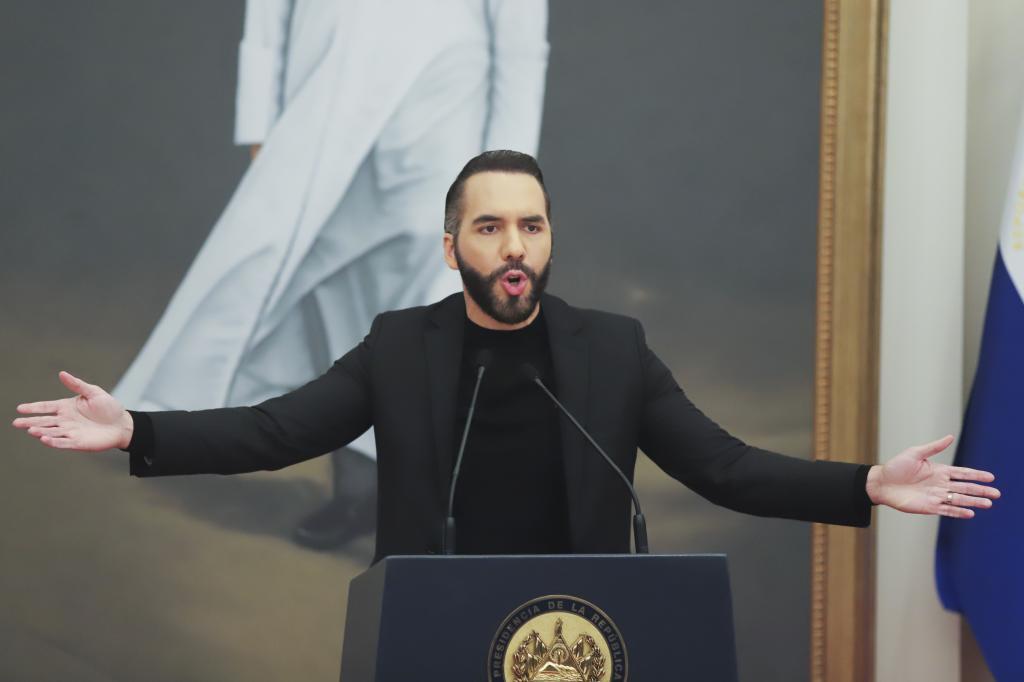
Much has been written about the President of El Salvador, but nothing as close as this little book of just over a hundred pages that presents itself as a CT scan and not just a portrait. In it, Martínez (San Salvador, 43 years old) reviews the different profiles of the most popular Latin American leader of the last decade and an idol that has also emerged on this side of the Atlantic: all-powerful Bukele, international Bukele - where the bar anecdote is recounted -, ridiculous Bukele, cruel Bukele, distracting Bukele, and anti-Bukele Bukele. "Let's cut to the chase: I consider Bukele a dictator," writes the author in the first line of the prologue as if taking a deep breath before diving in.
What follows is a resounding I accusebased on facts and not opinions that allows 1) to understand the origins of the Salvadoran leader; 2) to relive his rise to power first with the FMLN (communist), then with GANA (center-right), and finally with his prop party Nuevas Ideas; 3) to observe the construction of an authoritarian project parallel to - or despite - the investigative work of the El Faro newsroom; and 4) to understand the global fascination with a guy who handles all the levers of political communication, campaigns for bitcoin, and sells ultra-punitivism from a mega-prison set.
"All conservatives in America have taken Bukele as a model. But not only them. Even left-wing governments, like the outgoing one in Honduras, have copied his ways of reacting. He copied the state of emergency regime and established it in more than 30 municipalities. Bernardo Arévalo [President of Guatemala] has also tried to use his tools, such as exhibiting gang leaders in containers after they caused a riot. Bukele has not only changed political alliances, but also the way of communicating. Now, appearing strong is akin to resembling him. However, in all this, there is a fallacy: Bukele's model is not replicable. It is not something that can be copied in Spain, for example," warns Martínez just hours after Salvadoran Vice President Félix Ulloa met with the popular leader Alberto Núñez Feijóo and the President of the Senate, Pedro Rollán.
QUESTION: Were you surprised by those compliments for Bukele in Lavapiés?
ANSWER: I was surprised how someone constructed a discourse based on three commercials [advertorials], because what you mostly consume from Bukele in Spain is propaganda.
Q: What would you say to someone who supports the implementation in Spain of a hardline policy like Bukele's?
A: That they should allow someone like that to make deals with criminal organizations like those that existed in El Salvador. Bukele became mayor of San Salvador in 2015, winning the election by 6,000 votes. There, he signed a pact. His party paid a quarter of a million dollars to the three gangs [Mara Salvatrucha, Mara 18, and Mara Mao Mao] so that they would vote for Salvador Sánchez Cerén as president and for Bukele as mayor. I'm sure those 6,000 votes came from the gangs. It should allow someone operating outside the law to appoint any officials they want and remove those who are inconvenient. Bukele removed the prosecutors investigating him for those deals with the gangs. He dismantled the Constitutional Chamber and installed puppets. He removed judges with the absurd argument that everyone over 60 was corrupt. It should allow him to mold the State as he pleases, at the expense of any checks and balances. That is, it should allow him to eliminate one of the principles of democracy: the separation of powers. It should allow him to modify the Constitution at will. It should renounce another pillar of democracy: due process [the legal principle that guarantees that every person is treated fairly and equitably in a judicial or administrative proceeding] and accept a state of emergency or other regime that strips citizens of their rights. It should accept, for example, that two out of every 100 Spaniards are imprisoned and awaiting a trial that could take up to seven years. He should accept that more than 400 people died in prison with dubious autopsies or that torture became systematic again. He should swear absolute loyalty to him. If he likes that model, good luck. Let's see how it goes for him.
Óscar Martínez has been living in exile in Mexico for nine months. He decided to pack his bags after finding himself targeted as a signatory and coordinator of investigations that have exposed dozens of cases of corruption, repeated human rights violations, and criminal pacts sponsored by the Bukele administration. The reporter speaks via video call from somewhere in Louisiana (USA) while covering a story related to ICE abuses. He continues to shine a light on El Faro from hundreds of kilometers away from El Salvador... and from Nayib Armando Bukele Ortez, the politician who managed to convince six million people that only he was capable of ending the civil war between heavily tattooed criminals. The man who offered solutions, like Rodrigo Duterte in the Philippines, appeared at the opportune moment, prescribing a heavy-handed approach.
"It was 2015, and we had just experienced the bloodiest year of the entire post-war period, with 106 homicides per 100,000 inhabitants, a figure unattainable even for countries in conflict. People no longer wanted to believe with reason, but with faith," Martínez explains. Bukele detected the opportunity and shamelessly jumped to his ideological opposite. "Now he gives speeches at the Heritage Foundation, but back then he wore red, defended Nicaragua as the model to follow in Central America, and mocked people by writing tweets like, 'In the end, the communists didn't eat the children,'" he adds.
Óscar Martínez has been living in Mexican exile for nine months. He decided to pack his bags after finding himself in the crosshairs as a signatory and coordinator of investigations that have exposed dozens of cases of corruption, repeated human rights violations, and criminal pacts sponsored by Bukeleism. The reporter attends via video call from somewhere in Louisiana (USA) while covering the ICE's abuses. He continues shedding light on El Faro hundreds of kilometers away from El Salvador... and from Nayib Armando Bukele Ortez, the politician who managed to convince six million people that only he was capable of ending the civil war between criminals with heavily tattooed faces. The problem-solver, who, like Rodrigo Duterte in the Philippines, appeared at the right moment prescribing a bitter pill.
"It was 2015, and we had just had the bloodiest year of the post-war period, with 106 homicides per 100,000 inhabitants, an unreachable figure even for countries in conflict. People no longer wanted to believe with reason, but with faith," Martínez contextualizes. Bukele saw the opportunity and shamelessly jumped to his ideological antipodes. "Now he gives speeches at the Heritage Foundation, but back then he wore red, defended Nicaragua as the model to follow in Central America, and mocked people by writing tweets like: 'In the end, the communists didn't eat the children'," he adds.
"At the 'El Faro' newsroom, they even spied on the administrative staff with Pegasus."
Bukele also leveraged what he had learned at his family's advertising agency. So suddenly, voilà!, he projected a fresh, trustworthy, almost messianic image. "He moved away from the magical realism of hugging old ladies and kissing babies to present himself as a demigod," says Martínez of his staged performances. He built his image as a false outsider using tools that guerrilla dinosaurs like Sánchez Cerén hadn't a clue about. When the latter was asked his Twitter handle, he replied twitter.com. "Bukele quickly outshone them," he summarizes.
The mayor's first major coup after becoming president in 2019 was the launch of the Territorial Control Plan, with which he intended to stem the tide of gang-related crime. Bukele attributed the success in reducing homicides to the police and military deployment. El Faro, however, demonstrated with government documents that it was due to a secret agreement with the leaders of the three gangs. "The night we published the first revelation, he went crazy," admits Martínez. "Over time, he understood that it was better not to mention us, because when he directed people's attention to the newspaper, what they found was the truth."
The self-coup in 2020, the declaration of a state of emergency in 2022, the reelection in 2024, the passage of the Foreign Agents Law in 2025, the constitutional reform and the kick-down of presidential term limits that same year... Bukele, the Emperor's New Clothes, written with meticulous prose and scrupulous attention to detail, has the gripping pace of a bestselling thriller. Or of a work of nonfiction starring a fashionista obsessed with jackets featuring Simón Bolívar and Michael Jackson.
"All these radical right-wing populists, like other left-wing dictators before them, will always peddle the idea that democracy is exhausted and that, therefore, what's needed is a strongman," Martínez adds. "We've already seen what happens in Latin America when you give all the power to one person: from Cuba to Argentina, including Nicaragua. If the region could speak, it would say: 'Don't be so stupid.' The idea that democracy was attempted and failed in El Salvador is a lie. There was never a profound, real, corruption-free attempt at democracy."
The architecture of two ideas is currently emerging as a corollary of Bukele's policies: Bitcoin City and the Terrorism Confinement Center, the infamous CECOT. The first envisioned building a crypto Las Vegas from scratch, harnessing the residual heat of a volcano for mining operations. It was a fleeting fantasy: El Salvador's comatose economy and the IMF burst the bubble, which has resulted in a waste of between 200 and 400 million dollars. "Bukele is a man who doesn't think, he acts. He's a bit like Trump in that sense. Octavio Paz's saying about Carlos Monsiváis applies to him: 'More than ideas, he has whims.'"
The CECOT (Center for Coordination and Operations) did materialize. In fact, since its inauguration in 2023, it has been promoted as a showcase of "the safest country in the entire Western Hemisphere," as Vice President Ulloa described it a few days ago in Madrid. "It's the great showcase of the Bukele model. YouTubers and Trump-like politicians stroll through it," explains Martínez. "The gangs are confined to cells where the light never goes out, guarded by heavily armed, hooded men representing the state... What politician wouldn't want to project the image of a bunch of intimidating men behind bars these days? Besides, it's a prison that looks professional, that doesn't seem like something from the Third World. I feel sorry for my Spanish colleagues who made the trip there, because what they're offered is a guided tour. Go see Bukele's other 21 prisons, the ones the president denies access to. He's even barred international NGOs and the Evangelical Church. Inside those prisons, as confirmed by Amnesty International and Human Rights Watch, what's happening is a humanitarian crisis. The few who get out do so with skeletal remains; the autopsies of the many who don't make it out all say: 'Died of pulmonary edema.' It's a demonstration of the cynicism to which the state has sunk."
Bukele, who at the beginning of his career praised the investigations of El Faro, has gone so far as to accuse its journalists of money laundering, drug trafficking, and human trafficking. The Salvadoran repressive apparatus used the Israeli Pegasus software against them, in a stunning reversal of roles: those monitoring the excesses of power were themselves being monitored for doing their job. "They even spied on the cell phones of the administrative staff," confirms the editor-in-chief, who has gone from being a thorn in Bukele's side to a lump of kryptonite. "I suffered 43 wiretaps; that must be a record in Latin America."
Martínez insists on being so objective in his judgment, so meticulous in his analysis, that he has no qualms about acknowledging the tyrant's virtues. "He has a lot of political savvy to remain so popular," he states clearly from a long-planned exile shared with his two journalist brothers and his family. "But my prediction is that Bukele will become much more dangerous and violent when he becomes unpopular. That's going to happen, because 50% of the Salvadoran population lives below the poverty line."
On the other side of the computer screen, a man who isn't afraid to return to his homeland despite the risks it would entail for his safety and despite the perpetuation of the person who has targeted him explains himself while gesturing with arms covered in drawings and letters. One of the quotes written in ink is from a poem by Eduardo Benedetti. It reads: Don't save yourself,/ don't remain motionless at the edge of the road...