He was not as media-covered as Joaquín 'El Chapo' Guzmán, former leader of the Sinaloa cartel who was sentenced to spend the rest of his life behind bars in the US, but the death on Sunday of Nemesio Oseguera Cervantes, known as 'El Mencho', founder and leader of the Jalisco New Generation Cartel, has ignited Mexico. These are the keys and consequences not only for the nation led by Claudia Sheinbaum, but also for the rest of the region.
At 59 years old and originally from Michoacán, Oseguera had been linked to organized crime for over three decades, as recalled by AP, and was the most wanted drug trafficker by the US government. As shown by the wanted poster offering a reward for his capture, millions of dollars were offered for his head. The US Justice had him in its sights, and as early as 1994, he spent three years in one of its prisons for heroin trafficking. A conviction that did not change his intentions. He founded the Jalisco New Generation Cartel (CJNG) in 2009. The US Department of State declared CJNG a terrorist organization in 2025, as reported by Afp.
What power does the Jalisco New Generation Cartel (CJNG) have?
As revealed in a 2025 report by the Drug Enforcement Administration (DEA), this organization had a presence to a greater or lesser extent in all 32 Mexican states. The Mexican newspaper 'Milenio' highlights that, despite the existence of other groups, it "became the first criminal enterprise to expand its tentacles and operations throughout the country." A spread made possible in part by the weak institutional framework in Mexico, as pointed out by Mexican sociologist Isaac Enríquez Pérez in the aforementioned media.
CJNG trafficked cocaine, methamphetamines, fentanyl, and migrants to the United States. It operated as a paramilitary force, as it carried out attacks against Mexican security forces, as recalled by AP. For example, in 2020, it targeted Omar García Harfuch in Mexico City, the former chief of police and current federal Security Secretary.
What consequences can his death have?
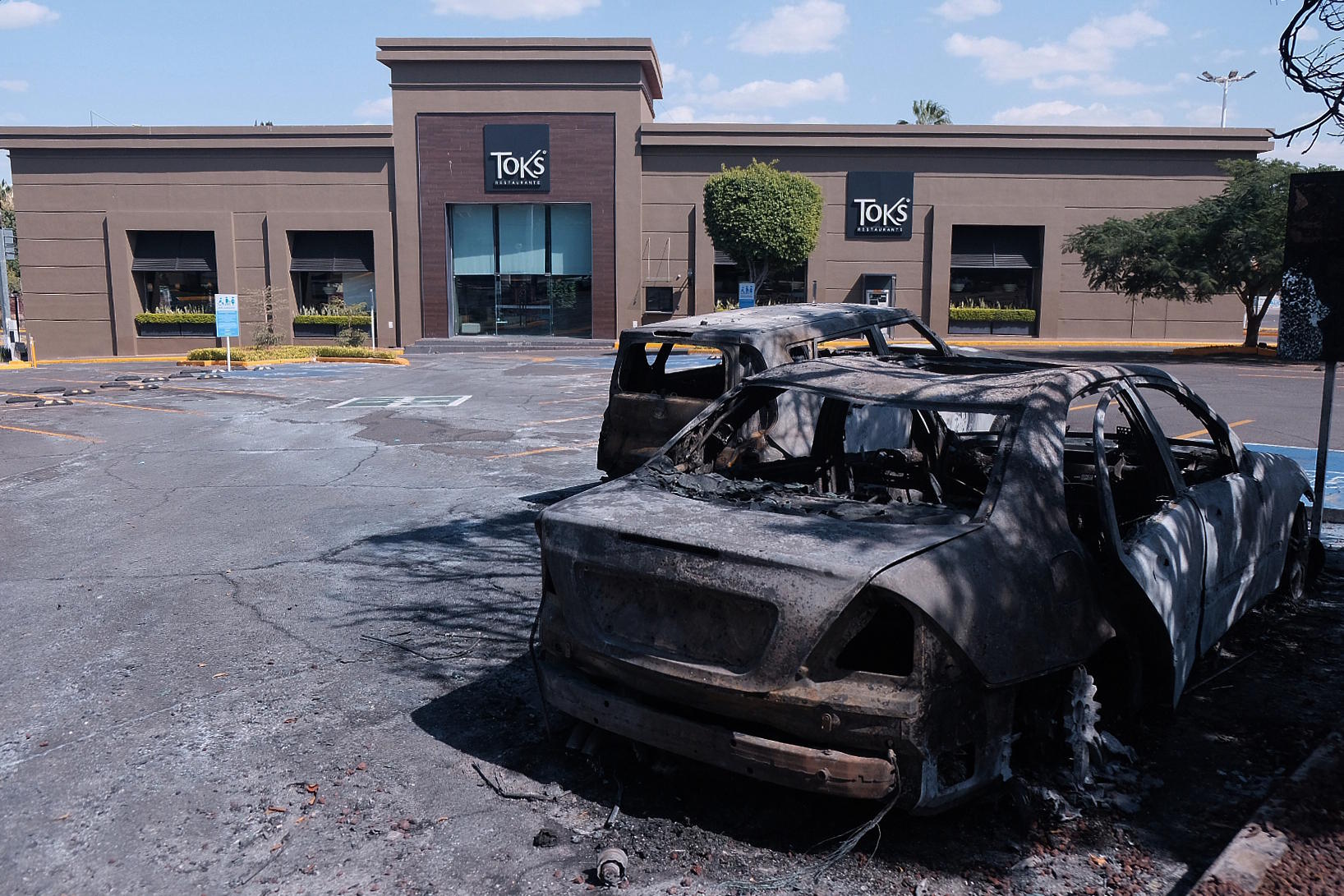
No one doubts the blow of beheading the organization, but the first consequence has been to sow terror in Mexico: more than 250 roadblocks, establishment fires, and the mobilization of its members. In fact, the country is on alert due to the wave of violence. Schools are closed in eight states, courts can remain closed at their discretion, and dozens of flights from the US and Canada have already been canceled, as reported by Afp. "Armed individuals arrived, I saw the gun, and they said to get out, we got out, and they had a car with the doors open," explained María Medina, an employee of a store that was set on fire, to the same agency. "I thought they were going to kidnap us, I ran to a taco stand and took shelter with them," she recounted.
In the longer term, it will have to be assessed whether his death reduces violence in Mexico. Politically, it gives breathing space to President Claudia Sheinbaum because she has given Donald Trump what he wanted at a time of maximum pressure in his 'backyard'. Although there was intelligence collaboration from the United States [White House spokesperson Karoline Leavitt affirmed: "(US) provided intelligence support to the Mexican government" in the operation], the Mexican leader has responded to the demands of the Republican. "The good outnumber the bad. Congratulations to the law enforcement forces of the great Mexican nation," declared US Undersecretary of State Christopher Landau on social media.
David Saucedo, a Mexican security expert, explained to AP that the greatest fear is that CJNG could decide to launch "narcoterrorism attacks... and that a scenario similar to what was experienced in Colombia in the 1990s could be generated, a frontal combat against the government with car bombs, assassinations, and attacks on aircraft."
Has Claudia Sheinbaum's change in security strategy influenced?
Her predecessor, Andrés Manuel López Obrador, developed his "Hugs, not bullets" policy, which proved unsuccessful. Sheinbaum is returning to frontal combat. A change in strategy that some experts attribute to US pressure.
While the current president has resumed frontal combat. The new government strategy could be a result of pressure from the US government, but it also bears the stamp of Omar García Harfuch (Secretary of Security and Citizen Protection of Mexico), who with this takedown adds a new medal.
How can it affect Latin America?
Fear has also spread in the region. To begin with, Guatemala has reinforced security on its border with Mexico, as in recent months there have been incursions by Mexican groups into its territory. The army is working to "maintain an environment of peace and security". Costa Rica has strengthened migration control. "We seek to prevent the entry into national territory of anyone related to drug trafficking activities and who, amid the special circumstances occurring in Mexico, intend to use our country as a safe haven," said Costa Rican Minister of Public Security Mario Zamora to journalists, according to Afp.