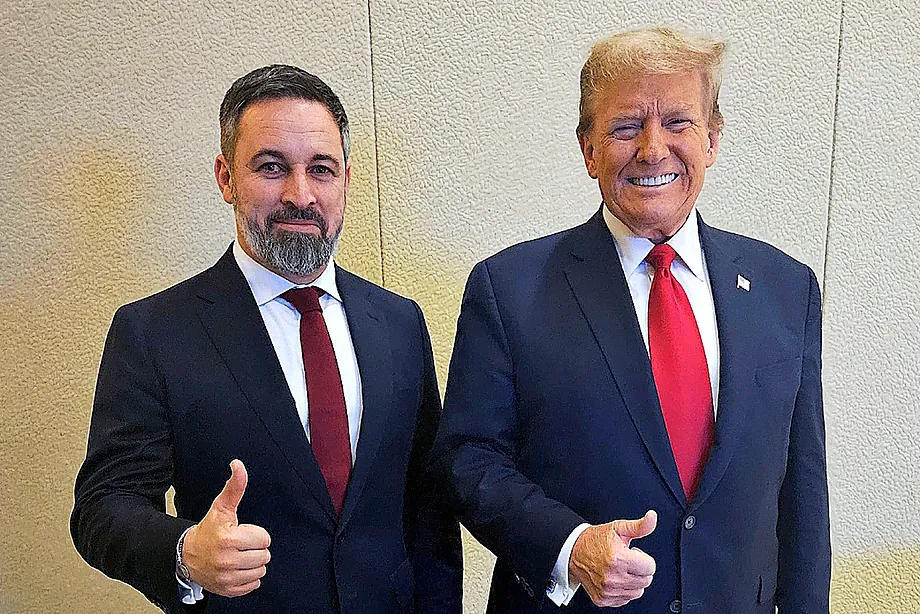
MAGA, the acronym referring to the slogan Make America Great Again, with which Donald Trump returned to the White House a year ago, has now become an ideology within the Republican Party. An ultraconservative political movement that aims to prioritize the national traits of the United States, combat immigration, 'woke' culture... and also internationalize. The 'maga' or 'trumpist' movement transcends beyond the United States and weaves transatlantic ties. Faced with the impossibility of holding political meetings with socialist governments, the strategy is to support European conservative parties to help elevate their leaders to power. This aligns with the National Security strategy approved in Washington last year and already has a direct impact in Spain, more specifically, in Vox.
The origin of Vox's relationship with the American political sphere dates back to 2020 when Santiago Abascal traveled to New York and Washington. There, he held several meetings with political representatives and think tanks, and eventually attended the speech with which Donald Trump closed the Conservative Political Action Conference (CPAC), a summit where years later the leader of Vox would speak - leading to a meeting between Abascal and Trump on one occasion. Months after that trip, the Spanish party launched Disenso, its foundation, now primarily responsible for developing the international links of the party. "Disenso did not originate strictly as a national study center, but as an initiative to also act in Europe and the Spanish-speaking world, with an Atlantic dimension," they explain to this newspaper from the foundation.
Santiago Abascal has a strategy and direct contacts with Trumpist think tanks to implement his 'maga' proposals in Spain, but with its own national characteristics. And he does so through the Disenso Foundation.
Disenso maintains a "direct relationship," as explained to this newspaper, with congressmen, senators, leaders of the Republican Party, and "high-ranking" government officials, as detailed by the foundation. They also point out that it has a "network of contacts" with conservative organizations in the United States, including The Heritage Foundation, America's First Policy Institute (AFPI), Hudson Institute, Center for a Secure Free Society, and the International Republican Institute, among others.
With these centers, Disenso has held "regular institutional meetings" both in Washington and Madrid, and in some of them, Abascal has also been present. For example, the Vox leader met with representatives of several of these think tanks in January 2025 when he attended Trump's inauguration in Washington. In February 2025, he met with the president of The Heritage Foundation, Kevin Roberts, at the summit of the European group Patriots held in Madrid, and last November, he met with him again at the Disenso headquarters. "Abascal has led the dialogue with think tanks, political leaders, and American institutional officials, actively engaging in building those relationships," they convey from the foundation.
The strategy is serious. So much so that Mike González is now part of the Advisory Board of Disenso. He joined due to his significant role at Heritage, where he works as the principal researcher of the Ángeles T. Arredondo E Pluribus Unum chair. His research areas include critical race theory, identity politics, diversity, multiculturalism, assimilation and nationalism, as well as foreign policy in general. He also served in the Bush Administration's State Department, working in the Europe office. With Asturian grandparents, he is very familiar with Spain, its political dynamics, and conservative parties.
"People demand a new type of politics to address issues such as mass immigration or the cultural advances of the left, which has led to the emergence of new movements in the second decade of the 21st century because center-right party voters have not liked the responses given to issues like transgender theory, immigration... Hence, Vox, the AFD (in Germany), the Lega in Italy...", he states in a phone conversation with EL MUNDO. He points out that he has "many friends in the People's Party". However, in his opinion, "many" within the People's Party "accept the cultural advances of the left."
González explains that ultraconservative movements have united: "Now we have a common enemy. The enemy of the Spanish left is very similar to Black Lives Matter," he asserts. And he claims that "Pablo Iglesias speaks like a communist here in the United States. So, we are confronting many Pablo Iglesias. In France, in the United States, in Chile, in Argentina, in Spain, in France, in Germany...".
Although the National Security strategy suggests direct support for governments and candidates considered reliable in the region, intervening in defining political alliances, González does not want to comment on whether Trump will publicly support Vox in the context of general elections. He does acknowledge that "Vox would be a good ally of the administration. Much better than what we have now. Sánchez has positioned himself as the international leader who will be anti-Trump."
In addition to Mike González, Vox has approached Joshua S. Treviño to continue their exchange of ideas. A former US military member, he is the principal researcher of the Western Hemisphere Initiative at the America First Policy Institute and the Director of Transformation at the Texas Public Policy Foundation. Treviño has visited Spain at least once in recent months where, in addition to meeting with Vox, he visited Spanish think tanks to present his project and express his interest in supporting the far-right political group in potential elections.
Disenso identifies several thematic issues where they find "confluences" with the US think tanks they are linked to. Among them, sources from the foundation point out immigration and border control, as well as "culture," which they consider a direct influence on politics. They believe that the "educational, media, and cultural sphere is a decisive terrain" and, on this matter, they share many views with American conservatism - for example, in opposition to 'woke' ideology. They also note similarities in the energy and economic fields: criticizing climate policies applied under "ideological criteria" and advocating for reindustrialization. Additionally, Disenso believes they are aligned with their US contacts regarding the "clear defense of sovereignty against the transfer of powers to supranational structures," as well as in identifying the China-Russia axis as a threat and their views on the São Paulo Forum, the Puebla Group, and the regimes of Cuba, Venezuela, and Nicaragua.
International relations are a key component of Vox's political approach. And, according to Disenso, the US "plays a decisive role." With Ibero-America being a "priority axis" for the foundation, maintaining direct dialogue is crucial, say the sources consulted, as this has allowed them to "have direct access to key political decision-making centers in Washington" and "establish Vox as a trusted interlocutor for the US Government."