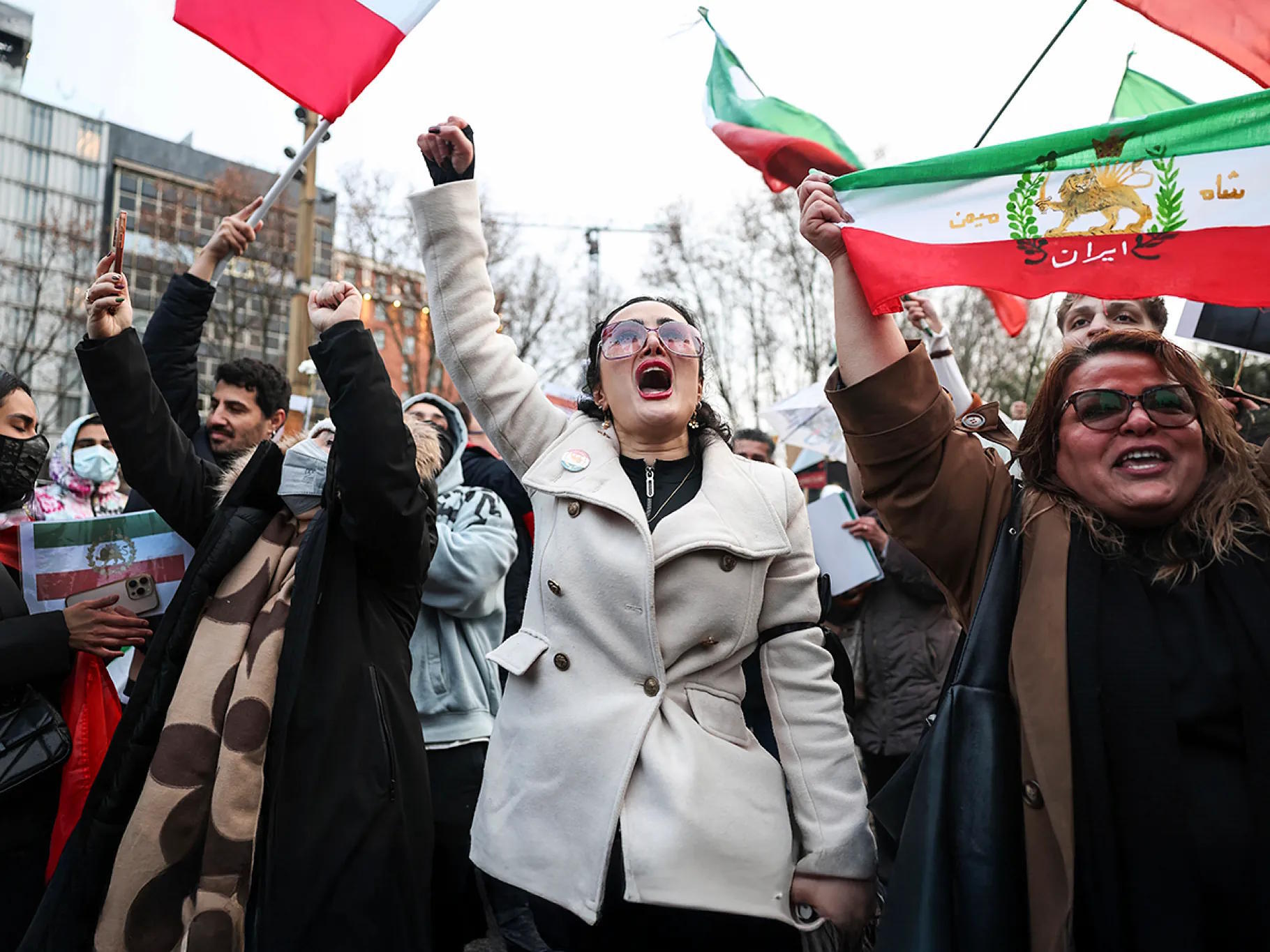
The first battle for freedom in Iran is fought on the body of women. Before in the streets, bazaars, and factories; before in the markets where the value of the rial plunges to become worthless paper; before in the darkness of cities dimmed by electrical ruin and the virtual darkness of the lockdown on the networks.
Protagonists of a slow and painful cultural revolution, fragmented and repressed but unstoppable, have inflicted the deepest fracture in the legitimacy of the Ayatollah regime. With minimal gestures that entail extreme risk - walking down the street with hair loose or singing in a country that has decreed them as sirens whose voices must be eradicated from public space - they have stripped their laws, morals, and idea of justice of authority.
That was their victory, albeit very partial, in 2022 when they took to the streets to burn the same hijab for which their compatriot Masha Amini was murdered at 22 years old in a Tehran police station. Her crime, wearing it incorrectly under the scrutiny of a dystopian theocracy where the police have a license to control the most trivial details of public life.
"I remember my fury when the guards at the university stopped me to check the clothes I was wearing," recalls Elnaz Sarbar, an Iranian exile in San Francisco and former Google programmer now studying robotics. "They could prevent you from entering class or taking an exam if they deemed your clothing inappropriate, or if you wore too much makeup or if a strand of hair peeked through the hijab." Just one of the countless - and humiliating - obstacles that hinder the daily lives of Iranian women.
"In Iran, there is gender apartheid," summarizes Mahya Ostovar, a Business professor at the University of Galway in Ireland. "Discrimination is present in all aspects of life: education, sports, employment, divorce, child custody... It is systematic and constantly affects personal freedom." And literal. Because they can "imprison you just for singing," as Sarbar points out, recalling the case of a friend sentenced to a year in prison for releasing a single. Before the sentence was carried out, she managed to leave the country to attend a concert in Germany. There she sought refuge.
"Women lose custody of their children after divorce, laws systematically favor men, if a man kills his wife or daughter, the punishment is much less, which opens the door to enormous domestic violence...," Sarbar lists. "In addition, sons inherit twice as much as their sisters... The whole system considers us half of a man."
"Being a woman in Iran means living in a constant and exhausting war for the most basic aspects of life," summarizes Meddis Tavakkoli, a psychotherapist in her thirties and an exile in Madrid, where she has become one of the visible faces of human rights activism. "You fight to choose your clothes. You fight to choose your university career. You fight not to be treated as a sexual object. You fight for the right not to marry. You fight for the right to divorce. You fight for the right to choose motherhood, or to reject it. Even leaving the house to buy something requires resistance. This endless struggle is our daily routine." The list is endless. "We need the permission of a man even to travel," adds Katayoun Kiani from southern France, a 37-year-old digital product designer, "harassment makes living very difficult."
A social pressure cooker that boiled over three years ago after the Amini case, and has sparked a visible cultural change today, according to the activists' testimonies. "If you look at the images coming out of Iran now, you can see, for example, that women no longer wear the hijab," says Ostovar. "This does not mean that the law has been abolished, but they are resisting it by refusing to cover their heads."
And in other social spheres, a change in mentality is also observed. "We are seeing in our own families how thinking has changed towards greater gender equality; people have realized the type of freedom they want. The values of that 2022 movement, Women, Life, and Freedom, have resonated in the minds of Iranians. That was their success. That was achieved."
But no revolution in history has been built from a single uprising, Kiani recalls. "Each movement plants a seed and pushes the next one forward. And through the Mahsa Amini movement, the world saw Iranian women from a new perspective: their courage, resilience, and willingness to risk everything for freedom. Those protests made room for a broader space of opposition outside of Iran," she insists. "The regime remained in power, but Iranian society transformed. The barrier of fear cracked, narratives changed, and the new generation learned how collective resistance materializes."
Tavakkoli recalls that Iranians have been fighting for 48 years against the regime. "The Women, Life, and Freedom movement was just one chapter in a much longer struggle." A very broad revolutionary process that, she criticizes, has lacked strong international support.
"The world has offered us symbolic actions and expressions of sympathy, and I respect those who have shown us their solidarity, but in half a century, there has never been a real political will in Western countries to remove the Islamic Republic from power. It didn't happen three years ago, or six, or 14, and unfortunately, it doesn't seem to be happening now either."
Civil resistance still has a very high cost, as we have just seen in this new wave of protests that has shaken the country since it erupted this time in the bazaars, where traditionally more regime-linked groups, such as merchants or the middle class, have also raised their voices.
"Now resistance is general. Before there were environmental, labor, sectoral protests... Today it is no longer about ideology or religion, but about basic struggle against a Government that cannot manage the country," says Sarbar. "In Tehran, there are problems with water, electricity, and basic services. People cannot afford rent, they have multiple jobs and still can't make ends meet. There is no freedom. When you have neither bread nor rights, you have nothing left."
The inequality, the computer programmer explains, is structural and the repression, savage. "On one hand, there are people with empty hands, and on the other, rich and immune security forces. War weapons have been used against the population, against people walking down the street. It's horrific."
Citizen outrage, Ostovar concludes, represents a "general rejection of the system, including the Supreme Leader and the institutions that support it." A complete overhaul of the regime that many Iranians, inside and outside the country, believe cannot be achieved without some form of external intervention.
"Trump has promised several times that if people took to the streets in Iran and were killed, he would respond," Tavakkoli recalls. "The regime killed thousands of people in just four days and nothing happened. How many of us have to die? You are Spanish; you know the Santiago Bernabéu stadium. Imagine that entire stadium filled with dead people. And yet, the world seems blind, perhaps deliberately reluctant to see or hear."
It is not clear how a US attack would be carried out, which would be, like in Venezuela, a controversial and potentially destabilizing move. "It's complicated. The Iranians do not have the luxury of waiting for external political solutions. It doesn't matter if we like Trump or not; any politician or actor who supports the Iranians with significant actions is welcome. The important thing is not who intervenes, but that there is real support," clarifies Ostovar.
Who to make a deal with
Would there be any possibility of making a deal with a part of the regime as Trump has done with sectors of Chavismo in Venezuela? "The supposed reformists are one of the main reasons why this regime has survived for 48 years. They have consistently worked to preserve the structure and pillars of the Islamic Republic," points out Tavakkoli. "They are the ones who sharpen the knife and tighten the noose of the regime's executioner."
And would the Iranians accept a US intervention after decades of propaganda about the Great Satan? "Propaganda no longer works," maintains Ostovar, "people know that the real enemy is the Government, not the United States. They want to live in peace with the world and have a normal relationship with free countries, without losing their lives or rights."
Something is changing
Cultural advancements in the female sphere have been visible since 2022: "Men have become more supportive of women in activities that were previously considered reserved for them," acknowledges Kiani, "there is now more respect, which shows that the movement is also changing social attitudes, not just politics."
However, the regime's repression has not eased. "The morality police continue to pursue women who do not wear the hijab and close cultural spaces, although the regime tries to balance to avoid a social explosion that overwhelms it," explains Ostovar, who recalls recent cases of state gender violence: "A year ago, a 16-year-old girl was killed in the Tehran metro; another woman was shot while driving..."
No to the veil
All raise their voices to change the perception of the Islamic veil in some European sectors. "In Western countries, the hijab is often treated as a fashion or cultural expression. But behind the veil there is repression, humiliation, and a violent ideology," asserts Tavakkoli. "The hijab is not culture. It is the symbol of an ideology that kills, terrorizes, and controls. Reducing it to something harmless is a serious mistake. I hope Western societies understand this truth before it's too late."
Sarbar intervenes to vividly describe how the hijab "reduces women to sexual objects": "If you're lucky, you can show your face; if not, you're like a walking tent, just like in Afghanistan." Culture, she insists, cannot justify oppression. "For centuries, women were also forbidden from going to university in the name of culture. The hijab is not a free choice. Girls are told from a young age that if their hair is seen, they will be punished."
The system of control and violence is deeply institutionalized. Tavakkoli recalls, for example, that despite what the regime says, the morality police has never disappeared; it has only changed form. "The hijab remains an instrument of control: without it, many women cannot access banks, public offices, or even some private institutions."
Cinematic version
The Iranian repression relies on a crucial pillar. A judicial system at the service of politics that has been portrayed countless times and chillingly in cinema. Recently in The Seed of the Sacred Fig, by Mohamed Rassoulouf, who had previously shown the involuntary executioners used by the regime in The Lives of Others. But if there is a movie that portrays the double legal standard for women, it is Seven Winters in Tehran: the raw representation of Iranian institutional violence embodied in the story of Reyhaneh Jabbari, a young woman sentenced to death for stabbing her rapist - and refusing to apologize for it - despite a strong international campaign to prevent her execution.
"All people in Iran - women, men, and children - want to be treated as human beings and as equal citizens. No one should have priority over another. No one should be repressed because of the gender they were born with. We want dignity. We want the law to be above all citizens. Equality before it. Justice for all," details Tavakkoli.
All equal
Kiani reinforces this perception: "We simply want an end to gender discrimination and oppression, and full access to human rights and basic freedoms, just like men."