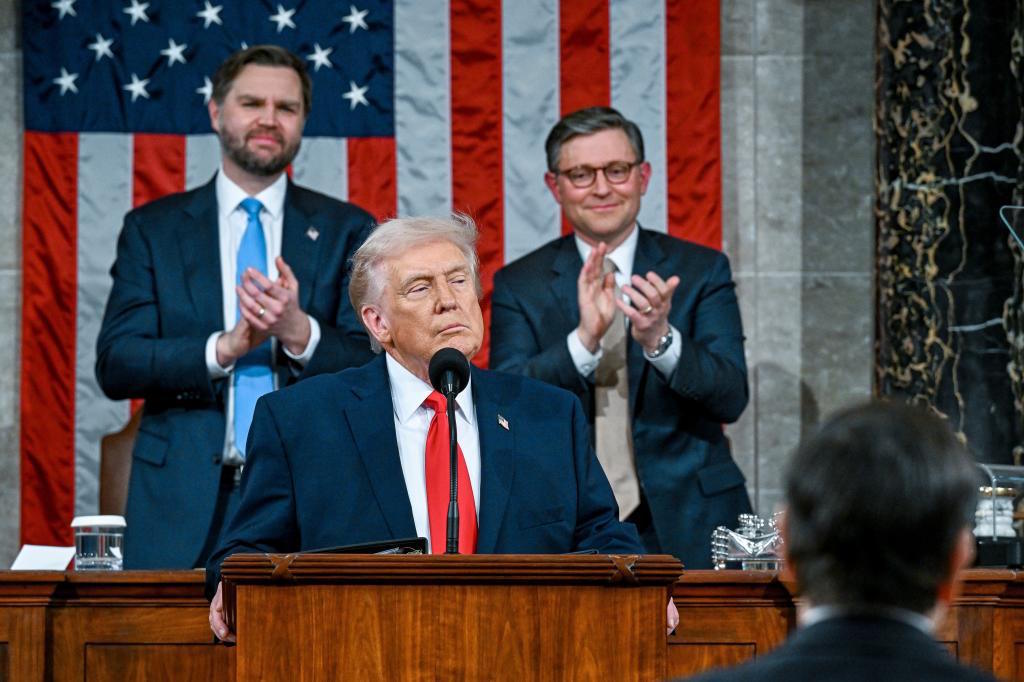
A lengthy speech, the longest in history. A total spectacle aiming for virality, with more guests and surprise appearances than ever before. With more medal presentations than all previous ones combined. A triumphalist speech, in pure Trump style, loaded with provocations, populism, lies, and half-truths. Laughter and over 100 standing ovations from his supporters. An intervention full of attacks on the opposition, immigration, equality and diversity policies, and critics of the administration. A State of the Union Address lacking solemnity, with no attempt to reconcile a divided country and nation, with almost no new content and with the main and almost sole objective of regaining control of the narrative and setting the tone for the only current important event in the US: the November legislative elections.
"Our nation is back. Bigger, better, richer, and stronger than ever," said the president in his opening words. "This 4th of July, we will commemorate two and a half centuries of freedom and triumph, progress and liberty in the most incredible and exceptional nation that has ever existed on the face of the earth. And you haven't seen anything yet. We are in the golden age of United States. When I last spoke in this chamber, 12 months ago, I had just inherited a nation in crisis, with a stagnant economy, record inflation, an open border, horrendous recruitment levels for military and police, rampant crime, and wars and chaos around the world. But tonight, after just one year, I can say with dignity and pride that we have achieved an unprecedented transformation, a turning point in history. Today our border is secure, our spirit has been restored. Inflation is plummeting, incomes are rising rapidly. The economy, in full swing, is advancing like never before, our enemies are scared, our military is ready, and the United States is once again respected like never before," he stated in the opening remarks.
The speech comes at one of the most delicate moments for the president, touched, wounded, showing his vulnerabilities. With his popularity at minimum levels, following the Supreme Court ruling that deprived the administration of its favorite tool for economic and foreign policy [Trump lashed out against it even though there were four Supreme Court justices in the room]. With a Congress that has passed two votes against the White House's wishes and has frozen funding for the Department of Homeland Security, which oversees immigration agencies like ICE. With the ripple effects of the Epstein case forcing arrests and resignations in Europe or the American business world. With the sense that Trump is no longer all-powerful. That he is no longer invincible and his figure will lead his party to lose the midterm elections. That he is, in short, like his predecessors, a lame duck, a president in his final stages with less influence than he had just a few months ago.
Trump, who had warned that his speech would be very long because he had many things to share and many successes to review, made no attempt to heal wounds, extend a hand, reduce polarization, or soften the suffocating atmosphere of Washington. On the contrary. His strategy is very clear: deny any possible mistake, blame immigrants and the opposition for all evils, and repeatedly claim that the economy is better than ever, thanks to him. Talking about the stock market reaching new highs or boasting, incredibly, that now two and a half million fewer people receive food stamps. Not because there are fewer poor people, but simply because his budget law has cut them.
SETTING THE TONE FOR THE MIDTERMS
No State of the Union Address has ever changed anything in American politics. This one won't either, but it serves to see where things are headed in the coming months, with the president articulating a message around security, growth (even if modest), and the idea that the US was a loser, a fool in the world, and now is constantly winning. Literally. "Our country is winning again. In fact, we are winning so much that we really don't know what to do. People tell me 'Please, please, Mr. President, we are winning too much. We can't take it anymore. We weren't used to winning in our country until you arrived,'" he said at one point while the national ice hockey team players displayed their gold medals on the stairs of the room.
The scene that best sums up the night took place approximately an hour into the president's speech. It was the most tense moment, full of protests, shouts, reproaches for the attacks on the Somali community and foreigners as criminals. Trump was comfortable provoking the opposition with mentions of a possible third term and changes in electoral laws, and they, with Epstein's victims as guests, desperately sought to unsettle the president, disrupt his script with shouts, interruptions, signs, and boos.
It was then that the president, while demanding from Congress "the full and immediate restoration of all funds for Border Security," revealed his intentions by saying: "one of the great advantages of the State of the Union Address is that it gives Americans the opportunity to see clearly what their representatives really believe. Therefore, tonight, I invite all legislators to reaffirm a fundamental principle. If you agree with this statement, stand up and show your support: the first duty of the American government is to protect American citizens, not illegal immigrants."
Half of those present did indeed stand up. The Government, the Republicans, some of the guests. The other half did not. The scene was not quick. Trump waited, delighted, saying nothing for a couple of minutes, with all eyes and cameras on him. Amid applause, boos, and gestures and grimaces, extending his arm as if to indicate that he did not understand how they could remain seated. It doesn't take an expert to know that in the coming months, one of the main Republican campaign announcements will be that, the president stating that the government's duty is to first protect Americans and the opposition, refusing to play along or participate, remained seated. As if they put illegals first. The trap was obvious, but there was no good way out.
Those who followed Trump's appearance in the Capitol a year ago will have had a déjà vu. Back then, the newly sworn-in president had boasted of "a mandate for bold and deep change" and warned that his administration would take "power out of the hands of this irresponsible bureaucracy and restore true democracy in the United States." That day he was exultant, triumphant, after an undisputed victory, after surviving an assassination attempt. Today, he has claimed that transformation in an almost identical night, designed by the same people, with the same flashy tricks, the same language, the same priorities, the same spirit, now dressed in a fight against fraud, both electoral and in social service programs.
That intervention, also the longest in history at the time, was contentious at the beginning, full of reproaches and boos. It evolved into a statement of intentions in pure Trump style about the transformation he was going to lead. And it ended up being the show that he and his followers adore and need. A show designed for television and social media, parading his top officials, signing executive orders on the spot, bringing half a dozen victims of foreign killers. Naming live a "member of the Secret Service" a 13-year-old boy with brain cancer. Giving recognitions to victims of sexual abuse or "gender ideologies." Or informing a young supporter to applause that he has been admitted to West Point, the military academy.
This year, the pattern was repeated down to the smallest details. Just like in 2025, African-American Congressman Al Green was ejected just minutes after the speech began, this time because he carried a sign that read "Blacks are not monkeys!", a reference to a recent post on the president's social media where the Obama couple were depicted as monkeys. Fifteen minutes into the event, the US men's ice hockey team, which won the Olympics a few days ago, entered the room. All with their medals receiving an ovation as the president announced that Connor Hellebuyck, the team's goalkeeper, will receive the Presidential Medal of Freedom, the highest civilian honor in the United States.
A few minutes later, he honored George "Buddy" Taggart, a soldier who fought in World War II under MacArthur's command and who will turn 100 years old... on July 4, 2026, the day the country celebrates its 250th anniversary. Right after, the cameras focused on a member of the Coast Guard next to the girl she rescued last summer in the horrific floods of Texas, at a children's camp. And later, mirroring last year, he named a future law to prohibit the issuance of commercial driver's licenses to illegal immigrants, after Delilah, a girl who was a victim of an accident a few months ago involving a truck driven by a person without permission to reside in the US. And the relatives of a woman who was stabbed. The rest of the night was similar. The widow of Charlie Kirk, a young woman who regretted a transition, the pilot of one of the helicopters involved in capturing Maduro, limping due to projectiles from Venezuelan defenses that shattered his leg.
Few commercials. Promises to make tech companies pay for the energy consumption of their data centers for AI. That funds cannot buy family homes. Or that there will be regulations so that lawmakers cannot enrich themselves in markets with insider information, something that is not only accused of many close to the White House, but also government members and especially the Trump family.
The president concluded the speech, nearly two hours long, just as he had started, recalling the imminent 250th anniversary of the nation, the Declaration of Independence, and the "brilliant Thomas Jefferson." When the world needs courage, boldness, vision, and inspiration, said the president, "it continues to turn to the United States, and when God needs a nation to work His miracles. He knows exactly who to turn to. There is no challenge that Americans cannot overcome, no border too vast for us to conquer, no dream too bold for us to pursue, no horizon too distant for us to claim, for our destiny is written by the hand of Providence, and these first 250 years were just the beginning (...) The golden age of the United States is already here. The revolution that began in 1776 is not over. It continues, because the flame of Freedom and Independence still burns in the heart of every American patriot, and our future will be greater, better, brighter, bolder, and more glorious than ever," he promised.
"The state of our Union is strong," Trump asserted. Strong may be his government, his prospects, the Stock Market, tariffs, his foreign presence, control of the Hemisphere. Many things can be strong, but if the speech reflected something, it is that the union is not. The country entered divided and left the same or worse.