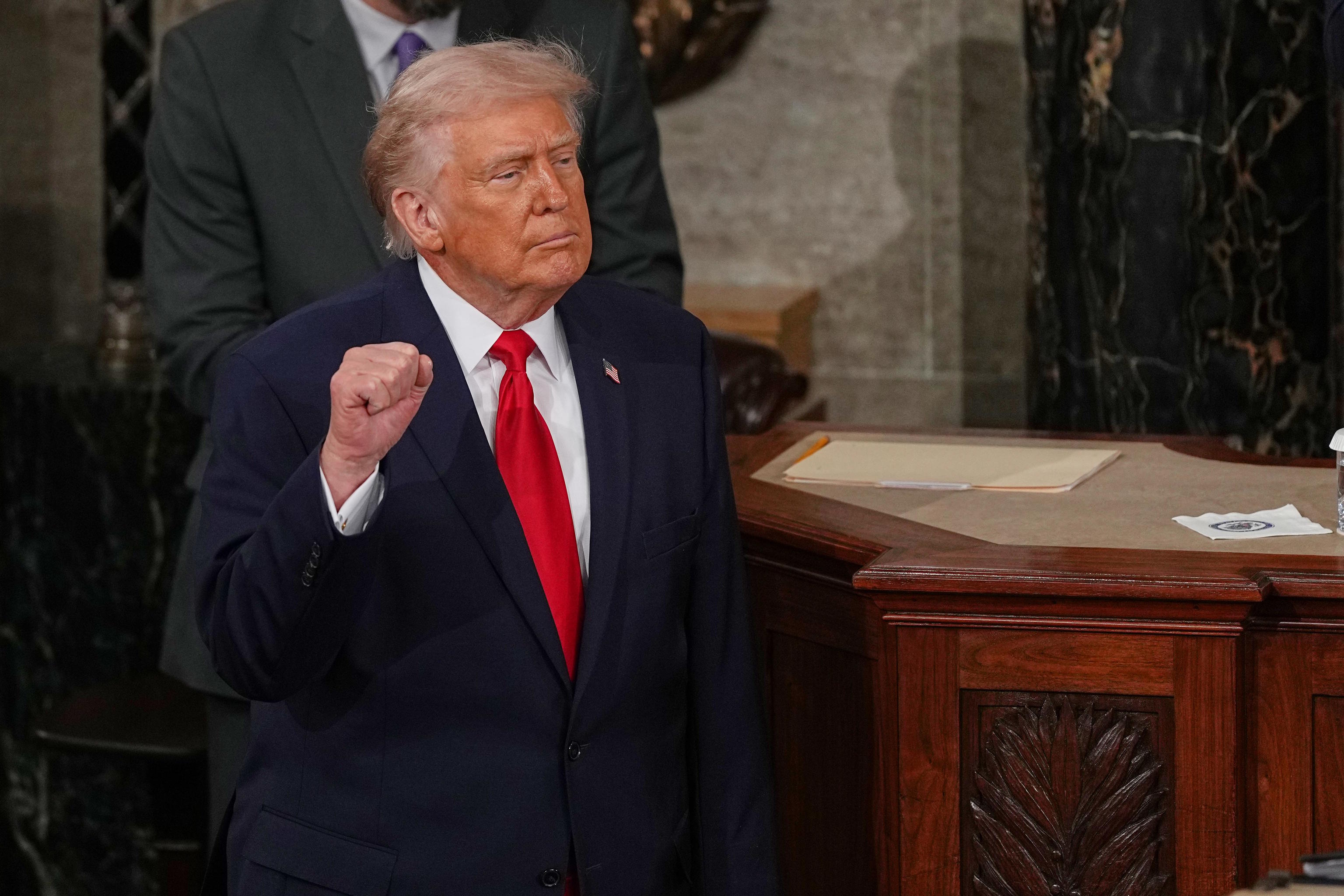
The President of the United States launched a new warning to Iran on Tuesday from Congress, amid what is theoretically the most solemn political speech in the country's life. He did so while his ships and aircraft carriers approach the region in the largest deployment in two decades. He did so while his son-in-law and special negotiator prepare for the next meeting with Tehran's diplomats. While experts say that never in history has a country mobilized so many troops to do nothing with them. "As president, I will make peace where I can, but I will never hesitate to confront threats to the United States where necessary (...) I prefer to solve this problem diplomatically, but one thing is certain: I will never allow the world's leading sponsor of terrorism to have a nuclear weapon. I cannot allow it," he said amid applause and chants of "USA, USA" from congressmen, senators, and members of his government.
Donald Trump boasted in his speech about the unprecedented attack seen in 2025. "In a groundbreaking operation last June, the U.S. military destroyed Iran's nuclear weapons program with an attack on Iranian soil known as Operation Midnight." But he focused mainly on attacking the regime of the ayatollahs both for its role over decades "as a sponsor of terrorism" and for the repression against its own citizens, whom Trump encouraged to continue taking to the streets because, he said, "help is on the way."
The president has insisted that "for decades, the United States' policy has been never to allow Iran to obtain a nuclear weapon. Since they took control of that proud nation 47 years ago, the regime and its murderous allies have spread nothing but terrorism, death, and hatred. They have killed and mutilated thousands of U.S. military personnel, hundreds of thousands, and even millions of people with what is known as roadside bombs. They were the kings of roadside bombs. And we eliminated Soleimani. I did it during my first term. It had a great impact. He was the father of roadside bombs. But in recent months, with the protests, they have killed at least, apparently, 32,000 protesters. They were shot and hanged. We prevented many from being hanged with threats of violence, but they are terrible people," the president continued.
Although Washington's position has been consistent in preventing Iran from acquiring nuclear weapons, there had never been a direct attack until Trump. Now, however, unlike past U.S. military operations in the Middle East or in Venezuela, the administration is not even making a great effort to build a narrative or a list of reasons. They are not tirelessly talking about citizen protests, nuclear threats, or regional security. They are not talking about the danger faced by Israel or how the U.S. would be much safer with a regime change. They are simply amassing troops and sending messages about the consequences if Tehran "does not reach an agreement," but without specifying exactly on what terms or about what. Until now.
Tonight, Trump hinted that the regime is close to acquiring weapons to attack his interests. A reason to act. "They have already developed missiles that can threaten Europe and our bases abroad, and they are working to build missiles that will soon reach the United States after the Midnight Hammer. They were warned not to try to rebuild their weapons program, particularly nuclear ones. We annihilated it, and they want to start again, and right now they are pursuing their sinister ambitions. We are negotiating with them; they want to reach an agreement, but we have not heard the magic words: 'We will never have a nuclear weapon,' which are the ones I want to hear," Trump said.
A few hours before the speech, Secretary of State Marco Rubio and CIA Director John Ratcliffe met via video conference with congressmen and senators specializing in National Security issues, known as The Gang of 8. To discuss various issues, but above all Iran, after the government deployed an unprecedented military force in two decades in the Middle East and spent the last week filling all national media with trial balloons about an imminent attack on Iran. The statements and leaks, all unattributed, have made an intervention inevitable, but presenting a whole range of possibilities. From bombings of Iranian nuclear facilities, despite Trump's assurances in the summer that they were destroyed and the program had been annihilated. To an operation to end the lives of the top leaders of the regime, dozens of them. Even including a long operation, with weeks or months of bombings throughout the country.
The Democrats present left showing their concern. And conveying the feeling that the attack was imminent. Senator Chuck Schumer, Democrat from New York and minority leader, warned: "Look. This is serious, very serious, and the administration has to explain its position to the American people." The number 2 on the Senate Intelligence Committee, Mark Warner, echoed the same sentiment: "this is an extraordinarily serious moment, a serious moment in the Middle East, a serious moment for the United States." Therefore, he asked Trump to clarify "what are the objectives of our country, what are the interests of our country, and how we are going to protect American interests in the region. Maybe we will hear it tonight, but if we do not hear it tonight, we need to hear it very, very soon," he said in reference to the speech.
None of them, however, did what many experts expected: insist time and time again that for any military offensive, the president needs the approval of Congress. "I am very concerned. Wars in the Middle East are not good for presidents or for the country, and we have not heard a single convincing reason why now is the time to launch another war in the Middle East," explained Congressman Jim Himes, the highest-ranking Democrat on the House Intelligence Committee.
"Satellite images show 66 U.S. fighters at the Muwaffaq Salti Air Base in Jordan. Numerous F-35s, the most advanced and lethal fighters in the world. This is just one of the recent deployments. Hundreds of attack aircraft and tanker aircraft in the region. The United States is preparing a major air campaign against Iran," wrote on his Twitter account Professor Robert A. Pape, one of the world's leading experts on the use of air power in combat. "This represents between 40% and 50% of U.S. deployable airpower in the world. This is similar to the wars in Iraq in 1991 and 2003. And it keeps growing. Never before has the United States deployed so much force against a potential enemy without launching attacks," he had already noted last week.
In recent months, the professor has warned in several essays in magazines like Foreign Affairs about the danger of thinking that bombings are a safe and distant way to intervene in the world. And that often, "precision strikes can prolong the wars they seek to contain," because "air power alone has never won a major war."