Although Venezuela is not currently the top foreign priority for Donald Trump, what is happening there remains very present in his administration. This Tuesday, for instance, it had a certain prominence in the highly anticipated State of the Union Address, the first one by the Republican leader since his return to the White House. However, it was chaotic, with mockery towards the state of the country's fishing sector due to the bombings of boats in the Caribbean. It included a live family reunion between a political prisoner of Maduro and his family, references to the good relations between his government and that of Delcy Rodríguez, and even the awarding of a valor medal to one of the helicopter pilots who participated in the operation to capture Nicolás Maduro and was seriously injured by the Bolivarian anti-aircraft defenses.
Venezuela appeared towards the end of his lengthy speech, almost two hours long. It was in the section dedicated not exactly to foreign policy, but to the reconfiguration of the entire order in the region. "We are restoring security and dominance of the United States in the Western Hemisphere, acting to protect our national interests and defend our country from violence, drugs, terrorism, and foreign interference. For years, large swathes of territory in our region have been controlled by murderous drug cartels, but with our new military campaign, we have virtually halted the entry of record amounts of drugs into our country, mainly by sea. As you may have noticed, this severely damaged their fishing industry. No one wants to go fishing anymore," he said amidst laughter.
He then boasted once again of "one of the most complex and spectacular feats of skill and military power in world history. Nothing like it had ever been seen. Foreign leaders, I won't tell you who called me, said: 'Impressive!'. They couldn't believe what they saw (...) The United States Armed Forces not only defeated an enemy but also put an end to the regime of the outlaw dictator Nicolás Maduro to bring him to American justice. An absolutely colossal victory for the security of the United States, and it also opens a new and bright beginning for the people of Venezuela," the president stated.
However, he also congratulated himself for "working closely with the new president of Venezuela, Delcy Rodríguez," who was the regime's number 2 and an accomplice in all its actions over the last decade, "to drive extraordinary economic advances for both countries and bring new hope to those who have suffered so much."
Trump made it clear that as long as Rodríguez and her people continue to collaborate with them, obeying, he will not promote a regime change or elections. But he also forced Caracas to start releasing the thousands of political prisoners filling its prisons. And he wanted to showcase that influence tonight. The entire State of the Union Address was filled with special guests, from a hockey team to heroes of World War II. Venezuela had its own protagonists and heroes, both civilian and military.
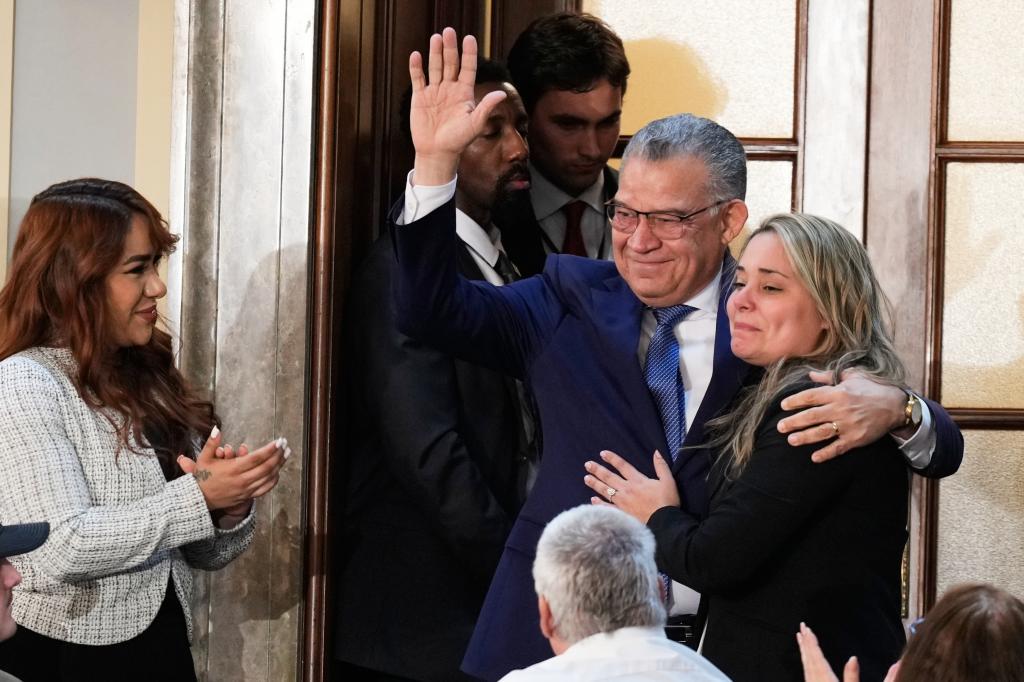
The first one, Enrique Márquez, a former member of the Venezuelan Electoral Commission who in 2024 ran as a candidate for a minor opposition party and denounced Maduro's theft of those elections to the unelected president's face. This led to his arrest and imprisonment for a year in the Helicoide, until just a few days ago. "Tonight, here is Alejandra González, who grew up in a very close-knit Venezuelan family and was especially close to her beloved uncle Enrique. After Enrique ran for office and opposed Maduro, he was kidnapped by security forces and imprisoned in the regime's infamous prison in Caracas. Alejandra feared she would never see her uncle again and feared for her own life. But since the January operation, we have worked with the new leaders, who have ordered the closure of that vile prison and have already released hundreds of political prisoners, with more to come. Alejandra, I am pleased to inform you that not only has your uncle been released, but he is also here tonight. We brought him here to celebrate his freedom with you in person. Enrique, please," Trump said from the Capitol before doors opened and the family symbolized the reunion with a long embrace.
However, this scene was not even the most personal and emotional of the night. Next, a soldier, supported by a device, and his family stood up at the commander-in-chief's request. "There were many heroes in that January raid to capture Maduro. Truly great heroes. It was very dangerous because they knew we were coming and were ready. But the feats of one warrior that night will live on forever, as eternal chronicles of military valor. Staff Sergeant Eric Slover planned the mission and was the flight leader in the cockpit of the first helicopter, a beautiful and powerful Chinook, carrying, as you can imagine, many American fighters. Eric wore the identification tags that his wife, Amy, had blessed with holy water before departing. Eric piloted the Chinook under the cover of night and descended rapidly upon Maduro in a heavily guarded military fortress protected by Russian and Chinese military technology. As he prepared to land, enemy machine guns fired from all angles, and Eric sustained serious hits to his leg and hip. Bullet after bullet, he absorbed four agonizing shots, shattering his leg into numerous pieces. And yet, even though the use of his legs was vital, the only thing Eric thought about then, even as he bled, was saving the lives of his comrades," Trump recounted in detail everything that happened and how he managed to stabilize the aircraft and relinquish command before passing out.
In recognition of the soldier's actions, "which far exceeded his duty," he was awarded live on air the nation's highest military honor, the Congressional Medal of Honor.