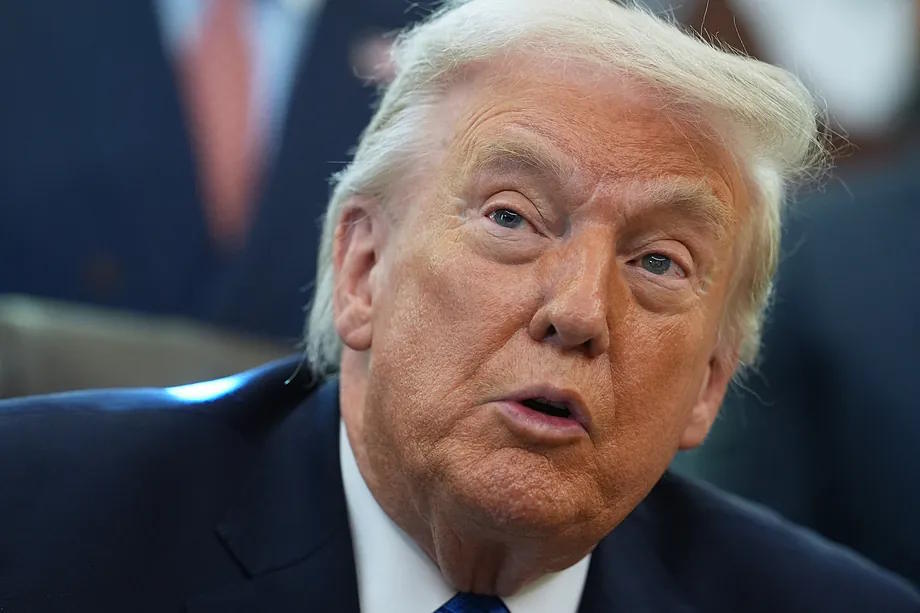
The President of the US, Donald Trump, has sought to bypass the Supreme Court's decision to overturn his tariffs by resorting to an extraordinary measure: the so-called Section 122, which allows for the temporary application of tariffs - for a maximum period of 150 days - in the event of a balance of payments crisis. Under this, he has decided to impose a general tariff of 10% starting this Tuesday and has threatened to raise it to 15%. In practice, this means that many countries benefit in the short term as they were previously subject to a higher average tariff, as is the case with Spain, whose average tariff has decreased from 14.4% to 12.6%.
This implies that American companies purchasing products of Spanish origin will have to pay a lower amount to the government in terms of tariffs, and after these 150 days, the tariff could potentially drop to 0%, which would be very beneficial to stimulate consumption. As explained by Carlos Cuerpo, Minister of Economy on Tuesday, around 60% of Spanish products are now "slightly better off" than they were under the previous agreement between the EU and the US, 10% are "slightly worse off," and 30% are "more or less the same." However, his department does not want to provide examples or specify which products fall into each group.
Products that were subject to a 15% tariff - such as machinery, bicycles, or food like cheese - will now have a lower tariff, while those that the EU and US had agreed to exempt from tariffs will now experience a temporary increase. This includes goods in the aeronautical industry, which encompasses airplanes and all their parts, machinery for semiconductor manufacturing, chemicals and critical raw materials, selected generic medicines, some agricultural products considered "non-sensitive," and certain strategic natural resources.
Nevertheless, the Ministry maintains that this is a temporary situation and that the EU is working to restore the certainty provided by the agreement reached in July between both blocs, as the current chaos creates an "extremely complex" situation for Spanish exporters who are unsure about selling their products in the country.
The uncertainty is even greater for buyers - American importers - who suddenly have to pay an additional tariff on their foreign purchases and are unsure if they will be entitled to a refund for all payments made to date.
"Analyzing the decision to use Section 122 to temporarily increase tariffs marks a new stage in the US trade war, but also limits its scope. Two safeguards reduce its durability: on one hand, courts could rule that the conditions for applying this provision are not met, as there is no real balance of payments crisis; on the other hand, tariffs imposed under Section 122 automatically expire at the end of the authorized period unless Congress explicitly extends them. Even with a Congress controlled by Republicans, such an extension is far from guaranteed," notes Michaël Nizard, multi-asset manager at Edmond de Rothschild AM.
This difficulty is leading the White House to explore other ways to limit trade, such as resorting to Section 301 (unfair trade practices) or Section 232 (national security reasons), indicating a shift in approach: "the possibility of imposing universal, high, and permanent tariffs is diminishing in favor of a more fragmented, legally challengeable, and country- or sector-specific approach," states the expert. In this scenario, there could be sectors that become the major losers of the policy change, such as the automotive sector, which Trump has already threatened with 30% tariffs.
By countries, "some are emerging as winners within this new framework, particularly Brazil, China, and India, which had been particularly affected by previous waves of tariffs and could see the pressure decrease," says Nizard, while "allies like the UK and Australia now appear to be relative losers, exposed to higher rates than before."
"The widespread application among trading partners, its temporary nature, and potential legal uncertainties indicate that the volatility of US trade policy will persist in the coming months. This uncertainty will also influence ongoing trade negotiations, especially with the EU," states Eiko Sievert, director of public and sovereign sector ratings at Scope Rating. "While the ruling increases uncertainty, the net impact on global trade flows and US public debt dynamics seems modest, considering that the White House can resort to various alternative laws to maintain its trade policy."
It remains to be seen if those who have paid these tariffs to date will be able to receive a refund. "More than 1,500 companies had filed lawsuits in commercial courts before the ruling. The Court did not clarify whether importers are entitled to refunds, leaving that issue in the hands of lower courts, potentially exposing up to $170 billion. While the President criticized judges for not providing guidelines, Treasury Secretary Scott Bessent stated that tariff revenues are expected to remain virtually unchanged in 2026 despite the ruling. The gap between legal uncertainty and fiscal expectations adds a factor of persistent political uncertainty," evaluates Lale Akoner, Global Market Analyst at eToro.