The forest of flags in Maidan Square has grown like a living, organic ecosystem, taking over adjacent gardens with small Ukrainian flags and those of its allies, as well as large emblems of the military units to which the fallen belonged, mostly military personnel but also civilian volunteers, doctors, and humanitarian workers. The snow that had fallen during weeks of brutal cold was melting today, revealing the photos of those who have given their lives so that, four years later, Ukraine continues to exist.
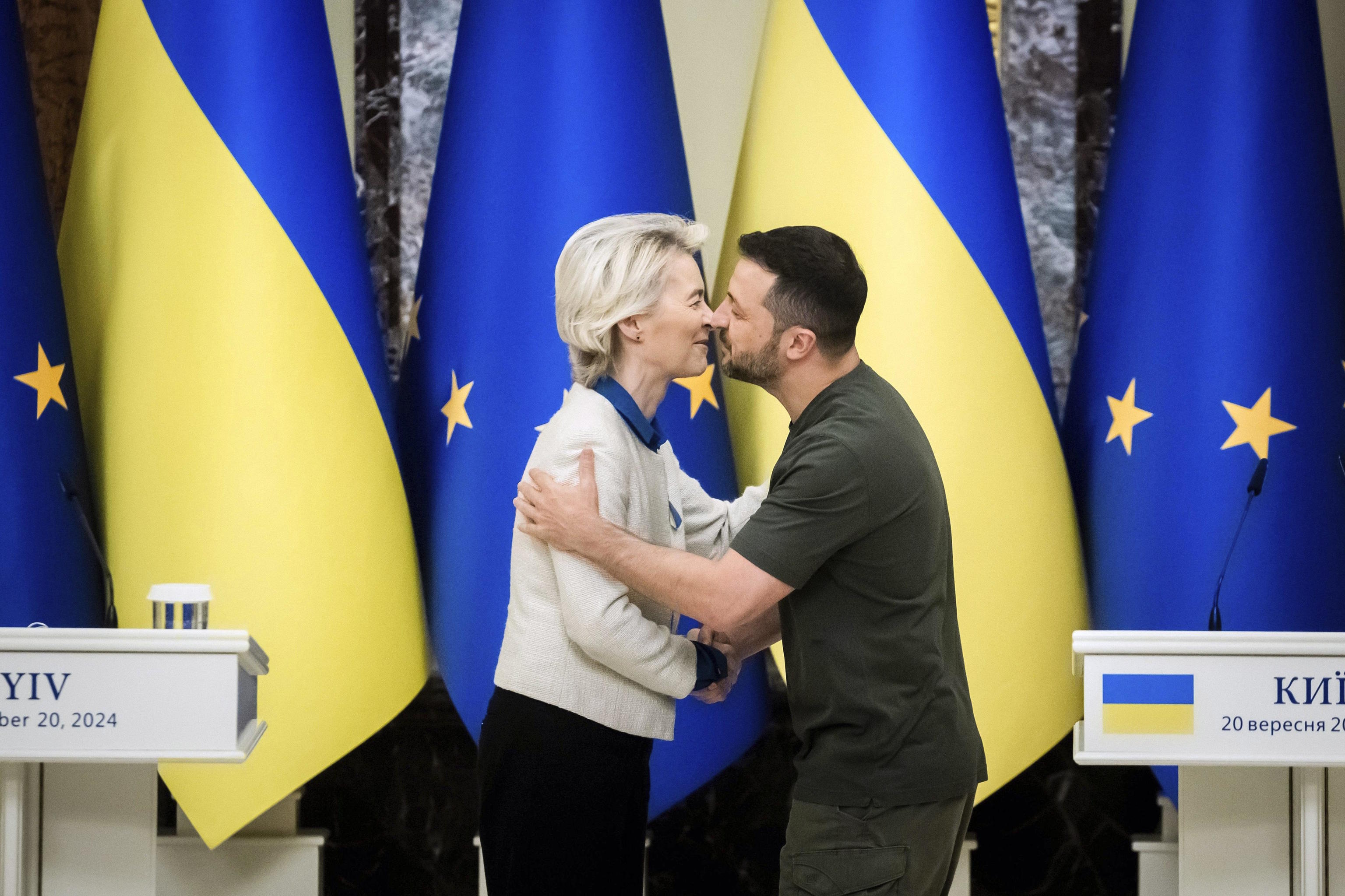
Volodymyr Zelensky, accompanied by Ursula von der Leyen, President of the Commission, and António Costa, President of the European Council, possibly the most consistent allies of the Kiev government at the moment, have also arrived in Kiev. The Finnish President, Alexander Stubb, as well as seven prime ministers and four foreign ministers, have also come to Kiev.
During their press conference in Kiev, Von der Leyen stated that Europe is preparing a new "winter energy package" worth 920 million euros to prevent a situation like the one created by Russian missiles, which have knocked out the entire electricity grid and a significant portion of the heating system in Ukraine. She also stated that Ukraine is "on the right track" in its process of becoming a new partner of the European Union.
Regarding Hungarian Prime Minister Viktor Orban and his maneuver to block the EU loan to Ukraine, the Commission President said on Tuesday: "The European Union will deliver the loan of 90,000 million euros (105,000 million dollars) to Ukraine one way or another." She also stated that the EU is asking Ukraine to accelerate the repairs of the Druzhba oil pipeline, a conduit damaged by Ukrainian bombs, which is crucial for transporting Russian oil to Hungary and Slovakia, precisely the EU countries closest to Russia that have also blocked the loan.
Zelensky reiterated to them: "It is essential that we have started working on the details of a key geopolitical security guarantee for Ukraine and for all of Europe, as well as on a clear date for Ukraine's accession to the European Union. The year 2027 is very important for us, and I hope it is achievable."
Zelensky also invited US President Donald Trump to visit the same square. "Only then can one truly understand what this war is really about," he said. Meanwhile, the G7 leaders, including Donald Trump, reiterated on Tuesday their "unwavering support for Ukraine". "We express our continued support for the efforts made by President Trump to achieve these goals by initiating a peace process and bringing the parties to direct talks," declare the heads of the United States, France, the United Kingdom, Germany, Italy, Canada, and Japan.
Zelensky also called on the European Parliament to set a specific date for his country's accession, considering that this guarantee is key to preventing Russia from blocking Ukraine's future for decades. In a telematic speech delivered on the fourth anniversary of the Russian invasion, the president thanked European support but emphasized that joining the EU is also a diplomatic tool in the midst of war. "It is not just a wish, it is a way to prevent Putin from trying to divide Ukraine and Europe," he warned.
The Ukrainian president advocated maintaining transatlantic unity with the United States and its allies and strengthening sanctions against Moscow, including the total elimination of Russian oil from European markets. He stated that energy revenues continue to finance the Kremlin's war machinery.
In his address, Zelensky framed the conflict within a broader confrontation between democracies and authoritarian regimes, asserting that Russia poses a structural threat to European security. He accused the Kremlin of attempting to destroy the freedom of its neighbors and of having followed a pattern of aggression from Chechnya to Syria and Ukraine. "Putin is war itself," he stated, while calling on Europe to stand firm and show that it will not accept violence or intimidation as political tools.