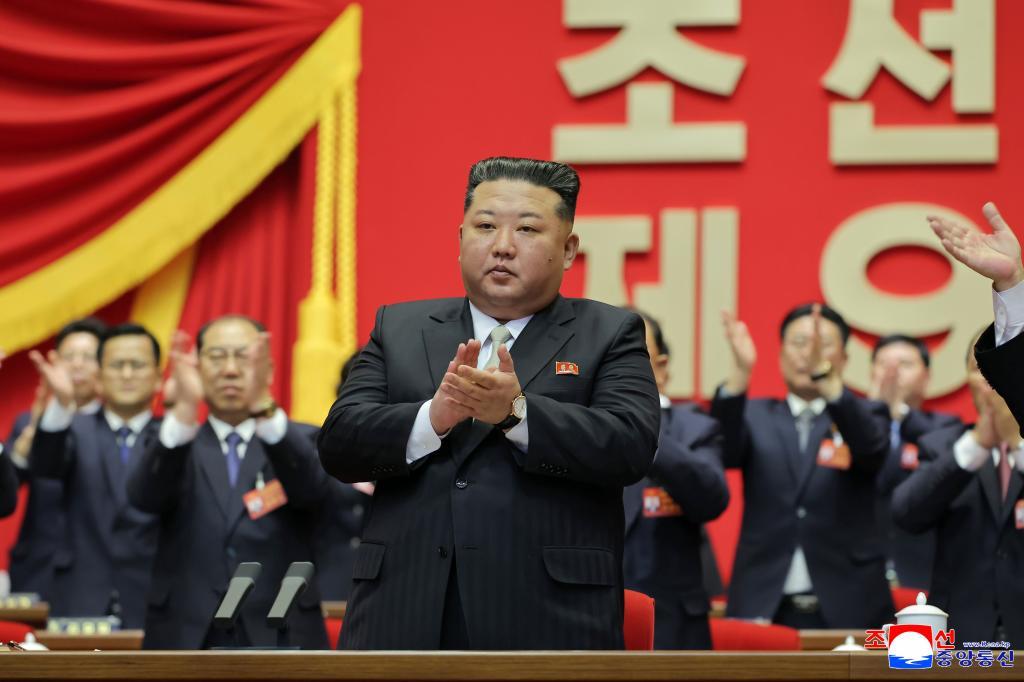
For North Korean propaganda, the "dear comrade" Kim Jong-un is the "best person in the world." This is how a flattering editorial in the Rodong Sinmun newspaper presented the dictator after being reelected this week as the leader of the Workers' Party during a choreographed congress held every five years.
"Under his leadership, North Korea has reached the highest level of absolute military strength," the editorial read. "Kim Jong-un has achieved unimaginable accomplishments that others would have taken centuries to achieve." In Pyongyang, hyperbole is not a rhetorical excess; it is state doctrine.
Thousands of delegates from the party's elites have participated in a quinquennial liturgy designed to showcase unity and discipline. The political conclave in Pyongyang has further consolidated Kim's authoritarian figure and his control of power after 15 years at the helm of the isolated Asian regime.
On Wednesday night, after the conclusion of the 9th Congress of the ruling party, a large military parade with over 14,000 troops took place in the capital. State media published photographs of the leader's daughter, the teenager Ju-ae, accompanying Kim at the event amid speculation that she is being groomed as his successor.
Unlike other parades, this time there was no procession of intercontinental ballistic missiles or nuclear weapons. What did repeat were Kim's usual threats, warning of "immediate" retaliatory attacks against any threat to the country's sovereignty. The supreme leader also pledged to build more nuclear weapons and enhance their missile programs.
In the speech broadcast by state media, however, an unexpected nod to the United States slipped in. Kim suggested that his country could "get along" with Washington, as long as the Americans respect Pyongyang's status as a nuclear power. The nuance is crucial: North Korea does not negotiate denuclearization; it aspires to normalize its atomic status.
The comment comes at a time of speculation about a possible attempt to revive the personal diplomacy that in 2018 led Kim to shake hands with Donald Trump in Singapore. That thaw, which continued with a summit in Hanoi, evaporated without substantive agreements. Since then, North Korea has made progress in solid fuel, military satellites, and attack capabilities. There are now many rumors that Trump could attempt a meeting with Kim as he will travel to Asia for an official visit to China at the end of March.
"If the U.S. respects the current status of our country as stipulated in the Constitution and withdraws its hostile policy, there is no reason why we cannot get along with the United States," said Kim, who, in contrast, closed the door to any idea of building closer ties with South Korea, whom he described as his "most hostile enemy."
Furthermore, as highlighted by state media, Kim warned that his forces could "completely destroy" the neighboring country if the North's security were threatened. The hardened rhetoric against Seoul is not new, but it is consistent with the regime's decision to blow up channels of cooperation.
During the congress held this week, North Korean leaders discussed and presented economic and military policies for the next decade, although few details of the agenda have been revealed. Opacity is the hallmark. North Korea continues to be burdened by international sanctions, border closures, and chronic energy and food shortages. The official message insists on self-sufficiency; reality points to an increasing dependence on China, its commercial lifeline.
The news that has emerged in recent days is that Kim Yo-jong, the powerful sister of the president, has been promoted to head of the party's Propaganda Department -previously she was deputy director-, consolidating her role as the guardian of the narrative and political operator, overseeing relations between the two Koreas. In a system where family loyalty is a guarantee of survival, her promotion strengthens the dynasty.