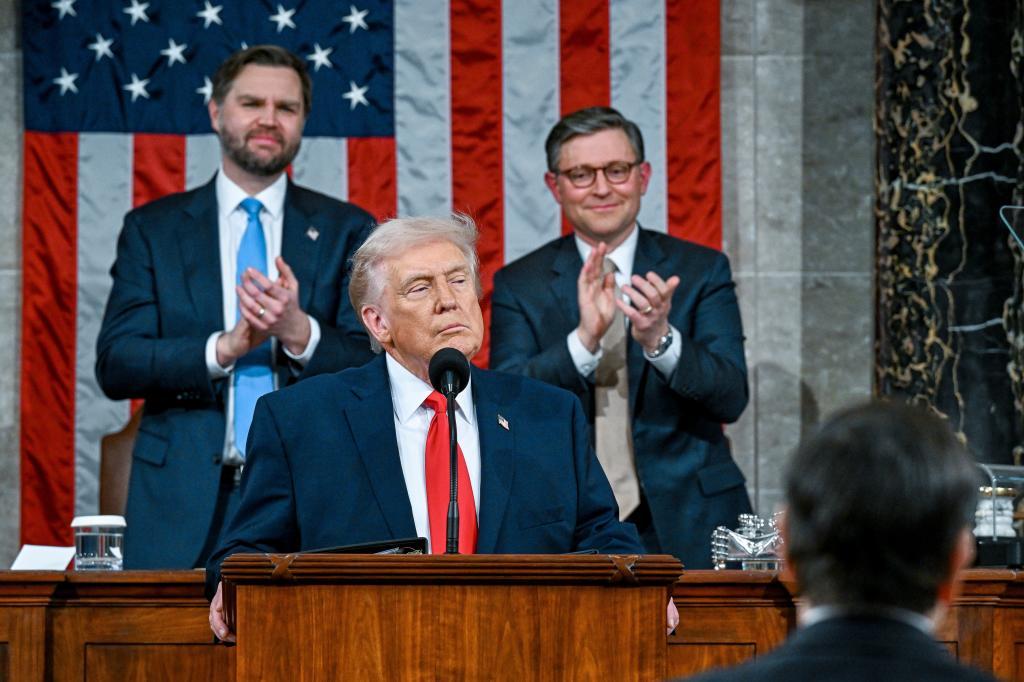
There are nine months left until the legislative elections that will shape the future of the US in the coming years, and there will be no truce until then. Polls indicate that Donald Trump's popularity is at an all-time low and that Republicans are set to suffer severe losses at the polls, potentially losing over 30 seats, which would hand control of Congress to the opposition.
Trump, unaccustomed to defeats, is currently showing his most vulnerable side, facing setbacks in Congress, in the courts, and on the streets. That's why he wanted to make his State of the Union Address, delivered on Tuesday night, a turning point. The unofficial start of the campaign with which he aims to change the defeatist narrative and set a new tone.
It was a long speech, the longest in history. A total spectacle aiming for virality, with more guests and surprise appearances than ever before. With more medal presentations and awards than all previous ones combined. A triumphalist speech, in pure Trump style, full of provocations, populism, lies, and half-truths. An intervention loaded with attacks on the opposition, immigration, equality and diversity policies, and critics of the administration. A speech lacking solemnity and with no attempt to reconcile a divided country and nation. On the contrary.
A decade of high-level political experience and a life in front of the cameras have taught Trump that lies and half-truths matter little, especially if they come down in torrents. The key is to capture attention and the spotlight, even more so in the era of infinite scrolling. They have to talk about you, even if it's in a positive light. And that anger, rage, and indignation generate more traffic than calls for unity, understanding, and collaboration. That's why he designed his intervention as a replica of the previous year's, with all kinds of surprises akin to a TV show, award ceremonies, emotional moments, widows, and victims of various forms of violence.
His speech began and ended by invoking US history and envisioning a bright future that the chosen people, the American people, deserve. "Our nation is back. Bigger, better, richer, and stronger than ever before", he began, praising the "most incredible and exceptional nation that has ever existed on the face of the earth." "When the world needs courage, boldness, vision, and inspiration, it still turns to the United States, and when God needs a nation to work His miracles (...) The golden age of the United States is already here. The revolution that began in 1776 is not over. It continues because the flame of Freedom and Independence still burns in the heart of every American patriot, and our future will be greater, better, brighter, bolder, and more glorious than ever before," he promised at the end.
The president focused the first half of the speech, almost with the optimism that characterized Ronald Reagan, on what he considers his economic successes, celebrating stock market data or promises of investment from large companies, a risky path as it may alienate or anger those who are struggling and hear the economy being celebrated does not represent them. Insisting that debates, or the term "affordability," are a "rotten lie" from the opposition and not bothering to make concrete proposals or promises did not help. Attacking the Supreme Court judges present for their ruling on tariffs did not help either.
According to real-time reactions from a panel of viewers gathered by Navigator Research, close to the Democrats, support for the president decreased precisely when he claimed that Americans are "winning," that prices were dropping, and when he mentioned tariffs.
But after that economic phase, Trump went on the offensive, as his nature demands. A complete rebuke and amendment against the opposition, immigrants, equality and diversity policies, and their critics. That's when Trump showed his fangs, his well-known side, blaming the "inherited legacy," calling political rivals "sick" and "crazy," accusing them of "destroying the country."
The scene that best summarizes the night, the strategy, took place approximately when the president had been speaking for an hour. It was the most tense moments, full of protests, screams, reproaches for attacks on the Somali community and foreigners as criminals. Trump was comfortable provoking the opposition with mentions of a possible third term and changes in electoral laws, and they, having Epstein's victims as guests, were desperately trying to unsettle the president, disrupting his script with shouts, interruptions, signs, and boos.
"Watching Ilhan Omar and Rashida Tlaib, with their low IQs, screaming uncontrollably last night at the elegant State of the Union Address, such an important and beautiful event, they had the bulging eyes and bloodshot crazy eyes, LUNATICS, mentally disturbed and sick, who frankly, I think should be institutionalized. When people can behave like that, and knowing that they are corrupt and corrupt politicians, so bad for our country, we should send them back to where they came from as soon as possible," the president wrote on his social media on Wednesday, repeating some of the epithets he only uses for black or minority individuals or the constant threats of denaturalization. The congresswomen, often targeted by the White House, accused him during his speech of "killing American citizens."
It was during the exchange of shouts when the president revealed his intentions by saying: "One of the great advantages of the State of the Union Address is that it gives Americans the opportunity to see clearly what their representatives really believe. That's why tonight, I invite all lawmakers to reaffirm a fundamental principle. If you agree with this statement, stand up and show your support: the first duty of the US Government is to protect American citizens, not illegal immigrants."
Half of those present did indeed stand up. The Government, the Republicans, some of the guests. The other half did not. The scene was not swift. Trump held on, delighted, saying nothing for a couple of minutes, with all eyes and cameras on him. Amid applause, boos, and with gestures and grimaces, extending his arm as if to indicate that he did not understand how they could remain seated. It doesn't take an expert to know that in the coming months, one of the main Republican campaign announcements will be that, the president stating that the government's duty is to protect Americans first and the opposition, refusing to play along or participate, remained seated. As if they put illegals first. The trap was obvious, but there was no good way out.
"In his speech tonight, the president did what he always does. He lied, sought scapegoats, and tried to distract attention, without offering real solutions to our nation's pressing challenges, many of which he is actively exacerbating," responded on behalf of the Democrats Virginia Governor Abigail Spanberger, who won the elections in November and was chosen, among other reasons, for reflecting a way to defeat the Republicans in November.
"The state of our Union is strong," Trump declared in his most triumphalist moment, saying that with him at the helm, "we never stop winning." Strong may be his government, his prospects, the stock market, tariffs, investment in AI, his foreign presence, control of the Hemisphere. Many things can be strong, but if the speech reflected anything, it's that unity is not. The country entered divided and left the same or worse. And without knowing why its troops are being deployed in the Middle East once again.