Kenzo still can't believe what happened to him a couple of months ago on the Tokyo subway, during rush hour, on the Ginza Line that runs through the financial heart of the Japanese capital. "An older man touched me under my pants," says this twenty-something. "We were as usual on the subway, completely packed. I felt the man behind me rubbing against me, but I thought it was because the car was so crowded. Until I felt him touching me under my jacket. Then, his hand went lower." Kenzo turned around and faced his assailant. "He was older than my father. I didn't scream or confront him. I did nothing. I just moved away a bit."
The young man, who graduated last year and is interning at a financial company, explains that was the first time he was a victim of sexual assault, but several of his friends, both male and female, have experienced similar episodes on Tokyo's public transportation. "In Japan, we use a term, chikan, to describe the perverts who harass and assault on trains and subways. Women are always the main victims, but young men also experience it," Kenzo asserts.
Official data supports his claim. One in six men using the railway services in the Japanese capital reports being victims of some form of harassment or sexual assault. This is according to a survey published last year by the Tokyo Metropolitan Government, which revealed that 15.1% of male train users in the capital had experienced such episodes. Among women, the figure jumps to 54.3%. An editorial in Asahi Shimbun, one of Japan's highest-circulation newspapers, emphasizes that this male percentage challenges the entrenched idea that these assaults are directed almost exclusively at women.
Several protests have been held against sexual assaults on public transportation.Tokyo Metropolitan Police
In the crowded cars, anonymity works in favor of the offender, and social silence often protects them. The survey also revealed that a significant proportion of victims, including men, do not report the incidents. Another broader investigation on sexual harassment conducted by the Japanese government a couple of years ago indicated that nearly 80% of young people who experienced sexual harassment did not report it to the authorities.
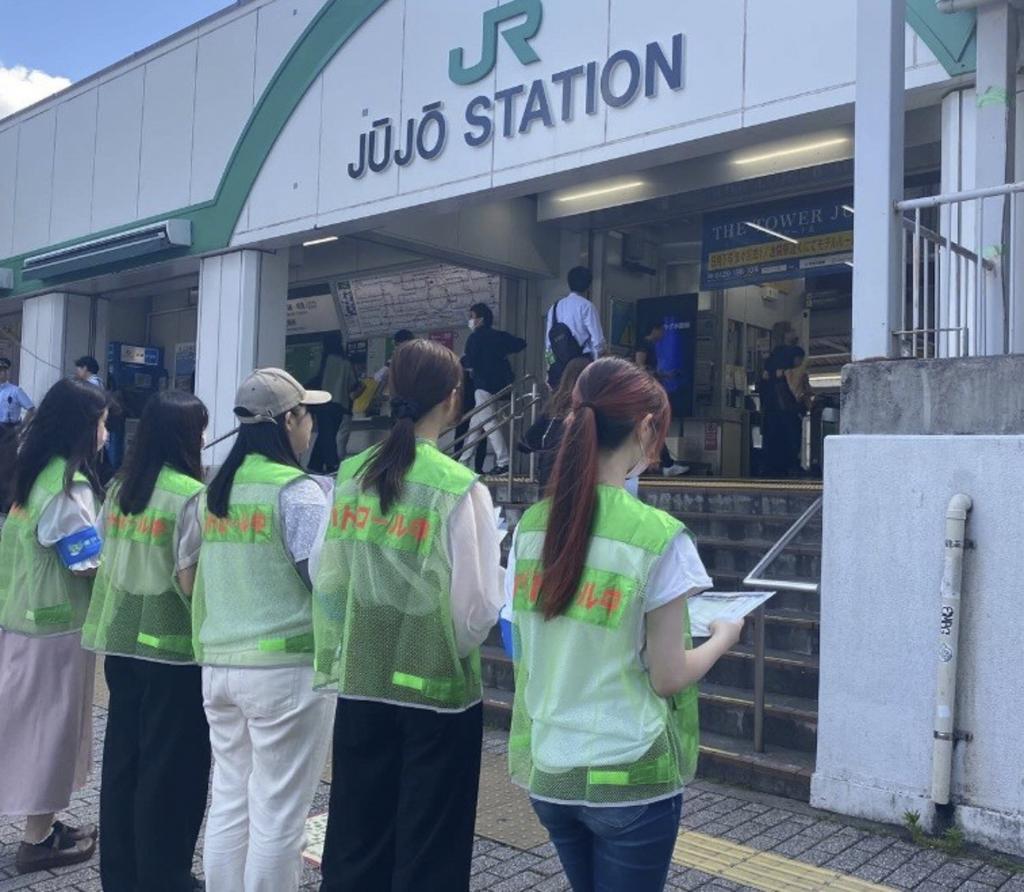
We know Kenzo's testimony because he is part of groups of young volunteers who collaborate with the Tokyo Metropolitan Police Department in preventive patrols. Some patrol stations looking for suspicious behavior; others distribute brochures explaining how to use Digi Police, the official anti-harassment app.
The app is simple and direct. Upon opening it, a red button: "repel groper". Pressing it sends a geolocated alert to the police. The distress call also reaches other users who have downloaded the app and are in close proximity to the victim at that moment. This technology, researchers point out, aims to compensate for what for decades, in a society as conservative as Japan, was a mix of shame and fear of making in-person reports in these situations.
Sexualization of very young women
Campaigns against chikan in Tokyo have reached the Akihabara district, the birthplace of electronics, manga, anime, and otaku culture. Here, the first maid cafes emerged in the early 2000s, popularizing the idea of waitresses serving customers dressed as Victorian-style maids or inspired by fictional characters. These establishments, where customers are received as "masters" or "mistresses," have always been controversial because their predominant aesthetic - uniforms evoking adolescence, very childish behaviors, and perverse dynamics of submission- contribute to the sexualization of very young women and the normalization of stereotypes.
Workers from these maid cafes in Akihabara have also taken to the streets to distribute leaflets in front of the subway station denouncing the sexual assaults they endure on public transportation. "Please help us eradicate sexual abuse," a sign read at one of their protests, where they also encouraged victims to use the Digi Police app.
Some of the affected individuals created the 'Digi Police' app to report cases of abuse and sexual harassment.Tokyo Metropolitan Police
The issue is that Japanese culture itself pushed decades ago to trivialize what is actually a crime. An article published in 1999 by the American magazine Wired explained that in Tokyo, it was not difficult to find vending machines selling used schoolgirl panties, comics fantasizing about groping on the subway, including maps of the best stations to commit them, as well as magazines sold at kiosks featuring images of real sexual assaults.
Today, the phenomenon has evolved but not disappeared. An investigation by the BBC uncovered the existence of clubs where men pay to recreate the fantasy of harassing and assaulting a woman. These places are filled with rooms that mimic the aesthetics of a Tokyo subway car. Even the muffled vibration of the train starting is heard, reproduced by hidden speakers. Some of these fantasies did not stay in the realm of theater: the British broadcaster also identified Telegram groups with thousands of members from these clubs sharing tips and videos of real assaults.
The Tokyo Police have been fighting against these crimes for some time. Currently, trains during rush hour have exclusive cars for women, and in addition to volunteers, there are undercover female officers patrolling stations trying to catch chikan, especially during exam season, equivalent to the college entrance exams in Japan, which fall in mid-January.
"Every year, around those dates, there are numerous anonymous posts on social media encouraging abusing students on trains because they are rushing to the crucial exam, and if they report being assaulted, they might be late for the test," explains a spokesperson for the metropolitan police, adding that in these situations, there has been a protocol for the victim to retake the exam for the past two years.
Tokyo and its impeccable urban order boast of being one of the safest cities in the world. And it is in many indicators. But that pristine image cracks underground. In the subway, in those cars where there is barely room to breathe, where bodies travel compressed to the point of erasing any physical boundaries, thousands of people - women and men alike - continue to travel with tension. During the tight rush hours (from 6:00 to 9:00), when the cars seem to pulsate as a single human mass, anonymity becomes an excuse, and silence an ally. It is there, on that routine journey to the office or university, where the chikan still finds refuge.