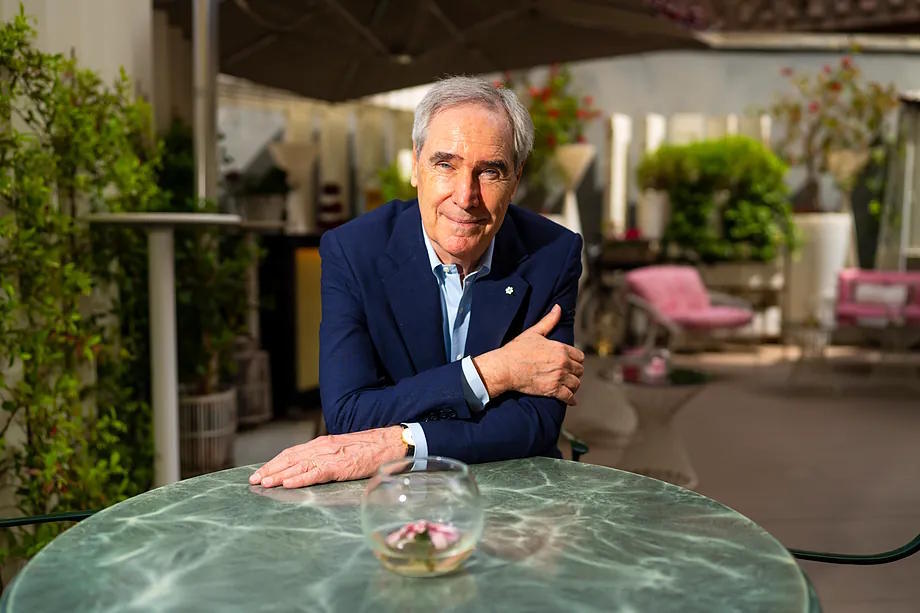
Michael Ignatieff, former professor at Harvard, former candidate for prime minister for the Canadian Liberal Party - the same party to which the current Prime Minister of that country, Mark Carney, belongs - and former rector of the Central European University - which Hungarian Prime Minister Viktor Orban expelled from that country - Ignatieff is a defender of the liberal democratic order that is being questioned in, precisely, countries with a democratic and liberal tradition.
Trump always says he opposes military interventions, even though in 2002 and 2003 he supported the invasion of Iraq. But he has bombed Iran, intervened in Venezuela, and could end up doing so in Cuba. In relation to Iran, he has deployed 350 combat aircraft and 40% of the U.S. warships at sea, which some of his voters do not like. It's as if Trump has lost part of his ability to understand what his electorate wants.
An attack on Iran - with or without active support from Israel - seems inevitable. No one understands this war. I don't either. I see no argument justifying it. Regime change makes no sense.
Why?
Because if he decapitates the Iranian regime, the country could descend into chaos, and in that case, one would only have to wait and see if a pro-American leader emerges. Perhaps he hopes the bombings will bolster opposition to the regime...
What if he only wants to destroy Iran's nuclear program?
After the June bombings [by Israel and the U.S.], there seem to be no military targets left. This is a war without justification, without reason, and unpopular among the American people. Foreign military operations are not a magic wand that boosts presidents' popularity, as was demonstrated in Venezuela.
While the U.S. negotiates with Iran, it also does so with Russia and Ukraine to impose a peace plan that would give Vladimir Putin much more than he has achieved on the battlefield. If an agreement is reached, what should Europe do? Reject it based on moral principles or be realistic and accept it?
Although it entails a terrible price, it is better to accept an agreement where Ukraine has to cede a fifth of its territory but without relinquishing sovereignty over it, and Putin declares a victory he has not achieved. In that case, I believe it is better for Europe not to send any peacekeeping forces.
Why?
Because the only ones who can defend Ukraine are its Armed Forces, which are by far the best in Europe and can impose punitive costs on Putin if he violates the agreement. Deploying French or British brigades on the ceasefire line is not practical. Firstly, Putin will not accept it. Additionally, these soldiers would not be peacekeepers or observers. They would need combat capabilities, so if a clash occurs, NATO would automatically be in a confrontation with Russia, which could end badly if Putin decides to use tactical nuclear weapons. I think it's better for Ukrainians and Russians to face each other, with Europe in the background, providing the former with everything they need.
Europe, in fact, is already providing virtually all the support Ukraine receives. U.S. aid to Kiev is literally zero.
It is incomprehensible that the U.S. has cut off its financial support to the Ukrainian state, so the only option for Europe is for the EU to continue providing it. The plan approved in December [vetoed by Hungary] provides funding for two years, but it is likely to be needed for many more, even if there is peace. Another crucial aspect is facilitating Ukraine's entry into the EU. This means cutting down on the ridiculous 20 or 30 points that Kiev must meet to achieve access. In return, Ukrainians can go to all European capitals to show how 21st-century warfare is conducted.
It seems that, despite the change in the strategic landscape in recent years, Europe still sees itself as a soft power, not hard power.
This is the case in many countries. For example, in Canada, where we have forgotten that we lost a huge percentage of our population in World War I and a considerable amount in World War II. Soft power is good. Spain has a lot of it because people worldwide adore the country, and its imperial past means many nations share cultural and linguistic ties with it. These are huge assets for Spain.
Is it enough?
No. Hard power is necessary, not just military power, but across a broad spectrum: economic, technological, energy, and communications. We are in a world of predatory hegemonic powers, and we cannot rule out the possibility of them using the technology they control to reinforce our dependence. This explains why the French view Google or Microsoft with suspicion. Spain will have to make tough decisions about how far it allows U.S. and Chinese technology to enter certain areas of its economy or state. These are critical aspects of hard power applied to national sovereignty. I believe Spain should be very concerned about what is happening in the Baltic Sea [where Russia is cutting underwater energy and telecommunications cables]. You have a very long and unprotected coastline in the Cantabrian Sea, the Atlantic, and the Mediterranean with extensive cable networks and significant satellite connectivity that you do not control, an area where Russia is heavily investing. Hard power is not so much about national defense but national resilience. For example, what can Spain do to ensure it is not left without electricity?
Spain is not in danger of being left without power. It managed that on its own 10 months ago.
Exactly! That's why I used that example! It was a shock to me! No one thought national resilience would be of paramount importance. We are now discovering that even in peacetime, countries must invest huge amounts of time and resources to ensure the survival capacity of their networks and infrastructure. Thinking that if Spain loses power, nothing will happen because it will come from Germany or France does not work.