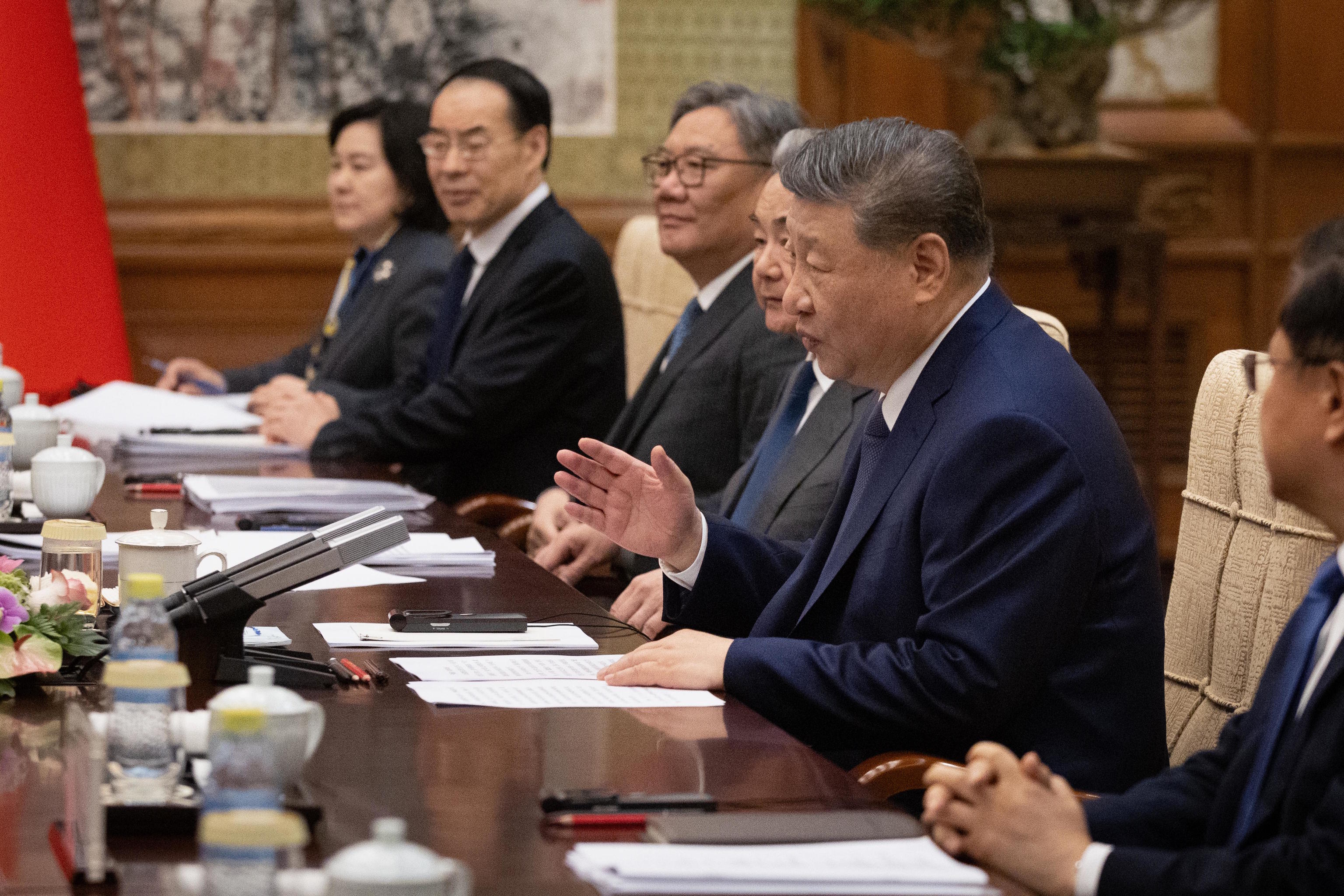
German Chancellor Friedrich Merz traveled to China this week with an agenda that combines economic pragmatism and geopolitical calculation. His first official visit to the world's second-largest economy is an attempt to recalibrate the most delicate relationship for Berlin at a time of global trade fractures, technological warfare, and European pressure to reduce strategic dependencies.
Merz traveled accompanied by heavyweights of the German industry - Volkswagen, BMW, Mercedes-Benz - because the relationship with Beijing is, above all, economic. In 2025, Germany and China traded a volume of 251.000 billion euros, 2.2% more than the previous year. China surpassed the United States last year as Germany's top trading partner for the first time. But the data hides a growing asymmetry: Berlin imported goods worth 170.600 billion and exported only 81.300 billion. The deficit, close to 90.000 billion euros - around 2% of the German GDP - marks a historical turning point. A decade ago, Germany recorded surpluses. Today, it buys more than double what it sells.
This was the background of the trip. After meeting with Chinese President Xi Jinping on Wednesday, the German leader announced that China had committed to purchasing up to 120 Airbus aircraft of European manufacture. "This demonstrates how valuable these trips can be," summarized the Chancellor. But the agreement, relevant to the European aeronautical industry, does not alter the structural trend. Germany is selling fewer and fewer airplanes and cars, while importing more batteries, solar panels, electronic components, and Chinese industrial goods at prices that its productive fabric cannot match.
On Thursday, Merz visited a Mercedes-Benz plant in Beijing and attended a demonstration of autonomous vehicles, a symbol of the technological race in which China also has an advantage. Chinese brands are advancing in electrification, software, and intelligent driving while European manufacturers struggle not to fall behind.
The German's last stop on his visit was the city of Hangzhou, one of the major innovation hubs in the Asian country, where he visited the facilities of the German company Siemens Energy and the Chinese manufacturer of humanoid robots, Unitree. This company, founded in 2016, has gained prominence in recent years and is at the forefront of the current robotic industry revolution in China.
Merz's trip takes place in a context where pressure is growing in Brussels to strengthen commercial defense mechanisms against subsidized Chinese exports. In Berlin, the debate on excessive dependence on the Chinese market is increasing. The strategy of many European leaders is based on a complex balance: reducing risks while strengthening ties, especially to attract large investments.
"Today we are closely connected. This generates opportunities, but also presents risks," said Merz after his meeting with Xi Jinping. "We want to avoid these risks for the benefit of both parties," he added, pointing out the problems in the supply chain of German manufacturers that were exposed last year when China tightened export controls on chips and rare earths.
Germany, more than other European Union partners, relies on China for critical raw materials, electronic components, and, above all, rare earths. Last year, Chinese export controls on these materials jeopardized production lines. The supply gradually resumed, but the message was clear: Beijing has immediate pressure capacity on the European industry.
German exports of automobiles and machinery to China have weakened while Chinese products gain market share in Europe. The German manufacturing sector is losing around 10,000 jobs per month, and in Berlin, some point to Beijing as a significant part of the problem.
Merz, after his meetings in Beijing, noted that the trade deficit had quadrupled since 2020, explaining that this was largely due to excess capacity. "This dynamic is not healthy," he declared.
To prepare for his first trip to China, German media reported that the German leader held a closed-door meeting with various German experts in the Asian country, from academics to veteran businessmen. "The Chancellor wanted to know how to establish a personal connection with Chinese officials," explained Jörg Wuttke, who represented BASF, the world's largest chemical company, in China for more than two decades.
Merz, who maintained a very conciliatory tone during his trip, aware that he had to try to correct an increasingly unbalanced relationship without blowing it up, now returns to Berlin after navigating in a gray area between industrial pragmatism and geopolitical prudence.