Bobby Fischer, one of the greatest chess players of all time, used to say that chess is simply life. Often labeled as crazy despite his genius, the American Grandmaster was clear that every action has consequences on the board and in life. That every move conditions the future of the game, just as every vital decision determines our future destiny. There can be no turning back, every move is irreversible. Also in the history of chess.
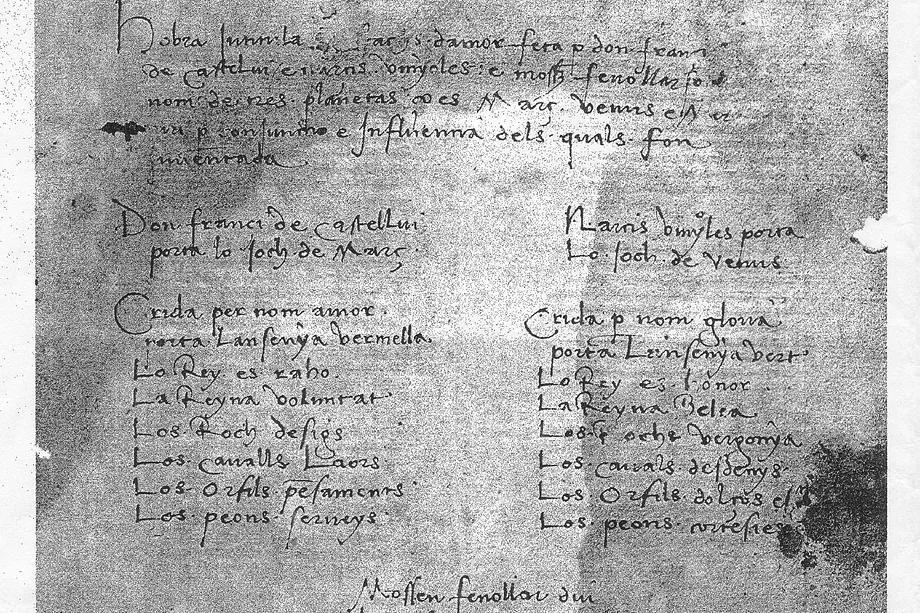
It was a Valencian poem, written in 1475, that forever changed the rules of the game. It was 64 stanzas - the same number, by the way, as the squares on the board - that altered the slow pace with which chess had developed for centuries. Scachs d'amor (Chess of love), as the poem was called, is "the text that inaugurates the modern age of chess, with the new and powerful queen reigning on the board," as summarized by José Antonio Garzón, a chess history researcher.
"The poem was a very transgressive text, as it would revolutionize 700 years of established chess practice," he emphasizes, regarding the release of the documentary Valencia, birthplace of modern chess. Sponsored by the Generalitat and the Valencian Chess Federation, the work seeks to rescue a history that is practically unknown as it marks 551 years since the poem was created.
But this text is not the only one that supports the Valencian origin of modern chess. The "holy grail of chess" is a lost book that would be published - also in Valencia - two decades later. Its whereabouts remain a mystery to researchers, despite being considered the first treatise on modern chess.
"Everyone knows that soccer was born in England or that basketball was born in United States, but not everyone knows that modern chess was born in Spain and, specifically, in Valencia," laments Emilio González, president of the Valencian Federation. And yet, "the rules invented by the poem have hardly changed in over five centuries. It's as if in all that time in soccer, only the offside rule had been slightly modified."
For Garzón, proving the Valencian origin of chess "has been a complex struggle against fate, as key documents took time to surface." The discovery of Scachs d'amor did not occur until 1905. The manuscript, written in Valencian, was found in the archive of the Real Capilla del Palau Requesens de Barcelona. Its authors were three poets from the so-called Valencian Golden Age: Bernat Fenollar, Narcís Vinyoles, and Francí de Castellví.
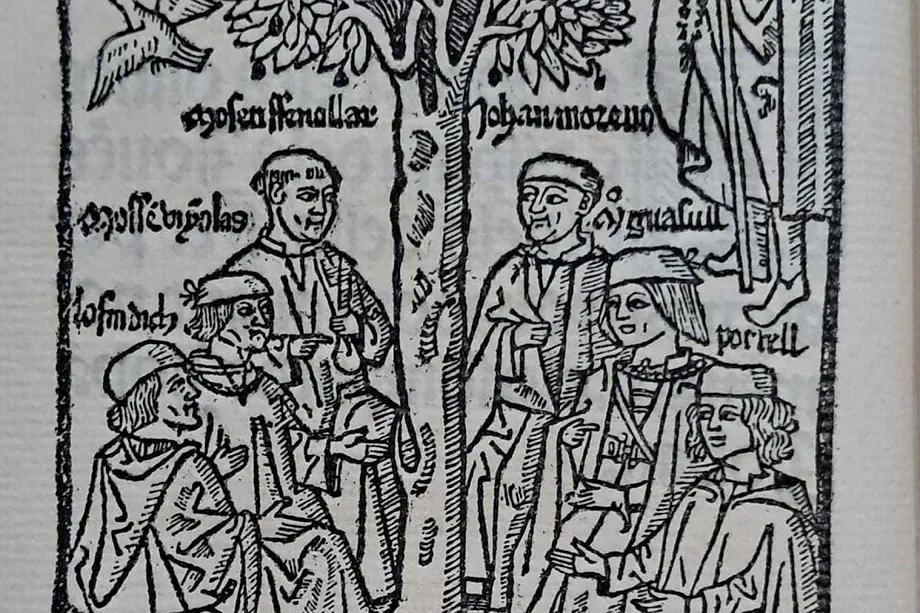
Engraving featuring the poets Fenollar and VinyolesBIBLIOTECA DE RAFAEL SOLAZ ALBERT
In the 15th century, Valencia was experiencing a period of economic and cultural splendor. The Lonja de la Seda was built, the first printing press in Spain was introduced, Joanot Martorell wrote his Tirant lo Blanch - the book that Cervantes saves from the bonfire in Don Quixote - and even in the Vatican, the Popes from the Borja family (Borgia in Italian) reigned. It is in this context that the three Valencian poets make their particular move on the game board.
The poem describes a chess game that, in practice, has become the oldest played according to modern rules. This is because, as Garzón points out, the authors themselves state throughout the poem that "such a way of playing has never been seen." "They reaffirm several times that the new proposal is theirs," he insists. "Our game wants to adorn itself with a new and surprising style," write the poets, who take on the roles of three characters: Mars, Venus, and Mercury.
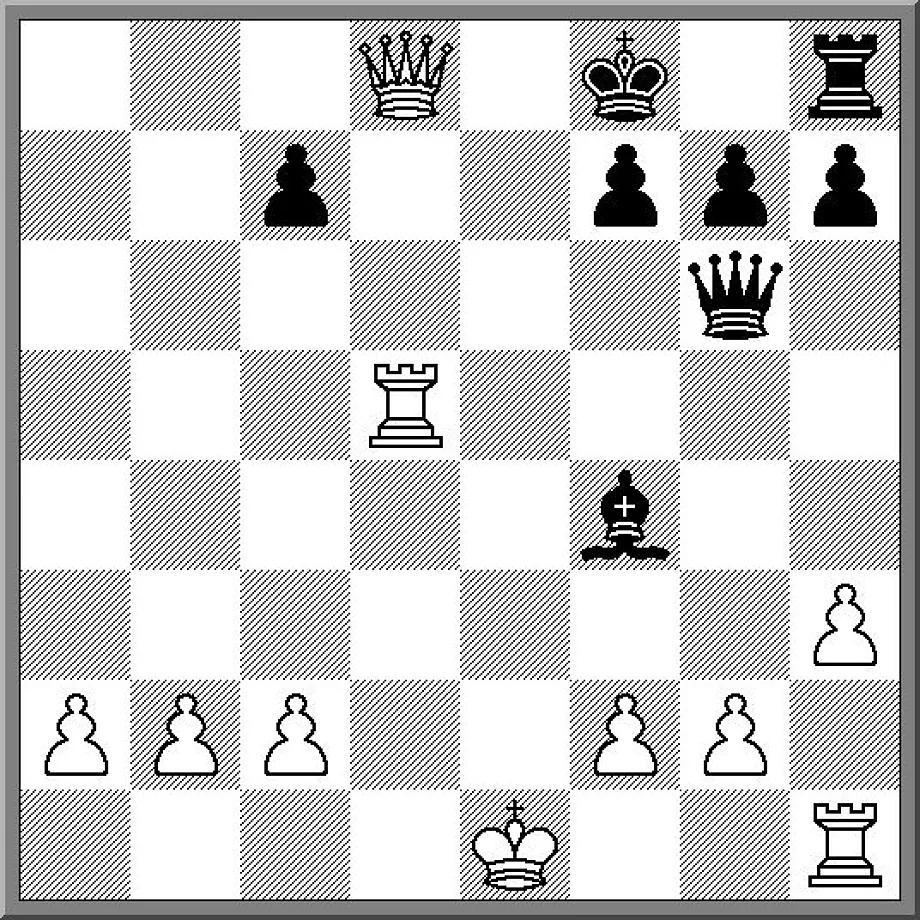
What was the great novelty of the poets? The invention of the queen, who becomes the most powerful piece on the board in what represents, in Garzón's words, a "feminine revolution." In fact, for Emilio González, the introduction of the new piece was a turning point in the history of chess because "from a very slow game, it became a very fast and dynamic one." "It was so well-received - he insists - that it is what we have today." A queen moving in all directions, able to reach from one end of the board to the other as long as the path is clear.
Garzón also speaks of the "cult of the feminine ideal" that shines through the text. "Throughout the poem, traits related to the queen are developed. There are allusions to beauty, the quality of being gentle..., which has led many to see a reference to the Virgin Mary." To support this theory is the fact that Fenollar, Vinyoles, and Castellví participated in a Marian contest in 1474.
But there is also speculation that the new queen was a tribute to Isabella I of Castile by the three chess players. Wasn't she another powerful queen? "There are stanzas that seem to overlap with real-life episodes, like the moment they say that queens do not fight each other. They seem to evoke the war that pitted Isabella I of Castile against Juana la Beltraneja [for the throne of Castile]," explains the researcher. In any case, Garzón leans towards the theory that the queen piece, if it had a reference, was created to safeguard the reform of the new rules of the game. Who would dare to question the changes?
To the "feminine revolution," Garzón adds another: the "popular" one. "The pawn, which in Arab and medieval chess did not have a relevant role, can now also aspire to become a queen." The origin of the promotion is also found in the poem: when a pawn reaches the last row of the board, it must be promoted. And, being the queen the most powerful, it is usually the chosen piece. "Two reforms in one," summarizes Garzón, thus pointing out the "tremendously progressive attitude" of the poets.
The next "link" in the history of modern chess is the work that helped spread and expand the new rules: the Llibre dels jochs partits dels scachs en nombre de 100. It is another Valencian work, by the author Francesch Vicent, which was published 20 years after the Scachs d'amor, in 1495. However, little else is known about it, except for the certainty that it existed to compile for the first time a hundred problems of modern chess.
Rafael Solaz, a Valencian bibliophile and documentalist, confesses that this story has had him "captivated" for over 30 years, when he first learned of the existence of the work through Garzón: "I began to investigate, and all the data led us to the Montserrat Abbey, where they had a record of an entry with the book. This confirmed that the work indeed existed and was printed." Moreover, "the person who registered it was looking at the book because it details the date, the printer, the author, and the title."
However, his search has so far been unsuccessful. Both researchers even launched an international contest years ago to try to find the work. Despite the interest it generated, luck was not on their side.
Solaz believes that the Inquisition could have contributed to its mysterious disappearance. After all, "a book considered of liberal arts like this one was not well seen." It is also considered that Francesch Vicent - who was a chess teacher of Lucrecia Borgia, the daughter of Pope Alexander VI - was a converted Jew and was persecuted. Or that the book was bound with another work and is mistakenly registered in some library in the world.
"This is the first modern chess treatise, and hence the importance for Valencia that the book is found, because there must be some trace," says Solaz. "We do not lose hope of finding it." It will be then when the circle of the history of chess can be closed.