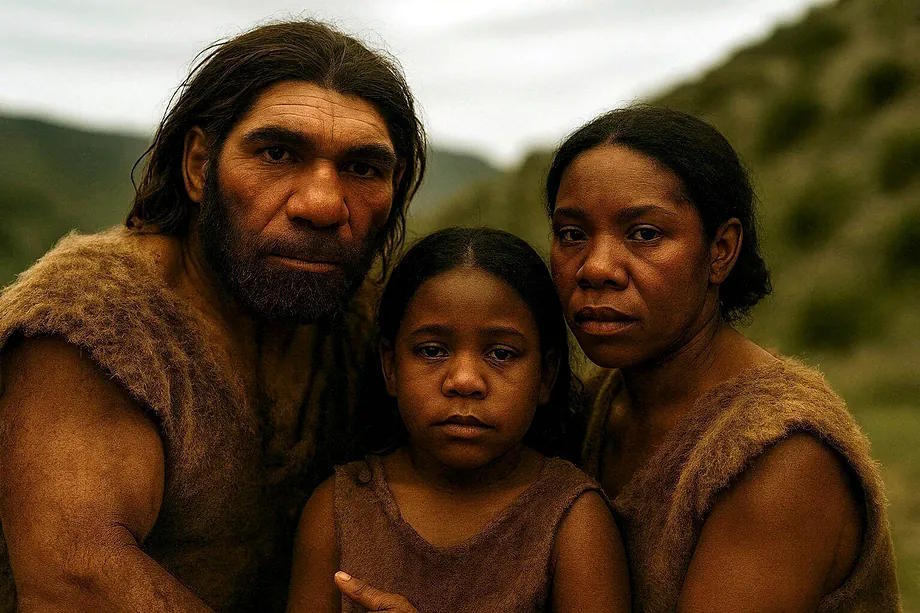
In 2010 a study revealed that, between 40,000 and 60,000 years ago, Homo sapiens and Neanderthals had exchanged genetic material and had common offspring. The analysis and comparison of ancient DNA with that of modern humans indicated that a portion of the Neanderthal genome was present in current Homo sapiens populations outside of Africa (subsequent studies have suggested a small presence of Neanderthal genes in the African continent, although to a lesser extent than in Europeans and Asians).
Further research into the genetic relationships between both species revealed that inherited Neanderthal DNA is not uniformly distributed in modern humans. Genetics have unveiled significant gaps in our genome without Neanderthal presence, known to specialists as "Neanderthal deserts." These genetic deserts are particularly noticeable on the X chromosome.
A group of researchers from the University of Pennsylvania (USA) analyzed the possible causes of this selective distribution of genetic material in our species. Their findings are published this Thursday in an article in the journal Science, where the authors argue that the answer lies in mate preferences, which would have favored unions between Neanderthal men and Homo sapiens women.
The authors examined Neanderthal genomes to assess the amount of Homo sapiens DNA that entered those populations during a documented interbreeding event (recent research suggests that genetic exchanges between both species occurred over a long period of about 7,000 years). By examining these Neanderthal genomes and comparing them with genetic data from current populations, they were able to create models on genetic flow patterns.
Women have two X chromosomes and men have only one, so genetic transmission is influenced by the information contributed by each parent. If Neanderthal men mated more frequently with modern Homo sapiens women, fewer Neanderthal X chromosomes would have remained in modern human DNA, and more Homo sapiens X chromosomes would have left a trace in Neanderthal populations.
To verify if Neanderthal X chromosomes contained human alleles, the team studied modern human DNA preserved in three Neanderthals —found in Altai, Chagyrskaya, both in Russia, and Vindija, Croatia— and compared them with various modern African genomes used as a control group, originating from populations without Neanderthal DNA presence. The analysis found a relative excess of 62% of Homo sapiens genetic material in Neanderthal X chromosomes, confirming the hypothesis of interbreeding between Neanderthal men and Homo sapiens women.
According to the authors, it was the species interactions that determined which parts of the human genome persisted and which disappeared, contradicting the hypothesis that human evolution was solely driven by natural selection of evolutionary advantages. "For years, we simply assumed that these deserts existed because certain Neanderthal genes were biologically toxic to humans, as often happens when species diverge," explains Alexander Platt, a researcher at the University of Pennsylvania and lead author of the article. "That's why we thought these genes could have caused health problems and were likely eliminated by natural selection."
The study in Science emphasizes the role of social interactions in human evolution and questions the idea that DNA modifications were solely due to survival. "We have discovered that a simple model of mate preference, where Neanderthal ancestry is generally more attractive in men than in women (or anatomically modern human ancestry is more attractive in women than in men), is sufficient to explain the results we observe," Platt points out.
For hundreds of thousands of years, human populations migrated to Neanderthal territories and vice versa, and when these groups encountered each other, they interbred, exchanging DNA segments. Population migration has traditionally been one of the main explanations for "genetic deserts," but the new research suggests that other factors should be considered. In any case, it may not be the only factor, as the authors believe that both differential migration and mate preference may have simultaneously influenced.
The team will now focus on investigating if similar genetic comparisons can provide insights into the gender dynamics of Neanderthal society. For example, whether women stayed with their biological families while men migrated to new groups. By mapping these ancient interactions, the researchers hope to shed new light on the complex social life of our closest evolutionary relatives.