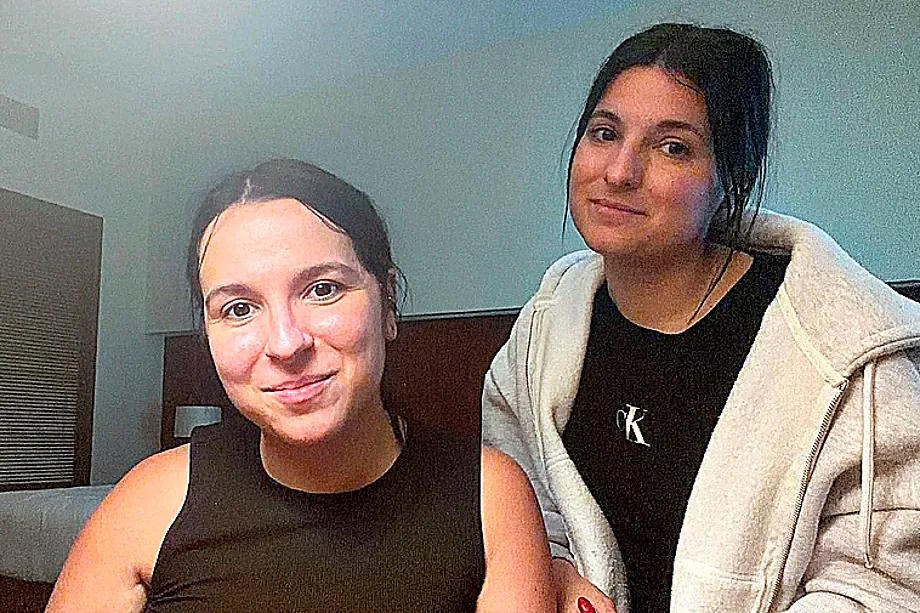
Ana, her husband, and their three young children have been living in Bahrain for over a decade, but yesterday they decided to leave the kingdom and cross the 26-kilometer bridge to Dammam, the nearest Saudi city. "To put ourselves in a safe place," explains this Spanish woman less than an hour after crossing the border. The journey is short but means being safe from Iranian rockets aimed at the headquarters of the Fifth U.S. Fleet located on the small island in the Persian Gulf where they live.
Their case reflects the situation experienced by thousands of Spanish residents in the countries attacked by the Tehran regime in retaliation for their support to the USA. The Ministry of Foreign Affairs is also monitoring travelers who have been caught in the wrong place due to the conflict. The closure of airspace in some countries or flight cancellations in others force them to remain in the conflict zone without a clear scenario for their return.
In the case of Ana and her husband, they left Bahrain after a sleepless night. "We left in a hurry from there. Last night was brutal. There were missiles falling and others being intercepted. They tell you it's better to stay at home to avoid missile debris." Their area is far from military installations and they have not had to be evacuated, but that has not prevented them from feeling on the front line. "We live next to a pole with sirens. Just as there are loudspeakers for prayers, there are also for sirens. The young children, between the sirens and the bombs falling, could not sleep. The whole house is shaking: there are many consecutive warnings and the noise is constant. We can't go another sleepless night, with sirens and bombings. The children are scared," she explains.
The warnings are "constant" and come in duplicate. First, the sirens sound, and at the same time, they receive a warning on their phones through a government application, advising them to seek shelter. Then comes the roar.
It was their own decision to leave, not based on official information. They acted based on the warnings they received from friends living in the area. "We left because we considered it was the best thing to do. It is expected that tonight will be worse. People have told us, Jordanian friends, Lebanese friends... There are companies working here that have already evacuated their people to Dammam," says Ana. "We have friends who have stayed and others have come like us. Many Spaniards have stayed," she says.
Her husband knows the area where they have taken refuge since yesterday because he works on that side of the border and crosses it every day, which has facilitated their displacement. The family decided to reside in Bahrain, a place they praise and never thought would become what it is now. "We have been here for 11 years and we had never felt unsafe. You never imagined this would happen in Bahrain, a very safe country. Here, you don't even have to lock your car or anything. People are very sad, they don't understand it."
The couple explains that they have been in contact with the Spanish embassies in Kuwait -on which Bahrain depends- and Saudi Arabia. "They tell us that we are on the repatriation lists in case it is necessary to evacuate people." Bahrain's airspace is closed, but not Saudi Arabia's. They will wait to see how the situation evolves in the emirate to decide whether to take a flight to Spain that they already have in mind: Dammam-Jeddah-Madrid. "We will see, because we don't know anything yet."
In neighboring United Arab Emirates, Albert has been living there for less than two years. Since arriving in Dubai in 2024, he had not experienced any similar situation. During the previous escalation of tension between Israel and Iran, the United Arab Emirates was warned that its airspace could be invaded. On Saturday, when the U.S. attacks began, he was with friends in a fairly desert area north of the city. In the afternoon, already in the city, they began to hear loud noises. "There were explosions, as if they were intercepting missiles," he explains, "at night, the lack of visibility of Dubai's sky, due to the suspended sand and humidity, did not allow us to see what was happening, but the noise was different. It was clear that they were military planes flying over the city."
He is not surprised that the United Arab Emirates could be targeted, as it is a country relatively aligned with the West and critical of Tehran. However, he insists that many project a more dramatic image from the outside than the reality. "People were writing to me thinking we had been attacked," he tells EL MUNDO, "but many missiles have been intercepted and the debris found is from drones. The question is whether they have been deactivated or fell because their lifespan ended."
As a Spanish resident abroad, he is registered in the Consular Registration Registry of the Spanish Embassy in the United Arab Emirates. Since the beginning of the tension escalation, the Embassy has not contacted him through any official channel. Through other Spanish contacts in the city, he received an audio message from a supposed embassy worker -which he has not been able to verify if it is true- giving certain advice to stay safe.
When the missiles started falling on Saturday, Marina (32) and Elena (29) were at the Sheikh Zayed Mosque in Abu Dhabi. "A mobile alert arrived. It warned us of 'a possible missile alert' and to seek refuge in a safe place and close windows. And we were in the mosque...", Marina explains over the phone. "So we went to the locker to pick up our suitcases and rushed to Abu Dhabi International Airport. Upon arrival, we found that everything was canceled," she concludes. The one-day excursion to visit the capital of the United Arab Emirates was their last stop on a family trip to Dubai; they had no accommodation booked as they were supposed to fly back to Spain in the early hours of that morning.
At the airport, they met four other Spaniards, and the group managed to book an aparthotel (470 euros per night). "We don't know how many days we will be here," Marina laments. "It's a bit chaotic. The hotel complies with the instructions of the Government (Spanish), but we have sent a message to the embassy because they are the ones who have to contact the hotel to activate this 'safeguard' protocol." Beyond that, there has been no further contact with the embassy. Yesterday afternoon, their travel agency informed them that they had secured a flight for Wednesday.
Also from Malaga, Michael, 33, was waiting with his pregnant wife, his two nephews (7 and 9 years old), and two other adults at the boarding gate to return to Spain. The help of an airport police officer helped them to be transferred to a hotel that, he says, is being taken care of by the airline and the Government of the United Arab Emirates. "Our situation is uncertain," he says, "from the [Spanish] embassy, we are left on our own. Fortunately, the Mayor of Malaga has offered us all possible help to contact the UAE embassy in Malaga."
Since Saturday, he had been calling the embassy. "After more than 50 calls," as he claims, "they finally answered." The only recommendation he received from the Spanish Embassy in the emirate was to stay tuned to their social media where they would be posting updates. "To my surprise, I asked [the embassy member] if they didn't need our contacts or phone numbers, and he said no, to stay tuned to the posts." Michael even asked if there was a possibility of "regrouping" all the Spaniards in case a "repatriation flight" was arranged.
The stories of Elena, Marina, and Michael join those of other 35 Malaga tourists trapped in the United Arab Emirates. The story of Ana and her family, as well as that of Albert, represent the 30,000 Spanish residents in the Gulf and neighboring countries living in this context of uncertainty.