Thousands of Beirut residents who had gathered in the southern suburbs inhabited by the Shia community in the afternoon were rhythmically beating their chests, to the almost plaintive melody sung by the announcer. It seemed like a scene taken from the days of mourning that dominate Ashura, when Shia Muslims commemorate the death of Hussein in the battle of Kerbala, a landmark event in the beliefs of this community.
"Al-Mahdi!", thousands of voices repeated in unison, referring to a kind of messiah - al-Mahdi - whose return they have been awaiting for centuries. Many of those present were sobbing as they listened to the chants. Black was the official color of the crowd, only broken by the yellow tones of Hezbollah's flags, the green ones of Amal - the two main Lebanese Shia groups - and the tricolor of the Iranian flag. There were devotees who simultaneously displayed portraits of Hassan Nasrallah, the leader of Hezbollah assassinated in 2024, and of Ayatollah Ali Jamenei.
Ahmad Hannan, 36 years old, had come with his wife and their young son, whom he was carrying in a stroller. He himself was waving a Hezbollah flag. "It's as if they had killed the Pope (Catholic). Jamenei was our Pope. USA and Israel have chosen war. They wanted it and they will have it for years. We only want revenge," he explained in perfect English.
Beside him, several parents embraced each other in shock while carrying their young children dressed in uniforms and the typical headbands worn by those seeking death. "We will all be martyrs. They will have to kill us all if they want to end our resistance. They have killed our leader but have not ended his ideas," defiantly proclaimed another young woman, Zahra Qayali, 23 years old.
Thus, overflowing with hatred and desires for revenge, tens of thousands of Shia Lebanese joined on Sunday the mournful commemorations that took place worldwide after the death of the Iranian leader Ali Jamenei was confirmed.
The population of the Shia suburbs of Beirut had already received the news of Jamenei's death during the night with bursts of gunfire and spontaneous manifestations of anger. In addition to being their main military support, the ayatollah was the religious leader of Hezbollah, a key element to understand the bond between this armed group and Tehran.
Shia Muslims do not follow a single figure that accumulates all religious authority as would be the case with the mentioned head of the Catholic Church. The references of this community, the so-called marja - Jamenei was one of them - acquire that status over the years of performance, and it is the devotees who choose whom to follow, regardless of their nationality or residence. In the world of the devotees, their religious decrees - the fatwas - are rules that must be obeyed. In this sense, one of Iran's most influential clerics, the centenarian Sheij Nouri Hamdani, demanded yesterday that "all Muslims" "avenge" the death of the Iranian leader in the person of "the perpetrators of this crime."
For a large sector of the Shia minority, paraphrasing the imam (cleric) of the Lebanese city of Kfar Kila, Abbas Fallalah, Jamenei's death "opens a new era" in a confrontation with Washington and Tel Aviv, which they predict will extend over time indefinitely. An opinion shared by the leader of the Lebanese Druze minority, Walid Jumblat, who stated that the aerial assault by Tel Aviv and Washington is the beginning of "a long war with unimaginable consequences for the region."
The big question for Lebanon is the future attitude of Hezbollah, but also that of Tel Aviv, which has not stopped attacking members of this group in recent months despite the ceasefire signed in November 2024. A Hezbollah spokesperson had indicated on Wednesday to Afp that the figure of Jamenei was a "red line" that Washington and Tel Aviv should not cross. Nasrallah's successor, Naim Qassem, released a statement condemning the aggression against Jamenei as a "supreme crime" and stating that their group "will fulfill its duty by confronting the aggression."
However, it is questionable whether the so-called Party of God has recovered from the significant blow it suffered at the hands of the Israeli army in the last confrontation. The Lebanese president himself, Joseph Aoun, hastened to issue a statement trying to control the repercussions of the event, for a country that continues to be full of villages ravaged by the last war against Israel. "The president has received through the US ambassador in Beirut a message confirming that Israel has no intention of escalating the situation in Lebanon," the president's office stated in a release.
For the residents of Dahiyeh, the Shia neighborhood of Beirut, any statement from the US or Israel after the offensive launched during negotiations with Iran lacks the utmost credibility. "They are cowards who attack treacherously!", commented Zahra Qayali.
Inspired by this wave of uncontrollable anger, the deadly attack on Jamenei sparked mobilizations - many of them violent - in countries as diverse as Iraq, Pakistan, Bahrain, and even Nigeria in Africa. In Baghdad, thousands of Iraqis headed towards the US embassy located in the so-called Green Zone of Baghdad from early morning, the enclosed perimeter in the city center since Washington occupied the country in 2003, with the intention of looting it. Security forces had to prevent their advance by firing tear gas and clashing with the gathered crowds for hours.
The highest spiritual authority of the entire Iraqi Shia community, the Grand Ayatollah Ali Al Sistani - considered a moderate in contrast to the ideology defended by the late Jamenei - also stood in solidarity with his followers and accused the "enemies" of Iran of trying to cause "great harm" to the neighboring nation, urging Iranians to maintain their "unity" and not "allow the aggressor to achieve their sinister objectives."
Iraq is gradually being dragged into the open regional war sparked by the attack by Israel and the USA, as the paramilitary factions allied with Tehran have begun to attack American interests and targets, while being hit by bombings attributed to the air forces of the two allies. In fact, four militants died and eight others were injured in an assault on their base in the Diyala province. Several drones of unknown origin - presumably launched by pro-Iranian factions - struck around the airport of the northern town of Erbil, where hundreds of US troops are stationed. The attacks continued as night fell.
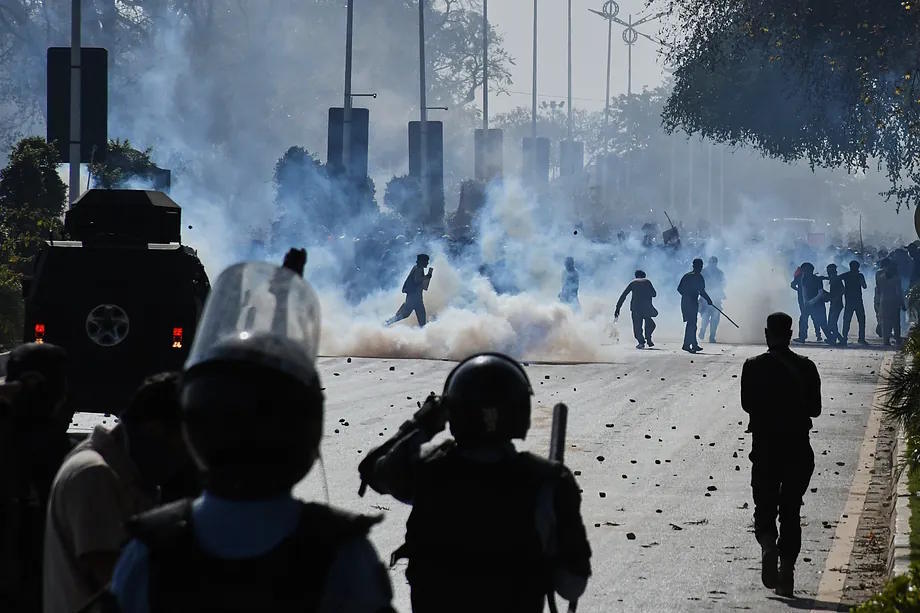
Even more serious were the clashes that erupted in the Pakistani city of Karachi, where the crowd even stormed the US consulate. Clashes with security forces left at least nine dead. "We are setting fire to the US consulate. We will avenge the death of our leader," said one of the participants in statements to the Afp agency. Another group of mourners set fire to the United Nations offices in the northern city of Skardu.
But the expressions of condolence were not unanimous, not even among the members of this faith. Videos from Iran showed residents of Tehran celebrating the disappearance of a leader they associate with the brutal repression they suffered last February, a mournful event that is far from being the first of its kind. According to Afp, some groups of Iranians took to the streets to proclaim joy, setting off fireworks and playing music in public upon hearing the news.