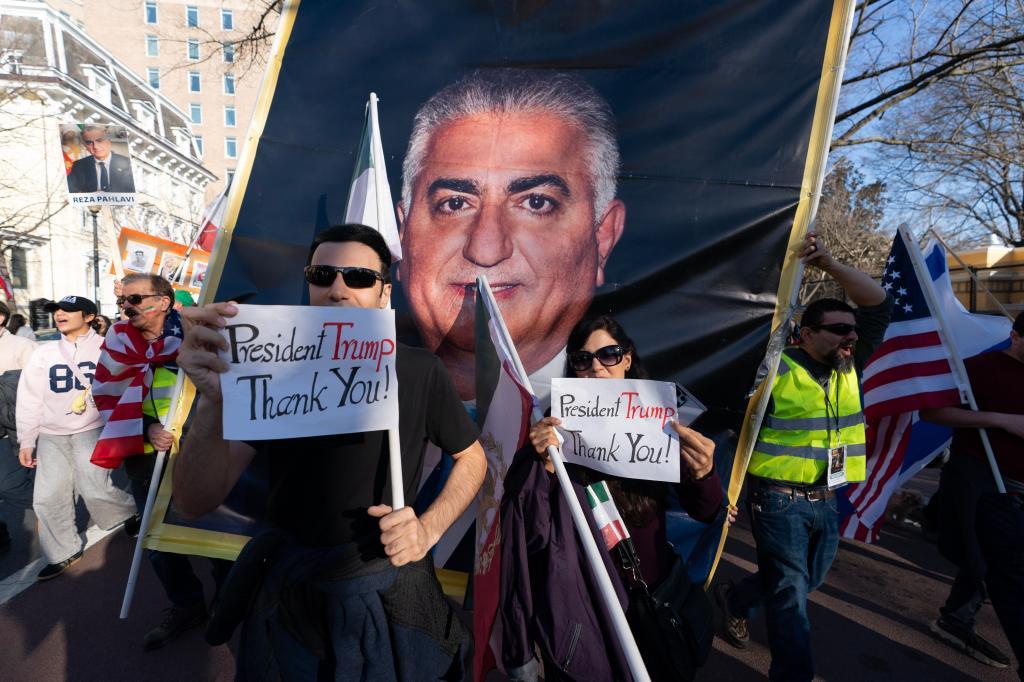
Reza Pahlavi has been for decades the main face of the Iranian opposition in exile, especially in the United States. For many, he is the comfortable option for the future of the West, a former combat pilot who from his mansion in Washington has campaigned for non-violence and a secular Iran. Throughout his long exile, Pahlavi has often felt that his opportunity, his moment, had arrived. But never like now.
Pahlavi was born in Tehran on October 31, 1960, seven years after the United States and the United Kingdom organized a coup against Prime Minister Mohammad Mosaddegh because he had nationalized the assets of the Anglo-Persian oil company, now known as BP. The eldest son of Mohammad Reza Shah and Shahbanou Farah Pahlavi, Farah Diba, the king's third wife, was named crown prince in 1967, during his father's coronation. He moved to the United States in the summer of 1978, upon reaching adulthood, to complete his training, but while he was away, the Revolution came, the monarchy fell, and he never returned. He studied Political Science, married Yasmine Etemad-Amini, and they had three children, with whom he lives in the outskirts of Washington.
"My compatriots, Ali Jamenei, the bloody despot of our time, murderer of tens of thousands of the bravest sons and daughters of Iran, has been erased from the pages of history. With his death, the Islamic Republic has come to an end and will soon be relegated to oblivion. Any attempt by the remnants of the regime to appoint a successor to Jamenei is doomed to fail from the start. Whoever they replace him with will have neither legitimacy nor longevity, and will undoubtedly also be complicit in the crimes of this regime," wrote the crown prince, as his team often calls him, on his social media account this Saturday.
"To the military, police, and security forces: any effort to preserve a collapsing regime will fail. This is your last chance to join the nation, to help ensure Iran's stable transition towards a free and prosperous future, and to participate in building that future," he urged the country's soldiers and agents in practically the same terms as Donald Trump, who in a video and a tweet promised "total immunity" to those who lay down their arms. The alternative, he told them, was "certain death."
The final part of Pahlavi's message was for the people. "The death of the criminal Jamenei, even if it does not bring back the spilled blood, can serve as a balm for the wounded hearts of the grieving parents, husbands and wives, sons and daughters in mourning, and the families of those who gave their lives in the National Revolution of the Lion and Sun of Iran. Honorable and brave people of Iran, This may be the beginning of our great national celebration, but it is not the end of the road. Stay alert and prepared. The time for a widespread and decisive presence in the streets is very close. Together, united and firm, we will achieve final victory and celebrate Iran's freedom throughout our beloved homeland," he added.
A controversial and divisive figure
Pahlavi is, for many, the best option in a transition to democracy. Or at least for the exit from the theocratic regime that has dominated the country since 1979. He has presented himself to the American administration as an interim leader, with support, infrastructure, and allies, capable of uniting the various factions inside and outside the country, on a path towards elections and a new Constitution. Also, using the codes that work best with Trump, he has stated that there is "a trillion-dollar business opportunity" for American companies in the country's reconstruction.
But for many others, he is a reminder that before the ayatollahs, there was no democracy either, but a family that imposed violence, punished the opposition, and enriched themselves. Or an agent (or at least the favorite) of Israel who, according to various analysts, has furthered his cause in recent months with disinformation campaigns on social media to make it appear that he has much larger on-the-ground support than he actually does.
In any case, the truth is that his popularity has increased in recent years, hand in hand with the secularization and modernization of civil society, social media, economic frustration, but also with a nationalist turn. His movement is now much more organized, effective, and professional. Also more aggressive. Capable of bringing together 250,000 people in the streets of a city like Munich, chanting "change for Iran," as he did a few weeks ago on the sidelines of the Security Conference that every year brings together all the heavyweights of the global Defense community in Germany.
For a long time, Pahlavi's discourse revolved around generic aspirations for democracy and freedom, ensuring that he was not seeking the restoration of the monarchy or even assuming power himself. He devoted all his time and energy to this, in constant contact with people in Tehran and with exiles from around the world, taking advantage of his fortune, never calculated, to do so.
After the protests of 2016, 2019, and above all, 2022, everything changed for the opposition leader. In 2024, Pahlavi announced that "at the request of his compatriots" he was prepared "to lead the national revolution and the transition period". The regime did not fall then, nor is it clear that it will now, but the religious military structure is weaker and more vulnerable than ever. "I too am preparing to return to the homeland to, at the moment of the victory of our national revolution, stand by your side," he said in mid-January in a video encouraging protesters to take to the streets.
Last Friday, the Shah's son published an updated version of what he calls 'Manual of the Emergency Phase of his Prosperity Project for Iran', a well-thought-out part of his strategy to rebuild the nation. The brochure focuses on the most urgent needs during the first six months after the potential collapse of the regime. It is probably not the best plan, but it is the closest thing to a roadmap.
His biggest problem is that this opportunity may have come perhaps 20 years too late. Trump has ordered the attack that none of his predecessors dared. And he is flirting with regime change in a way that only the most convinced neoconservatives dreamed of back then. On January 22, Pahlavi and María Corina Machado, the Venezuelan opposition leader who now also temporarily lives in Washington, had a meeting. "We have exchanged perspectives on our respective struggles and united our efforts towards a common goal: the liberation of Iran and Venezuela from oppression," they explained. "As authoritarian regimes deepen their criminal cooperation, those of us who defend freedom must coordinate even more closely," they added.
The struggles of both reflect this change in mentality in the great superpower and the elites, but above all in the White House. When the US invaded Iraq and overthrew Saddam Hussein, in Washington the prevailing feeling was that anything was possible. That after the fall of the USSR, the United States could achieve anything, especially by betting on regime changes and nation-building. The neoconservatives, then, were seduced and supported Ahmed Chalabi, an exile with good rhetoric and many contacts who convinced the George Bush administration that the Iraqis would welcome the soldiers with open arms and that he would be an unbeatable candidate to lead the country. "The George Washington of Baghdad," they nicknamed him. The disaster was absolute.
Many fear the same could happen now with the Shah's son. "Well, I've observed him, and he seems like a good person," Trump recently said of Pahlavi. "But I'm not sure it's appropriate at this time for me to meet with him as president. I think we should let them all come out and see who emerges," he concluded, speaking of the opposition. In recent weeks, in an effort to build bridges, the Iranian has increased his appearances on Fox News, the president's preferred network. He has criticized the Democrats while praising Trump and has been seen at all kinds of events within the conservative and Republican sphere. "President Trump will go down in Iranian history as the most celebrated foreign leader who changed the landscape and, as a result, the world," he said on television Saturday.
Courting the White House
Pahlavi has always been a divisive figure, both within and outside the country, especially among ethnic minorities. He has never acknowledged the crimes of his family's authoritarian regime, nor apologized for the torture. His top advisors and collaborators, moreover, often speak of revenge and violence, and are extremely combative, aggressive, and even threatening toward other sectors of the opposition.
"My plan is, first and foremost, the territorial integrity of Iran. Secondly, the clear separation of religion and state, an indispensable requirement for democracy. We have already paid the price, understanding what it means to live under a religious dictatorship. Thirdly, of course, the equality of all citizens before the law and individual freedoms. And, most importantly, the process, or democratic process, that allows the people to choose and decide what the future system of government will be," he said this weekend in an interview on the The famous CBS program 60 Minutes opened the door to a monarchy.
The Shah's son is not the only alternative, but perhaps the best positioned in Washington. That's why, in recent weeks, while courting Trump and his team, Pahlavi has hardened his tone toward his rivals, attacking other opposition figures like Nobel Peace Prize winner Narges Mohammadi, dismissing them or accusing them of being "leftists," "terrorists," and "wokes."
Analysts say it's difficult to estimate how many Iranians truly hope for Pahlavi's return, as he is currently using social media, satellite communications, and even radio extensively to reach citizens. His critics say he exaggerates his support and lacks the experience or training to lead a country he hasn't set foot in for almost 50 years. But he believes he does have the charisma, the backing, and the family name to make "Iran great again," using Trump's slogan. In the most recent opinion polls, about a third of Iranians said they supported Pahlavi, while another third strongly opposed him, according to data from Dutch pollster Ammar Maleki. But he is undoubtedly ahead in popularity than any other opposition figure.
"My dear compatriots, decisive moments await us. The aid that the President of the United States promised to the brave Iranian people has already arrived. This is a humanitarian intervention, and its target is the Islamic Republic, its repressive apparatus, and its extermination machinery, not the country and the great nation of Iran. However, despite the arrival of this aid, we will achieve final victory. We, the Iranian people, will complete this task in this final battle. The time to return to the streets is approaching," he insisted on Saturday night, once again encouraging protests.