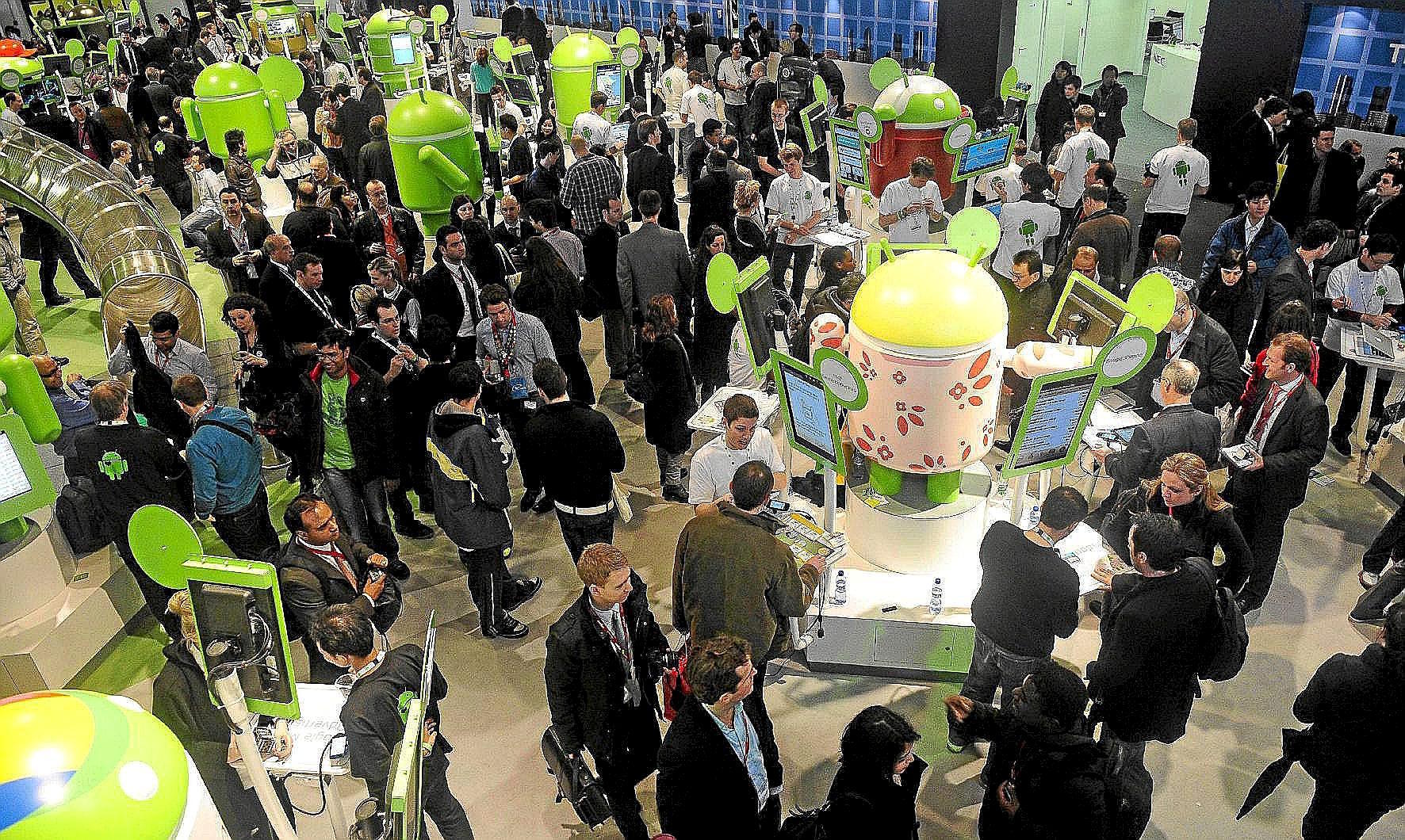
The Mobile World Congress (MWC) is no longer just a congress, and it's no longer just about mobile. This is the summary provided by its executives after the last 20 years of celebration. Little remains of the exhibition of computer devices, then known as 3GSM, which in 2006 decided to be held in Barcelona. The mobile novelties or computers from Nokia, Sony Ericsson, Alcatel, or Panasonic were the stars of the early editions, to which each year added models and more capabilities, such as Blackberry with email and professional apps, the arrival of GPS for cars, or the first smartphones and tablets.
The contrast example can be found in the content: companies no longer only present mobile phones at the MWC but all kinds of technological solutions (the most popular now being artificial intelligence or AI) in tools valid for any sector. Where once the latest MP3 model was sold, now a virtual operating room is exhibited, Boston Dynamics' robot dogs, AI solutions for agricultural production, or Satelliot's aerospace services alongside other satellite or quantum technologies.
So, the contrast example after 20 years can be measured with different variables. In numbers, attendance at the MWC has increased by 118% since the first edition (from 50,000 attendees in 2006 to 109,000 in 2025 according to MWC figures). Other numbers: GSMA, the organizing entity and trade association of operators and telecommunications companies, estimates its economic impact at around 7.5 billion euros (including the 585 million expected for 2026). Also illustrative are the dimensions: from occupying 40,000 square meters in its early years, the MWC now fills 240,000 square meters, with plans to occupy a new pavilion in 2028 (Hall Zero) that will add another 60,000 square meters to the venue.
"The change has been immense since that first Mobile World Congress," summarizes Francesc Fajuda, general director of MWC, to this media outlet. Immense in a strategic sense: "20 years ago, we talked about computing. And it was a cost, the lesser evil that organizations had to assume to have email, databases... A very unstrategic perception. Because 20 years later, there is no company in the world that is not a technology company." And indeed, in the initial editions, approximately 50% of the attendees were from the mobile telephony environment.
"Right now, 60% of people come from all industries worldwide," explains John Hoffman, CEO of GSMA. 25% of attendees are senior executives or representatives of international governments, details Fajuda. And all countries are invited to participate, unless they are subject to sanctions by the countries of the European Union or the United Kingdom, clarifies Hoffman. This is why Russia has not participated since 2022. However, despite pressures from parties like ERC or Comunes, the participation of Israeli companies is allowed, who will share space with other companies from Gaza and the West Bank.
The audience was a challenge that was maintained even during the toughest years of the economic crisis, marked by the absence of major firms like Nokia or Apple, but revived in the light of new technologies. The most critical year, both Hoffman and Fajuda acknowledge, was 2020 and the Covid-19 crisis, when the MWC anticipated the decree of health restrictions to cancel the event. The organization emphasized the uncertainty due to a virus that had already caused more than 1,100 deaths and 44,000 infections in China at the time, a country crucial for the sector and key in the development of the Mobile (resulting in 6,500 attendees), and the added difficulty in international mobility.
However, both agree that the following years were the most rewarding, regaining public attention. The audience has also diversified. Mobile manufacturers, telecommunications operators, digital companies, and politicians have found in the MWC the perfect stage for their major announcements and claims. From business alliances like Samsung and Vodafone in 2018 to counter Apple's growth, Telefónica's collaboration with 20 other telecommunications operators to create Open Gateway in 2023, or more cross-cutting partnerships like Vodafone and Aqualia to digitize water meters in 2024..., to the creation of the Spanish Society for Technological Transformation announced by the Government at the 2024 event.
In recent editions, European firms take advantage to demand less bureaucracy and regulation, as well as greater flexibility for major mergers, facing competition where they are hindered compared to the US and China. These tensions (through the company Huawei) also find a place at the MWC.
And while some of the initial appeals of the MWC to attract attention were to have celebrities like Robert Redford or singer Will.i.am walk through its halls, soon the bosses arrived to participate in the conferences: the event has hosted speeches from Elon Musk (Starlink) and Mark Zuckerberg (Meta). The latter attended the fair for the first time in 2014, just after acquiring WhatsApp, and his meeting with the (still) Prince and Princess of Asturias balanced the initial business snubs, later political, as a result of social tension in Catalonia.
Because, overall, these 20 years have been a reflection of technological and international evolution, but also of Spain's internal politics. The dates between February and March have been chosen to celebrate from labor strikes in transportation (Barcelona Metro, Ferrocarrils, VTC) to independence claims during the years of the procès.
Internal instability influenced the continuity of the MWC, although companies advocated for it to remain in Barcelona, as part of a commitment to Spain as a country capable of promoting major international events. In the most critical years, GSMA called for "stability and security" as the only conditions for the MWC to remain in the Catalan capital. This mobilized government investment, which reacted with contributions of 55 million euros in non-refundable funds for the MWC, committing another 110 million euros from the Generalitat and the Barcelona City Council to retain the congress until 2023.
Some confidence was restored to GSMA, which already has a contract for celebrations until 2030. Therefore, Mobile is here to stay.
Under the slogan The IQ Era (The Era of Intelligence), the theme will revolve around the definitive leap of the industry with AI already integrated transversally in networks, devices, and digital services. Specifically, in the ability to automate processes thanks to AI, redefine connectivity through advanced 5G, and explore the first developments related to 6G.
The event starts today, until next Thursday, and brings together the main global technology companies. GSMA estimates that it will attract around 110,000 attendees, with over 20% being senior executives.
Major corporations such as Cisco, Deutsche Telekom, Ericsson, Google, Huawei, Intel, Lenovo, LG, Meta, Microsoft, Netflix, Nokia, Qualcomm, Samsung, Telefónica, Tik Tok, and ZTE, will be present with their innovations at the event, as reported by Efe.