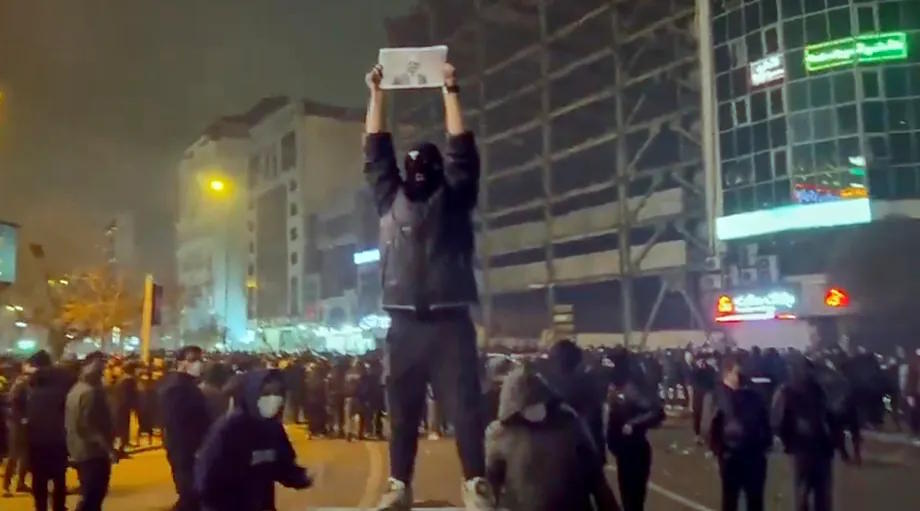
On the eve of the US and Israel attack on Iran, Reza Pahlavi, son of the former dictator overthrown in 1979 and now one of the leaders of the opposition in exile, engaged in a new public dispute with the new alliance of Iranian Kurdish parties, deepening the traditional division among opponents of the regime led by Ali Khamenei and questioning the possibility of a viable political alternative to the religious autocracy.
The dispute arose on Wednesday when Pahlavi accused the newly formed Iranian Kurdish Political Forces Coalition (CFPKI) of making "imaginary and absurd claims about Iran's territorial integrity and national unity," accused some of its members of collaborating with the late Iraqi dictator Saddam Hussein and the Iranian ayatollah Ruhollah Khomeini, and even issued a veiled threat, stating that those who try to "cross" what he defined as a "red line" will "face a decisive response from the Iranian nation."
The CFPKI was announced on the 22nd and is composed of the five most significant Kurdish formations in Iran, including groups such as the Party of Free Life of Kurdistan (PJAK), the Iranian Kurdistan Democratic Party (PDKI), or the Kurdistan Freedom Party (PAK).
Mohammad Nazif Qadri, a senior official of the PDKI - one of the historical groups of that community, which has been in armed opposition to Tehran for decades - stated that it is a "political-military alliance to overthrow the regime and liberate all Iranian Kurdistan from its control."
The leader of the PDKI, Mustafa Hijri, explained that the coalition's project includes "assuming the administration of the region" - the Kurdish provinces in the northwest of the country - after the hypothetical fall of the regime, and calling for elections to form "the governing bodies of Kurdistan."
The announced unity of Kurdish forces is an almost unprecedented fact given that the dozens of groups that operate in northwest Iran and the neighboring Iraqi Kurdistan also have a long and even bloody history of fratricidal clashes.
As Babasheikh Hosseini, the leader of another of the formations included in the agreement, Khabat, explained in a recent conversation at his base in Iraq, "the lack of Kurdish unity has always been a weakness that even led us to civil war (among groups of the same ethnicity)." "It is historic that we are now able to speak with one voice," he added.
Hosseini, like the rest of the Kurdish leaders, rejects the figure of Pahlavi as a possible alternative to the power of Ali Khamenei, recalling the troubled relationship the monarchy had with his community.
The Kurds and the Shah's dictatorship
Under the ultranationalist ideology of the Pahlavi dynasty - which ruled the country between 1925 and 1979 - the Iranian Kurdish community - between 8 and 10 million people - saw their language excluded from education and administration, and their cultural expressions restricted, as Tehran made efforts to promote Farsi throughout the country.
Throughout those decades, different Kurdish tribes rose up against central power, eventually establishing the only Kurdish republic in recent history, that of Mahabad in 1946, which was crushed by the Shah's soldiers within a few months. Kurdish groups rose up again in 1967 with the same fate. It was bloodily suppressed by the Iranian army.
"Pahlavi has never criticized the excesses of his father (Iran's last king). We want democracy, and Pahlavi wants to recreate his father's dictatorship. We are tired of being part of Iran. No Kurd will accept Pahlavi telling them what to do," Babasheikh Hosseini stated, surrounded by a group of armed followers at his base, not far from the Iraqi city of Erbil.
"We are not fighting against the religious dictatorship to replace it with another dictatorship," Mustafa Hijri had commented to this newspaper in another interview.
The Kurdish community actively participated in the overthrow of Shah Mohammad Reza Pahlavi, thinking that a new government could facilitate their autonomy aspirations, but their relationship with the new religious authorities that took power in Tehran did not improve.
On the contrary, after Kurdish forces, especially fighters from the Iranian Kurdistan Democratic Party (KDPI), took control of the main military bases and some of the cities where this population is the majority - including the symbolic town of Mahabad - and called for the establishment of Kurdish autonomy, Tehran reacted in the spring of 1979 by sending the army, leading to a bloody confrontation that left thousands of victims.
The conflict escalated after the brutal repression suffered by the city of Sanandaj during what was called "Bloody Nowruz" - it occurred on the eve of the emblematic Nowruz festival, the Iranian New Year, also celebrated by all Kurds - in March 1979, continued with the siege of the town shortly after, and reached its climax with the religious decree issued by Ayatollah Ruhollah Khomeini urging "holy war" against Kurdish "separatists" in August of that year.
The Kurdish uprising, one of many that population staged against Iran's central authority, was only crushed in 1980 but resurfaced in the following years. The main leader of the KDPI, Abdul Rahman Ghassemlou, was later assassinated in 1989 in Vienna by an agent of the Iranian authorities.
Meanwhile, Pahlavi and his top advisors have been publicly promoting a US and Israel offensive against Iran to end the religious autocracy. One of his main supporters, Saeed Ghassemi-Nejad, made it clear in a recent column published in The Jerusalem Post - Israel has become one of Pahlavi's staunchest supporters - that power should be handed over to the Shah's successor.
In recent days, Ghassemi-Nejad has made calls on social media for an armed uprising against Iranian government forces to coincide with the expected US and Israel airstrikes.
In an apocalyptic tone, Ghassemi-Nejad even predicted that Iran would suffer "power outages, destruction of telecommunication facilities, fuel shortages, or food scarcity" due to the chaos scenario he envisions.
The disagreements between Reza Pahlavi and the Kurdish groups are just a reflection of the deep fragmentation that the opposition to the Iranian religious autocracy has suffered for decades, which not only includes Pahlavi or the Kurdish formations but also a myriad of formations such as the Mujahideen-e-Khalq radicals - a group that was considered "terrorist" for years even by the US - and internal opposition groups, also fractured among civil groups, unionists, or reformists who operated in the orbit of figures like former presidents Mohammad Khatami and Hassan Rouhani, former Prime Minister Mir-Hossein Mousavi, and cleric Mehdi Karroubi.
As recently stated by Foreign Affairs magazine, the nebula of adversaries to Tehran is "like an archipelago of political islands divided by geography, generation, ideology, and exposure to repression," as prone to mobilize against the clerics in power as they are to quarrel among themselves.
Many experts point out that the lack of a solid project as an alternative to Saddam Hussein's dictatorship in Iraq led to a horrific civil war and the emergence of projects as outlandish as the Islamic State.
The repeated armed clashes between Tehran and Kurdish groups - whose bases in Iraq have been bombed by Iranian missiles and drones in recent years - have also multiplied in the southeast, near the border with Pakistan and Afghanistan.
According to local reports, last Tuesday, IRGC personnel killed six militants from Jaish al-Adl, a jihadist group that operates mainly in the Sistan-Baluchestan province, bordering Pakistan.
Subsequently, the Iranian chain Press TV indicated that other units of the Iranian forces had dismantled a network of activists in the southeast of the country, arresting eight people and killing three others.
An insurgent faction, the self-proclaimed People's Front of Fighters (MPF), acknowledged that half a dozen of its militants had died in clashes with another Baluch group, which is allied with the central power.
Jaish al-Adl is the most active faction that emerged from the decline of its main predecessor, Jundallah, whose leader was Abdelmalek Rigi, captured in 2010 and subsequently executed.
The leaders of Jaish al-Adl announced last December another broad coalition of Baluch forces that, in addition to promoting armed struggle, planned to activate a civil opposition front in the areas where their community resides.