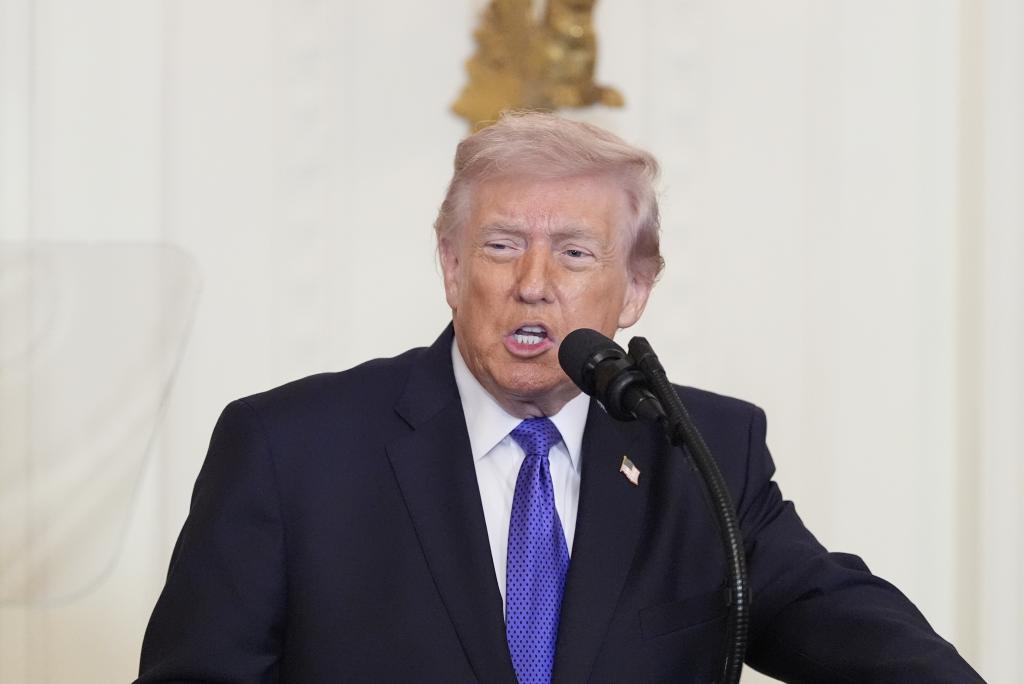
The President of the United States, Donald Trump, and his government are rewriting the playbook, the philosophical foundations of their ideology, and their red lines on the go. Trump came to power leading the MAGA movement (Make America Great Again) saying, "I am not going to start wars, I am going to end them." "No more wars, no more disruption, we will have prosperity"; "I am the candidate of peace." But since returning to the White House, he has bombed seven countries, captured Nicolás Maduro forcing a change within his regime, and ended the life of Ayatollah Ali Jamenei and nearly 50 senior Iranian officials. The "candidate of peace" who mocked "warmongers" and those who "advocate for regime changes" and call themselves "nation builders" is now immersed in a new conflict that is gradually escalating at a regional level. And this Monday, going even further, he stated, causing a new shock among his supporters and voters, that he does not even rule out the deployment of troops in Iran.
"I am not bothered by the deployment of troops on the ground. All presidents used to say 'There will be no troops on the ground.' I don't say that. I say 'they probably don't need them,' or 'if they were necessary,'" the President responded on Monday to The New York Post, a sensationalist and conservative newspaper that quickly dedicated its entire front page to the issue with the headline: "Soldiers on the ground." For the U.S. President, "the big wave" of attacks is yet to come.
"I think the polls are very good, but I don't care. I have to do the right thing. I have to do the right thing. This should have been done a long time ago," added Trump when asked by the media about the lack of public support. An urgent Reuters/Ipsos poll conducted over the weekend shows that only 27% of Americans approved of the attacks, while 43% disapproved and 29% were unsure. Pre-attack polls, the newspaper says, "showed similar minority support for a possible war."
Trump's statement must be taken with caution. Since Saturday morning, he has spoken with dozens of journalists in short interviews, and to each one, he has provided a different fact, opinion, or view. His response seems to have more to do with the possible lack of voter support, especially from the MAGA world, clearly hostile to wars in the Middle East and which in the last 48 hours has expressed its discontent in very harsh terms, than with a possible military strategy. But the President, who knows communication in the age of infinite scrolling better than anyone, has not made a slip. He wanted to send a message, or several.
Just an hour earlier, Defense Secretary Pete Hegseth did the same: an open response that did not rule out the sending of troops. Any communication advisor knows that in response to such a question, anything other than a clear, unambiguous denial will be turned into headlines. Still, Hesgeth, a former television presenter, stated that the Government, the Pentagon, and the President were not going to engage in games or give clues to anyone about their objectives, methods, and limits.
"There are no soldiers in Iran right now, but we are not going to engage in discussing what we will or will not do. I think it is one of those fallacies that have been committed for a long time, that this department, presidents, and others tell the American people, and our enemies exactly what we are going to do, how long we will be there, exactly how far we will go, what we are willing to do and what we will not. It's nonsense," he stated at a press conference at the Pentagon alongside the generals.
"President Trump will ensure that our enemies understand that we will go as far as necessary to promote U.S. interests. But we are not foolish about it. There is no need to send 200,000 people there and stay for 20 years. We have shown that objectives that promote U.S. interests can be achieved without being foolish. Now, will we be bold? Are we willing to be decisive? Do we dedicate months and months to planning the effects we want to achieve? Absolutely. But there is no reason to tell you, the enemy, anyone, what we will or will not do to achieve a goal. We fight to win. We fight to achieve the objectives that the President of the United States has set, and we will do so without hesitation," Hegseth insisted.
In his remarks, the Secretary of Defense continued in that vein, admitting that the U.S. is at war but that it will not be "an eternal war" like those in Iraq or Afghanistan. "We did not start the war, but we will finish it," he also said without explaining how Iran started it.