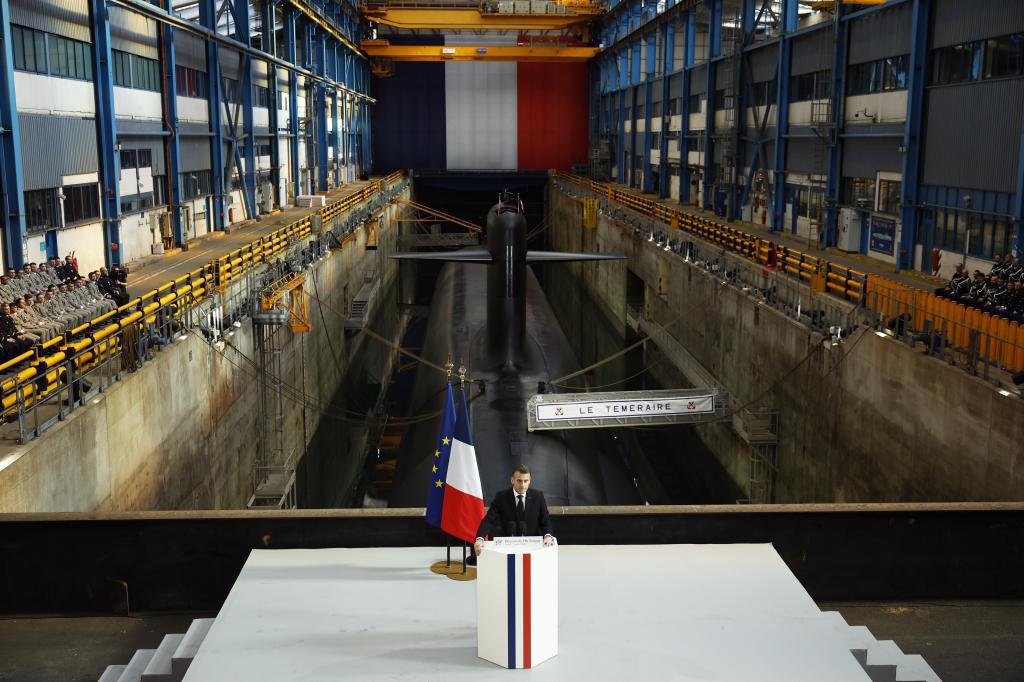
Eight European countries have joined the "advanced deterrence" plan announced on Monday by President Emmanuel Macron, who has decided to increase the French nuclear arsenal and give it a continental dimension in the face of "a period of political turmoil fraught with risks." An hour after the emblematic speech at the Île Longue base in Brittany, France and Germany made public the decision to create a "high-level nuclear steering group" that will become operational this year.
"We must strengthen our nuclear deterrence in the face of a combination of threats and reflect on our deterrence strategy deep within the European continent, while fully respecting our sovereignty," Macron emphasized, following the announcement that some analysts see as the first step towards the creation of a European nuclear umbrella.
Throughout his speech, Macron made constant references to Russia and "the conflict in the Middle East, which will continue to bring instability and potential conflict to our borders." The French government also announced its readiness to "participate in the defense of Gulf countries and Jordan" against Iranian attacks, with Macron himself warning that France will "strengthen its defensive support positions with countries with which we have defense treaties."
With a nuclear submarine as a backdrop, Macron confirmed a 180-degree shift in the strategic use of French deterrence force (estimated at 290 warheads), previously considered part of the country's "nuclear autonomy strategy" and not integrated into NATO (unlike the 225 warheads of the United Kingdom). "I will not hesitate to use this weaponry to protect our vital interests," Macron stressed.
The French president announced his intention to increase the number of nuclear warheads and at the same time acknowledged his intention to reach agreements on "advanced deterrence" with eight European partners, especially in countries on the "frontline" such as Germany, Poland, Sweden, Denmark, the Netherlands, or Finland. Macron also added Greece to the initial list (Spain and Italy have so far adopted a cautious stance).
"Germany will be an important partner in this effort," Macron highlighted, also emphasizing close collaboration with the United Kingdom in nuclear and long-range missile matters. Among other forms of collaboration, France could discuss with its allies the possibility of deploying its Rafale fighter jets equipped with ASMP-A missiles in other European countries. The four French nuclear submarines, recently equipped with the latest generation of M51.3 ballistic missiles, could also be included in future European security missions, as has recently been the case with the Charles De Gaulle aircraft carrier, which made a stop in Malmö, Sweden.
"Europeans have become accustomed to their security depending on security standards established by third parties," Macron warned in his 40-minute speech. "Let's be clear: that was the European security architecture with agreements dating back to the Cold War. (...) Our era demands a different approach. We must rebuild the rules. What I most desire is for Europeans to regain control of their own destiny."
In a somber tone, Macron predicted that "the next half-century will be an era of nuclear weapons." "The global architecture for nuclear arms control is so weakened that it resembles a field in ruins," he said, "and this does not contribute to fostering the necessary trust to rebuild collective security standards."
Macron emphasized how "Russia's slow and cruel war against neighboring Ukraine poses a serious risk to Europe." "This same Russia, embracing revisionism and brutal imperialism, continues to develop new weapons, such as hypersonic nuclear missiles, nuclear torpedoes, and even a particularly dangerous project for humanity involving the launching of nuclear weapons into space," added the French president.
"The last six years have weighed on France and Europe like decades, and the last months like years," Macron concluded. "Our competitors have evolved, and so have our partners. The world is becoming more challenging, and the past few hours have once again demonstrated this. Therefore, it is my duty to announce with seriousness to the nation a change commensurate with our national and European challenges."