Lebanon started a new chapter of that cyclical script in which it seems trapped for decades. A narrative where the characters, like Abu Ali, are so tired of playing the same role that they respond wearily to the visitor.
"What's the point of talking? Is anyone going to change our lives? Do you know how many times I've had to flee my home since I was born (I'm 55 years old)? 12 times! Back and forth like a suitcase!" explained the Lebanese man mid-morning, leaning on a corner waiting to decide where to continue his escape.
Abu Ali was one of the hundreds of thousands of Lebanese who woke up in the early hours, just before 3 in the morning, startled by a wave of explosions that shook the capital of the Arab nation.
This reignited the war that began in 2023 and had only partially calmed down after the precarious ceasefire signed by Hezbollah and Israel in November 2024. A relative ceasefire, as the Tel Aviv forces had ended the lives of hundreds of irregular group militants and many civilians since that date.
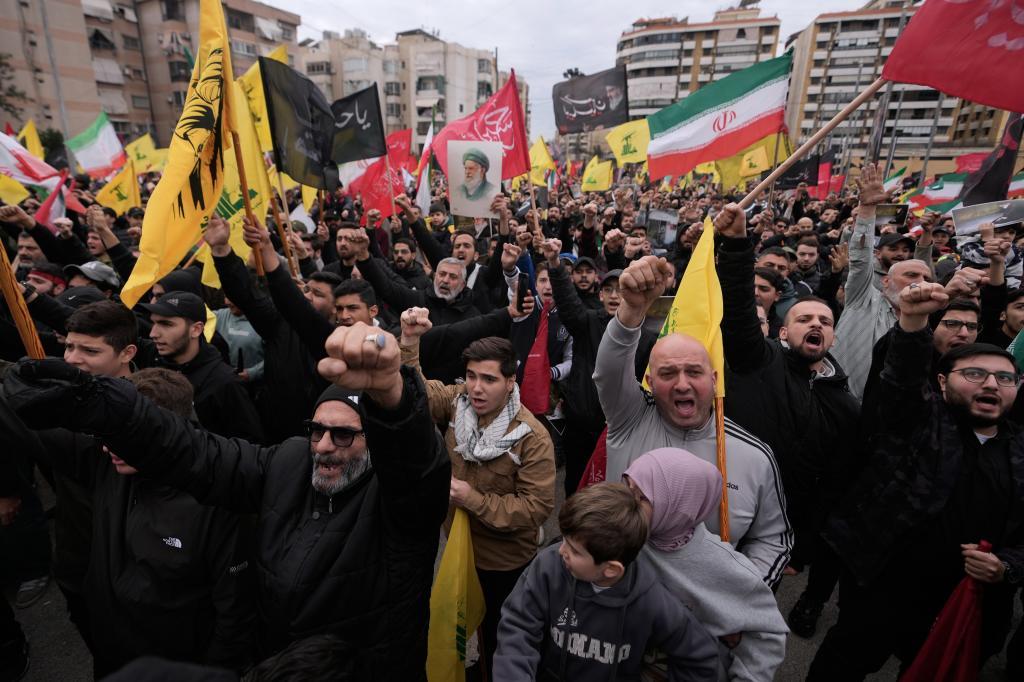
The death of the top Iranian leader, Ayatollah Ali Khamenei, revived the confrontation after the paramilitaries now led by Naim Qassem launched several rockets and drones against Israeli territory, dragging Lebanon into the devastating regional conflagration initiated by the joint Israeli and US offensive.
The Party of God had warned that it considered the late Khamenei as a red line since the Iranian cleric was not only their main political support but also their spiritual guide, a key element in the ideology of a group where religion is crucial.
Immediately after the Israeli salvo in the early morning, a human flood began to escape from Dahiyeh, the southern neighborhoods of Beirut where Hezbollah has its headquarters. They did so in cars, creating a massive traffic jam shortly after 3 in the morning; on motorcycles, where up to four people piled up with their suitcases; or on foot, dragging the few belongings they could hastily gather.
The honking of car horns mixed with the gunfire of armed men who thought they could restore order with their bursts but only managed to increase the frenzy of the population.
"It was like an earthquake! Just like when they killed Nasrallah!" said Ahmed Shoboh, catching his breath next to the other five members of his family, by a road in Dahiyeh where the smell of smoke lingered.
The scenes were a replica of those seen in September 2024 when Israel launched a general offensive against Hezbollah, causing the exodus of nearly a million people and the death of almost the entire leadership of the group, including its leader, Hassan Nasrallah.
The setting repeated itself. Martyrs' Square once again seemed reserved for the most excluded, the Syrian refugees who arrived in Lebanon years ago fleeing the violence that ravaged their country.
Amina Mahas left Aleppo six years ago. In 2024, she ended up displaced in Tripoli, in the north of the country. This Monday, she was trying to figure out her immediate future with her three children. They had spent the night outdoors, sitting on the ground. "I have no idea where we are going to go", she admitted, shrugging her shoulders.
Dozens of families gathered around the palm trees of the famous corniche - the seaside promenade - of Beirut or congregated in the same abandoned hotels that were used as makeshift residences for the displaced before.
At the same time, thousands of vehicles were stuck in southern towns like Sidon, trying to move away from the fifty or so villages marked by Israel as targets.
The Haidar clan, led by the 62-year-old father, Ali, had not slept a single hour. They reached the capital's waterfront after walking for several hours. "There was no way to move forward with the cars. It was all chaos," he recalled. Mechanically, they returned to the same place they fled to in September 2024, and he, like back then, was now pondering what their next refuge would be. "We are fed up. If a ship appeared now and offered to take us to India, we would board without hesitation," he said wearily.
The luckier ones, if that can be considered luck, ended up in schools that had already been used as shelters just over a year ago.
The Hariri High School, named after the slain Prime Minister Rafic Hariri, housed over 200 families. Among them was Hassan Misilman's family. "We have had to move seven times since 2023. I lost my home in Merkaba (the southern village where I'm from) and then the one I rented in Dahiyeh," said the 49-year-old Lebanese man.
The absolute weariness shown by almost all those interviewed was not only directed towards Israel but, for the first time, several members of the Shiite community openly criticized Hezbollah for getting involved in yet another conflict when the country is far from having recovered from the last one.
"Have they gone crazy? Was Khamenei Lebanese?" indignantly expressed Hussein (who declined to give his last name) when commenting on what had happened.
In fact, Hezbollah's decision confirmed its progressive isolation from the majority of local communities, whose leaders reacted by harshly criticizing Iran's allies.
The government of Prime Minister Nawaf Salam, in coordination with President Joseph Aoun, declared the armed wing of Hezbollah illegal, an unprecedented event in the country's recent political history, triggering a deep internal crisis since the Hezbollah leadership has always stated that any attempt to confiscate their weapons will lead to a new civil war like the one Lebanon suffered in the last century.
"The decision of war and peace depends exclusively" on the State, and that "implies the immediate prohibition of all military activities of Hezbollah and its obligation to surrender weapons," Salam stated after a turbulent emergency meeting of his cabinet, which curiously includes two ministers from the paramilitary group.
Salam also dismissed the apprehension of a fratricidal confrontation. "Threats of civil war no longer convince anyone; there is no internal division, and the vast majority of Lebanese are against these actions," he pointed out.
The Shiite irregulars did not even garner the support of their former Christian allies from the Free Patriotic Movement, whose leader, Gebran Bassil, stated that "a war to support Iran will bring us more ruin without saving Iran."
Just minutes before 4:00 PM, another powerful explosion shook the Lebanese capital again. "Attack," shouted one of the waiters at a central restaurant, with the monotonous tone attributed to events that no longer come as a surprise.
It was the first of the umpteenth round of detonations that occurred throughout the night, raising huge columns of smoke from the aforementioned suburb of Dahiyeh. The ruins left by the destroyed buildings in the last hours will blend with those that had not even been cleared after the wars of 2023 and 2024.
Lebanese authorities estimated that at least 52 people have died in the last hours, most in the capital's suburbs, and 154 have been injured.
Israel acknowledged hitting nearly 70 targets linked to the paramilitaries, including "weapons depots" and missile launch ramps, but also facilities of the parallel banking system maintained by Hezbollah.
Tel Aviv specified that among the dead are prominent party leaders such as its intelligence chief, Hussein Moukalled. Defense Minister Israel Katz added that Nasrallah's successor, Naim Qassem, is also among those they want to kill.
For Abda Sayeg, 53, the political calculations of both sides mean very little. All he wants is for his four children and his wife to be able to aspire to something more than the sofa that is now their "home" in one of the rooms occupied by displaced persons in the city center. "You in Spain talk about soccer, and we have to be content with talking about wars," he said with his head bowed.