When Israel attacked Iran in June 2025 - known as the Twelve-Day War - one of the bombings in Tehran hit the building next to Ameneh Barahminava's house, so that remains of corpses reached her yard. Ameneh is the first person we call to gather the feelings of Iranians living in Spain about what is happening in their country, but she does not answer the phone. Two decades ago, a university classmate who she rejected blinded her by throwing acid on her, and she moved to Barcelona seeking a miraculous medical treatment to restore some light to her eyes. In 2008, the trial against her attacker took place, and she requested that he be literally blinded in retaliation. The Iranian justice system granted her the right to blind the man who attacked her by pouring acid in his eyes. The sentence made headlines worldwide as an example of the brutality of the Islamic Republic that the US and Israel are now trying to end, and Ameneh gained international recognition. On July 11, 2011, when the convict was already in the medical room waiting to have acid applied to his eyes, she forgave him in exchange for a compensation of 150,000 euros.
If Ameneh does not answer the phone, it is because she is in Tehran demanding the payment that she has never received, even though he is already free.
"She is with my mother at home. I told them: 'Don't be afraid, the war will be short, don't go out, eat what you have at home'." Ameneh's sister, Shirin, speaks from Barcelona, who moved to Spain 22 years ago to be her sister's guide, to help her. "I am very tense, on one hand I am bothered that they are attacking my country and the people, and on the other hand I remember that last month 43,000 people were killed," says Shirin, referring to the deaths in Iran during the government crackdown on the 2025-26 anti-government protests. "I feel relief for the death of Jamenei, his sons, and the top Iranian leaders, but it is a very strange feeling for me because those who know me know that I am a person of peace, I never wish death upon anyone... I have conflicting feelings," adds Shirin, a graduate in Spanish Language and Literature, who works advising Iranians on paperwork to open a business or apply for residency.
Divorced in Iran - "I was able to do it because he requested it, the right to divorce is held by the man" - she experienced firsthand the oppression of the theocratic regime - "the morality police stopped me a thousand times just because my clothes were light-colored even though I was well covered - but what she most reproaches the regime for is the poverty in which, she claims, the population is immersed. "We have gold mines, oil, the best saffron in the world, pearls... but people beg, people sell their organs, women prostitute themselves to feed their children. Everything is nationalized and controlled by the State. They and their children take the money and live abroad as rich people," says Shirin, who does not see Reza Pahlavi, the exiled Shah's son in the US, as the solution. "First, he does not live in Iran; and second, his followers are other dogmatists. We want a liberal Iran, not people who want to do the same as the ayatollahs but in a different way."
Parsa Jafari is 29 years old, a DJ, music producer, and promoter, and arrived in Madrid with his parents two decades ago when he was 9 years old. When he turned 18, they all returned to Iran because he had to fulfill military service. Only he returned to Spain. "There, electronic music is illegal, punishable by death. During the three years I was there, I organized illegal parties with other artists, basically risking my life, but thanks to us, electronic music entered the country," he says.
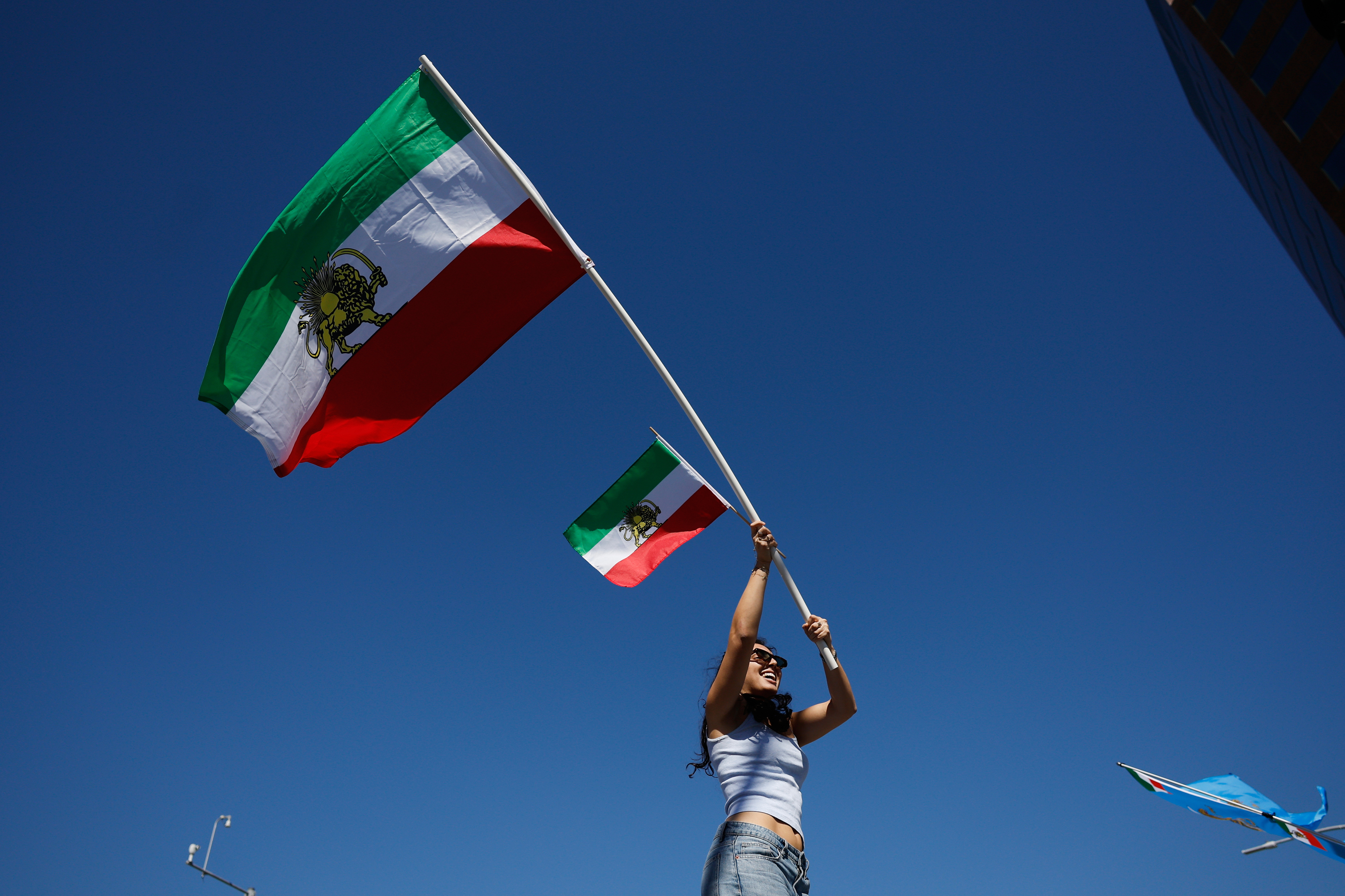
"My mother and sister, who are experiencing everything firsthand, tell me that people are happy about this war, they needed it. People have missiles aimed at them and dance in the streets because they know that this war is not against them but against the Islamic Republic," says Parsa, in favor of Reza Pahlavi taking the reins of Iran. "Let our king return, let our Shah return."
Fariba Ehsan is the president of the Iranian Association for Human Rights (AIPDHE). She is 60 years old and arrived in Spain 30 years ago after divorcing in Iran. "Since 2009, we have been demanding a change of government but a democratic change, from within Iran and in the hands of Iranians," says Fariba, opposed to a regime change by force. "Wars do not bring democracy or freedom, they leave the country destroyed."
Activist Mediss Tavakkoli is 38 years old and has been living in Spain for four years. She is one of the many Iranian women who have protested in Madrid against the repression of the Iranian regime. "The real terrorists are the Islamic Republic; if there is any danger to Iran, it comes from the regime, not from the US or Israel," she says. "I am happy that President Trump and President Netanyahu are fulfilling our wish."