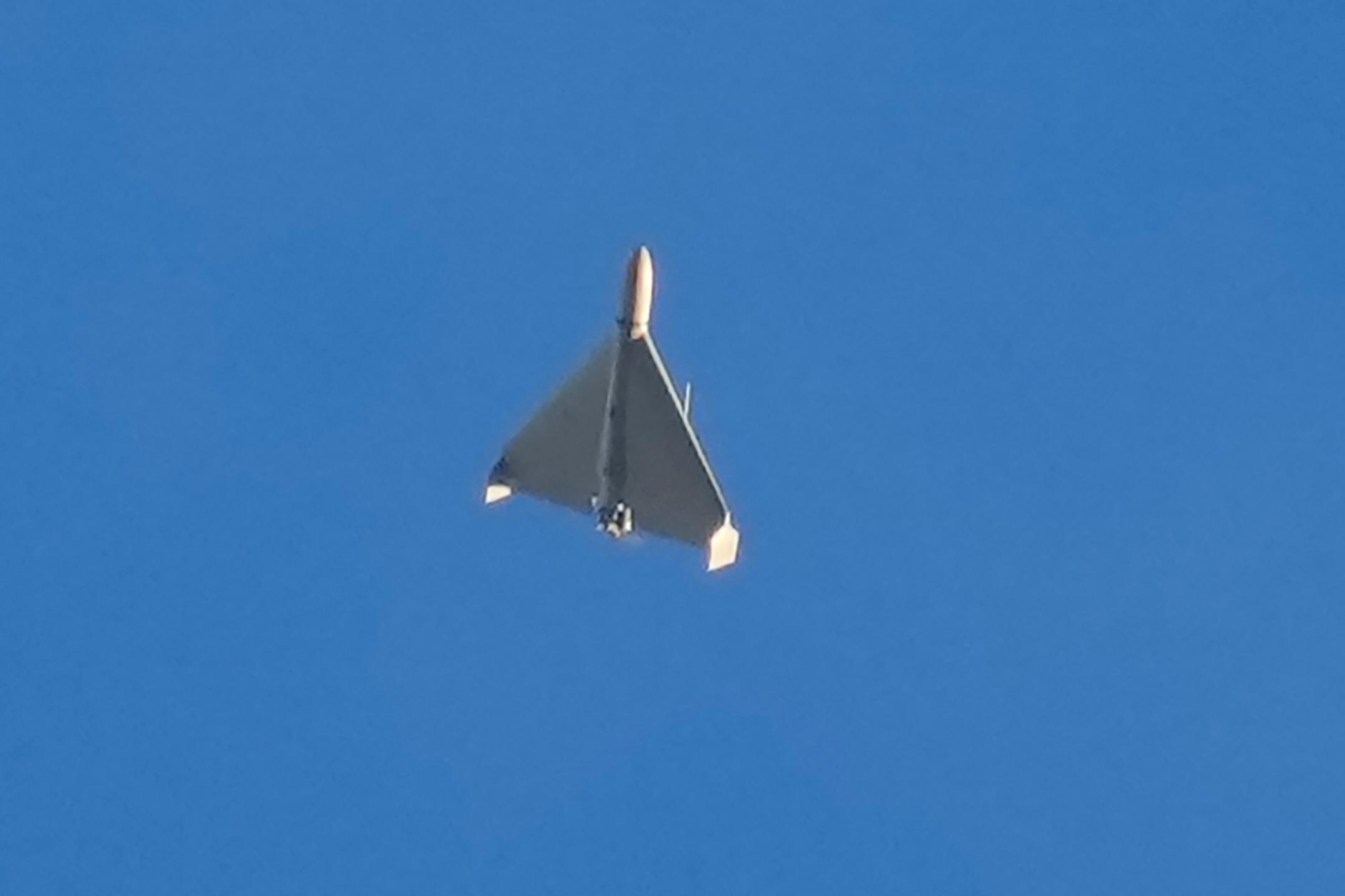
The name "Shahed," which means "martyr" in Persian, accurately defines its operational purpose: these small aircraft are designed for one-time use, meant to explode upon impact with their target. Known technically as Geran-2 in its Russian-manufactured version, this device is classified as a kamikaze-type "loitering munition."
Physically, the Shahed-136 features a distinctive truncated delta wing shape, with a central fuselage merging into the wings and stabilizer fins at the tips. With a length of 3.5 meters and a wingspan of 2.5 meters, this approximately 200-kilogram artifact is powered by a rear-mounted engine driving a two-blade propeller in a "pusher" configuration. This technical setup allows it to reach speeds exceeding 185 kilometers per hour and an impressive flight range of around 2,500 kilometers before its final impact.
The main strategic advantage of these drones lies in their price, estimated at only 20,000 euros per unit, a negligible amount compared to conventional weaponry. Due to this low cost, they are often launched in massive waves (in batches of five or more) from mobile launch platforms to overwhelm enemy air defenses, forcing them to deplete their expensive resources on economic targets. Although their nose carries a modest warhead of between 30 and 50 kilograms of explosives, their impact is highly effective against ground targets from a distance.
However, the drone has clear technological limitations: its low technological level hinders its ability to successfully target mobile or challenging objects, unlike more sophisticated models like the Turkish Bayraktar. Despite this, its frequent use in current conflicts has shown that airspace saturation can be as destructive as high technology, posing a persistent threat to infrastructure and civilian populations.