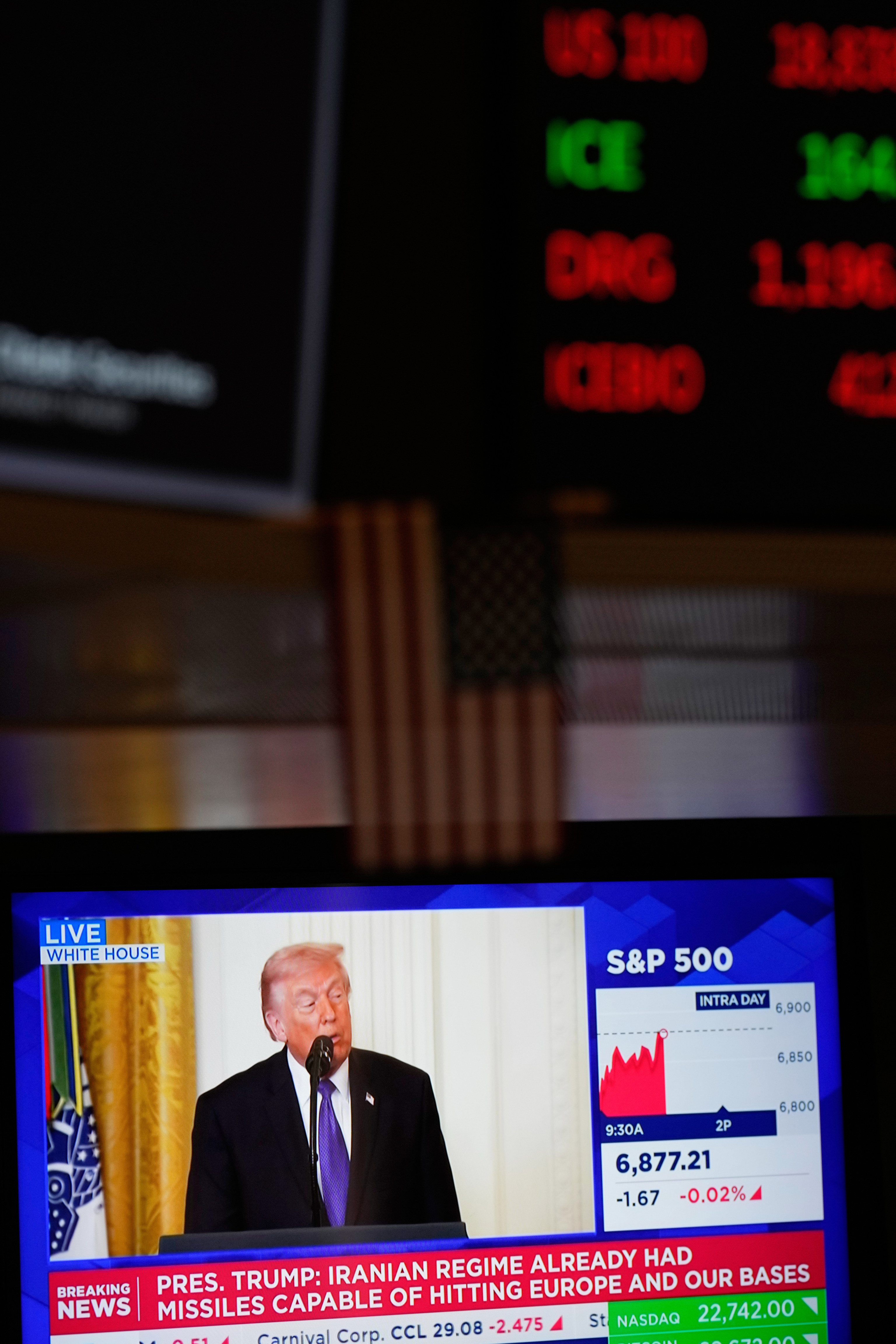
It is unknown how long the US and Israel's war with Iran will last, or how long the blockades or sieges on key trade points in the Middle East will endure. But what is known is that the prices of oil and gas keep increasing, and business activities persist.
Amidst this, markets worldwide are experiencing another day of losses in trading. A shock due to the war in Iran that analysts believe will be strong but temporary. Today, for now, it leads to a day of stock market plunges for everyone.
The latest market to open this Tuesday was Wall Street: the Dow Jones industrial index started its session with a 0.84% drop, the tech-heavy Nasdaq followed suit with a 2.01% decline, and the S&P 500 retreated by 1.18%. Not surprisingly, as their futures were already indicating a drop of over 2% before the opening amidst the escalating tensions in Iran. However, the significance of this opening lies in the fact that, despite yesterday being a day of losses, at the close of the American markets, the S&P 500 and Nasdaq managed to rebound, offering some hope for stabilization today.
It is worth noting, however, that the volatility index, the VIX, stood at 26 points at the same time, indicating that markets are at a high level of uncertainty and, therefore, turbulence. Meanwhile, analysts from firms like Bankinter maintain this Tuesday that the war in Iran will have a "limited and transitory impact on the market and will soften throughout the week."
In Europe, at the bell on Tuesday, the Euro Stoxx 50, which includes major companies in the Old Continent, plunged by 1.8%, a situation that worsened with falls exceeding 3.7% at the opening of Wall Street. The critical session in Asia continues from hours earlier, where all indices have fallen, with South Korea's Kospi being the hardest hit with a 7% drop.
Today, the situation in European markets is deteriorating further. In Spain, the Ibex started the day with a 1.54% drop, but before noon, its plunge reached 4.5%, with all its companies experiencing stock losses. Only Repsol, at times, managed to be on the gaining side. The rest of the Spanish listed companies are in the red. Particularly severe are the declines of Acciona, Naturgy, Sacyr, Solaria, Acerinox, Banco Santander, and ACS. In the case of Naturgy, the decline in the value of its shares is due to the war context and also following the news last night that Blackrock, through GIP, was withdrawing from its capital, prompting a board restructuring.
In other European cases, the German DAX that started the day with a 1.9% drop, by midday was down by 3.73%. The Paris stock exchange fell by 1.3% at the start of the day and plummeted by 2.93% by midday. The same goes for the London Stock Exchange, whose initial 1% decline grew to 2.88% in the European midday session.
Meanwhile, the conflict continues and trade tensions escalate. Last night, new threats from the Iranian Revolutionary Guards to "burn any ship" attempting to cross the Straits of Hormuz or to attack oil pipelines were revealed. While yesterday's reaction was negative but moderate, markets are becoming increasingly uneasy about the sharp rises in gas and oil prices in the context of a war with no set timeline by Donald Trump.
As it is becoming evident, the key lies not in the stock market but in the commodities market, which dictates everything else. Oil continues to rise in price, reaching an increase of 8% at the opening of Wall Street, setting its price at $83 per barrel. This is its highest price since July 2024, according to Reuters. Additionally, while gas surged by 25% in the European opening, it rose by 40% in the American market, matching the significant increase from yesterday following the closure of one of QatarEnergy's largest plants. Meanwhile, gold is cushioning the price hikes, as although the ounce was trading at $5,250 at noon, it reached $5,400 yesterday.
In Asia, despite Monday's session not being particularly critical, the plunges have arrived on Tuesday. Tokyo's main index, the Nikkei, plummeted by 3.06% on Tuesday. In Seoul, its stock market dropped by 7%, while Hong Kong's index closed with a 1.1% decline. The cuts in stock prices were widespread, more critical in the defense and shipping sectors, which had seen significant gains in the previous session. It is important to remember that one of its giants, China, remains the largest buyer of Iranian oil (accounting for 90% of its exports).
Renta 4 analysts warn that today's focus will be on whether the crossfire reaches more energy infrastructures, with fears that it could lead to the shutdown of operations at the Ras Tanura refinery in Saudi Arabia due to Iranian actions (which could prompt the country to join the US and Israel in the war against Iran). Also, the fact that QatarEnergy has already halted the largest LNG export facility should not be overlooked. The country controls 20% of the global supply of liquefied natural gas, accelerating the energy price hikes that continue today.
Furthermore, in the same context of high uncertainty, in the bond market, the yield on the Spanish 10-year bond has reached 3.232%, an intraday increase of nearly 0.2%. What stands out is its risk premium against the German bond, the European benchmark, which has risen by 0.6% since yesterday, reaching 43.8 basis points.