For decades, the name yakuza evoked a mix of fear and fascination in Japan. Their hierarchical and violent clans, with almost feudal codes of honor and offices with visible nameplates, were a tolerated anomaly in a country obsessed with order. But something has changed in the underground of the Asian archipelago.
While the old bosses age, a new criminal creature advances and begins to make a lot of noise: the tokuryu. The term - an abbreviation to designate "anonymous and fluid criminal groups" - was coined by the National Police Agency of Japan (NPA) a decade ago.
After years of legal offensives against the major mafia syndicates, the noose around the yakuza tightened, suffocating much of their traditional operations. Blocked bank accounts, banned labor contracts, restricted rentals, and tax persecution: the Japanese state turned yakuza membership into a social and economic burden.
In the 1990s, when American journalist Jake Adelstein began investigating organized crime in Tokyo - an experience he later turned into the bestsellerTokyo Vice - the number of yakuza affiliates exceeded 80,000. Today, it barely reaches around 24,000, with the average age of its members over 50. "There has been no generational turnover," explains Adelstein to this newspaper. "The bosses are elderly and their influence has plummeted."
The result, according to sources from the Tokyo Metropolitan Police, was not the disappearance of organized crime, but its mutation. Unlike traditional yakuza, the tokuryu lack a fixed structure and do not show up as much in the public eye. They have no offices or business cards. They operate in the shadows as more hidden networks that recruit through fake job offers on social media, forums, and encrypted messaging apps, especially on Telegram.
THE NEW BOSS COULD BE A DELIVERY PERSON OR A STUDENT
Unlike the old tattooed gangsters, the tokuryu do not display a criminal identity: they are laborers, delivery persons, students, and precarious workers, without gang tattoos, who enter and exit the world of crime as easily as they change jobs. "It's not easy to trace these new groups because, unlike the yakuza, they are decentralized and not seeking recognition, but profitability," explains one of the Tokyo agents investigating these mafias.
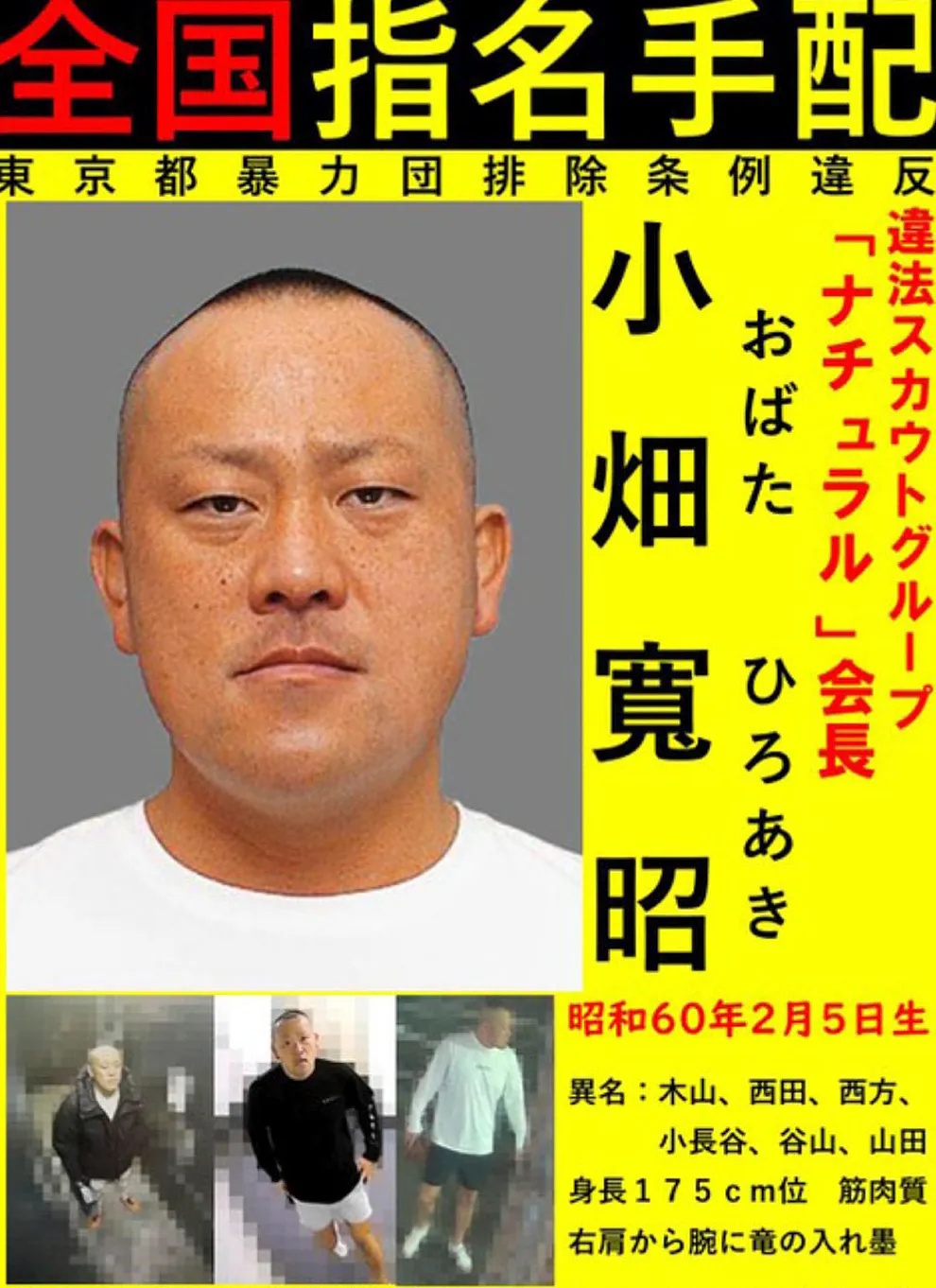
This fluid nature is much harder to track. But authorities are stepping up their efforts. In January, the Japanese police announced the arrest of one of the leaders of a major tokuryu group. Hiroaki Obata, 40 years old, was arrested on Amami Island, in Kagoshima Prefecture. He is accused of leading Natural, a network dedicated to recruiting women on the streets of Tokyo for the prostitution industry. The boss, who was on the run, was hiding in a hotel. In a search of his room, the agents found 1.7 million yen in cash inside a safe, which is around 9,200 euros at the exchange rate.
According to investigators, Natural, believed to have around 1,500 members nationwide, paid 600,000 yen in cash (3,200 euros) to members of a subgroup of the old yakuza to allow Obata's gang recruiters to operate in the Shibuya district, in the center of the capital. The traditional yakuza clans, weakened but still influential in certain territories, often "rent out" their space to these emerging bands, which provide young labor and navigate better in the darkness of cyberspace.
"THE YAKUZA WAS DEEPLY INVOLVED IN REAL ESTATE AND INVESTMENT FUNDS"
The yakuza consolidated its power during the American occupation, in post-war Japan devastated and subject to rationing, when the black market became a parallel engine of the economy. Under the scarcity and institutional weakness, the major syndicates (the strongest and most feared being the Yamaguchi-gumi) expanded their influence through corporate extortion, forced mediation in commercial disputes, and infiltration into strategic sectors. For decades, with part of the police on the payroll, the mafia integrated into the formal economic fabric of the entire country. Until Japanese authorities launched a crusade against crime by suffocating their operations and imprisoning their leaders.
"From 2009 to 2012, a series of ordinances were passed in Japan penalizing doing business with the mafia. For the first time, paying them, hiring them, or simply maintaining financial ties with the yakuza became a crime. Regulatory pressure, combined with increased banking controls and systematic exclusion from public contracts, suffocated their sources of funding and accelerated a sustained decline in affiliates and structures," details Adelstein, who has been living in Japan for over three decades.
"I thoroughly investigated the connections of many clients of companies that hired my services, and discovered how criminals were deeply involved in major real estate companies or significant investment funds," continues the writer. By the end of 2014, the Yamaguchi-gumi had 10,300 official members. In 2024, according to police reports, this yakuza group barely had 120 affiliates.
The Tokyo Metropolitan Police, which is establishing new units to study and pursue the new mafias, estimates that around 10,000 criminals are now linked to various tokuryu groups that mainly run scam networks across the country. In Kabukicho, Tokyo's red-light district, mafias also recruit young women to work in host clubs: venues where customers pay for conversation and overpriced drinks. The line between companionship and exploitation is blurred. Many girls are first used as bait and, once indebted by imposed consumption or commissions, are pressured to offer sexual services in hourly hotels. Others end up on the streets, trapped in a difficult-to-break debt spiral.
The model is replicated in reverse in certain clubs where male hosts seduce lonely female clients. After accumulating exorbitant bills, some women are coerced into prostitution to settle the debt. The mechanism is perverse and effective: it does not require large structures, only skilled recruiters, invisible accountants, and the implicit threat of extortion under debt.
AN ARTIFICIAL INTELLIGENCE TO PURSUE THE MAFIOSOS
"Our main priority will be to pursue the tokuryu groups," stated last year Yoshinobu Kusunoki, Commissioner General of the NPA. Last fall, the Japanese police announced that they were relying on various generative artificial intelligence programs to strengthen the fight against the tokuryu, with the main goal of identifying their leaders and dismantling their structures. To enhance detection, agents implemented an AI-based analysis system.
This tool examines police reports from across the country and maps complex connections between suspects, sharing the results with various investigative divisions. Authorities also announced that they would enhance international cooperation by sending investigators abroad, especially to Southeast Asian countries, where operational bases of these networks are believed to be located.
Japan believed it had tamed its mafia by turning it into an aged vestige suffocated by the law. And, to some extent, it succeeded: the major yakuza clans no longer dictate the pulse of neighborhoods or flaunt their power with impunity. But organized crime has adapted to the new times, and the tokuryu are a symptom of that mutation.