On April 29, at quarter to two in the morning local time, something happened in the Red Sea that had not occurred since 1945 in the Pacific Ocean. A ballistic missile (meaning it describes a parabola between its launch and its landing) launched by the Houthis, allies of Iran in Yemen, came close to hitting the US aircraft carrier Harry S. Truman.
Truman is not a small ship. It measures 333 meters in length - a little more than three soccer fields - and weighs around 100,000 tons fully loaded. Its two nuclear reactors could easily supply light to Valladolid without any issues, something that many would have appreciated at that moment when the power was returning to Spain after the major blackout the day before, on April 28.
To evade the missile, Truman had to perform such a sharp evasive maneuver that, in one of its bays, a 13-ton tractor towing a 15-ton F/A-18 fighter jet (assuming it was not carrying fuel) lost control and fell with the plane into the Red Sea, where they remain today, two and a half kilometers deep. The tractor driver was unharmed, although the F/A-18 pilot sustained minor injuries when he jumped out of the cockpit to avoid ending up in the sea with the €60 million worth of military equipment lost forever that day.
It was the first time since 1945 that a US aircraft carrier lost a plane due to an evasive maneuver during an attack. But it could have been much worse. If the missile had hit Truman, it would have become the first aircraft carrier hit by an enemy projectile since March 19, 1945, when the Franklin was struck by a Japanese kamikaze pilot, resulting in the deaths of 800 sailors and aviators.
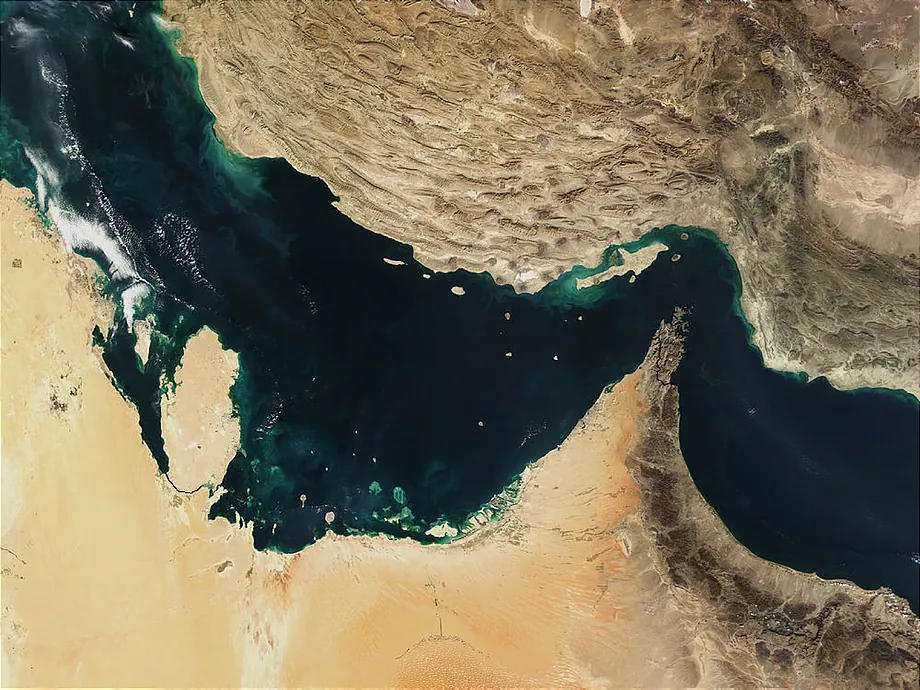
The Truman incident is part of Iran's strategy to close the Strait of Hormuz, through which 19.5% of the world's oil exports pass. Tehran is combining the Houthis' strategy in the Red Sea war that nearly hit Truman and the so-called hedgehog defense, which is the core of Ukraine's defense in its war with Russia and would be the method Taiwan would use if invaded by China.
The Strait of Hormuz, in an archive image.WORLD
The key is that Iran does not need to implement a classic naval blockade to close Hormuz, while the United States would have to carry out a conventional military operation to keep it open. At its narrowest point, between Iran and Oman, this waterway is only 33 kilometers wide. But there are only two routes - one for entry and one for exit - for ships, each about two or three kilometers wide. Tehran has not needed to launch a full-scale military campaign to stop vessels from circulating. Simply raising the risk for ships to cross dramatically has been enough. The threat, along with some symbolic isolated attacks, has been sufficient to deter shipping companies worldwide.
In addition, Iran has a wide range of anti-ship missiles, with ranges between 300 and 1,200 kilometers, including cruise missiles (flying parallel to the sea) and ballistic missiles, like the one the Houthis used against Truman. Iran has attempted to target them to reach the Lincoln, the twin of that aircraft carrier, but without success. Nevertheless, their presence in large quantities is enough to force the US Navy to operate at a great distance from Hormuz and with considerable caution to avoid more incidents like the one on April 29. Finally, Iran has at least 5,000 mines that it has threatened to use in the Strait.
This is how Tehran has closed that waterway with a statement from the Revolutionary Guard on Monday and a series of isolated bombings (although possibly using dozens of drones in them, most of which were shot down) at three ports and oil facilities in Oman - paradoxically, the country in the region that has made the most effort to maintain equidistance between Iran and the US - the UAE (Dubai, Abu Dhabi, and Fujairah), Saudi Arabia, Qatar, and Bahrain. None of these actions have been dramatic. To date, only between three and six civilian ships have been hit, and one of them, Iranian, could have been attacked even by the United States. In these actions, two Indian sailors have died.
These are not the actions one would expect to shut off 19.5% of the world's oil supply. In fact, during the seven-year war between Iran and Iraq from 1981 to 1988, those countries attacked about 450 oil tankers, of which around 60 were sunk. However, the Strait of Hormuz was never closed. Now, Tehran has achieved it with only three to six ships hit, of which only one has sunk, although two more may be destined for scrap.
And the global economy has felt the impact. Around 150 tankers are immobilized in the eastern part of the Strait. In total, there are about 750 ships in the Gulf or en route to the region that are currently stationary at sea, waiting to see what happens. Additionally, about 1,000 ships of all types have reported geolocation and navigation problems - especially in their GPS systems - due to the extensive electronic activity resulting from the war. Naval traffic around the Arabian Peninsula is at a standstill.
All this chaos plays into the hands of the Iranian government, which has thus threatened an energy crisis with barely any need to attack ships. Just like its Houthi allies after the outbreak of the Gaza war in 2019, Tehran has sown panic among global shipping companies without launching a widespread offensive against maritime traffic in the region.
Starting tomorrow, Wednesday, the vast majority of insurance policies issued by major companies in the sector - such as the British Northstandard and P&I or the French Gard - will no longer be valid due to the war. This means that insuring a ship is impossible. The "high-risk" zone is not limited to Hormuz but covers virtually the entire Persian Gulf coast of the riparian countries and also Oman, which is in the Arabian Sea. Thus, even coastal ships that do not venture far from the shore cannot be insured. This is part of the ayatollahs' strategy to extend the war's damage to their neighbors.
At least for now, there are few signs that the situation will change, posing a significant problem for the global economy. A one-week closure of the Strait of Hormuz has moderate consequences. However, beyond that, we enter terra incognita, especially if market expectations are that the problem will not be resolved. The Brent crude oil barrel was at $55 before the war, a historically low price, and there was a widespread consensus that the world had an oversupply of oil. The closure of Hormuz changes that. A barrel at $100 or $120 suddenly becomes a possibility. And with it, a surge in inflation and perhaps a global recession.
In addition, Iran has complemented this strategy with selective attacks on the oil facilities of its neighbors in the southern part of the Persian Gulf. On Monday morning, Tehran launched a drone attack on the Saudi refinery at Ras Tanura, the sixth-largest in the world by refining capacity. Officially, the facility was only hit by drone fragments shot down by anti-aircraft defenses (blaming the drone fragments that fall and denying direct impacts was invented by Russia in its war against Ukraine and has now become widespread throughout the Middle East). Nevertheless, the damage was serious enough for the state-owned Saudi Aramco to shut down Ras Tanura. This meant withdrawing 750,000 barrels of oil per day from the world. In other words, the consumption of the Netherlands.
Something similar has happened in Qatar. Both drones have struck critical infrastructure at the gas processing plants in Mesaieed and Ras Laffan. The latter processes the production from the Earth's largest natural gas field, the North Field, which Qatar shares with Iran. As a result, Qatar has suspended the export of all petrochemical products: from gas to fertilizers and plastics. Oman has virtually closed its ports after several drone actions, and the Fujairah terminal is operating at a minimum.
In this situation, only Saudi Arabia has the possibility to bypass Iran through the so-called East-West Pipeline, which crosses the country from the Gulf fields to the Yanbu terminal in the Red Sea. However, it is an imperfect solution. Of the between five and seven million barrels per day that Saudi Arabia exports through the Strait of Hormuz, only two or three can exit through Yanbu. Furthermore, the pipeline is vulnerable to more drone attacks, and it has several "bottlenecks" along its route. Rivalries - sometimes bordering on war - among the Arab countries of the Gulf have prevented the construction of a network of pipelines and gas pipelines connecting the fields to the Red Sea.
Waiting and watching does not seem to be the solution. But military intervention is also uncertain. In 1987 and 1988, the US escorted a dozen super tankers from Kuwait that Iraq, at war with Iran, used to export its crude oil. On the first trip, the tanker collided with an Iranian mine. Although it did not suffer major damage, it was a reminder of Tehran's ability to carry out asymmetric maritime warfare. The escorts culminated in a series of naval battles between the US and Iran in which Washington easily prevailed, but after a considerable deployment of resources in the region. At that time, Iran did not launch waves of suicide drones, nor did it have missiles capable of reaching ships at 1,200 kilometers. This reenactment of the tanker war from 1981 to 1988 is much more uncertain for the global economy.