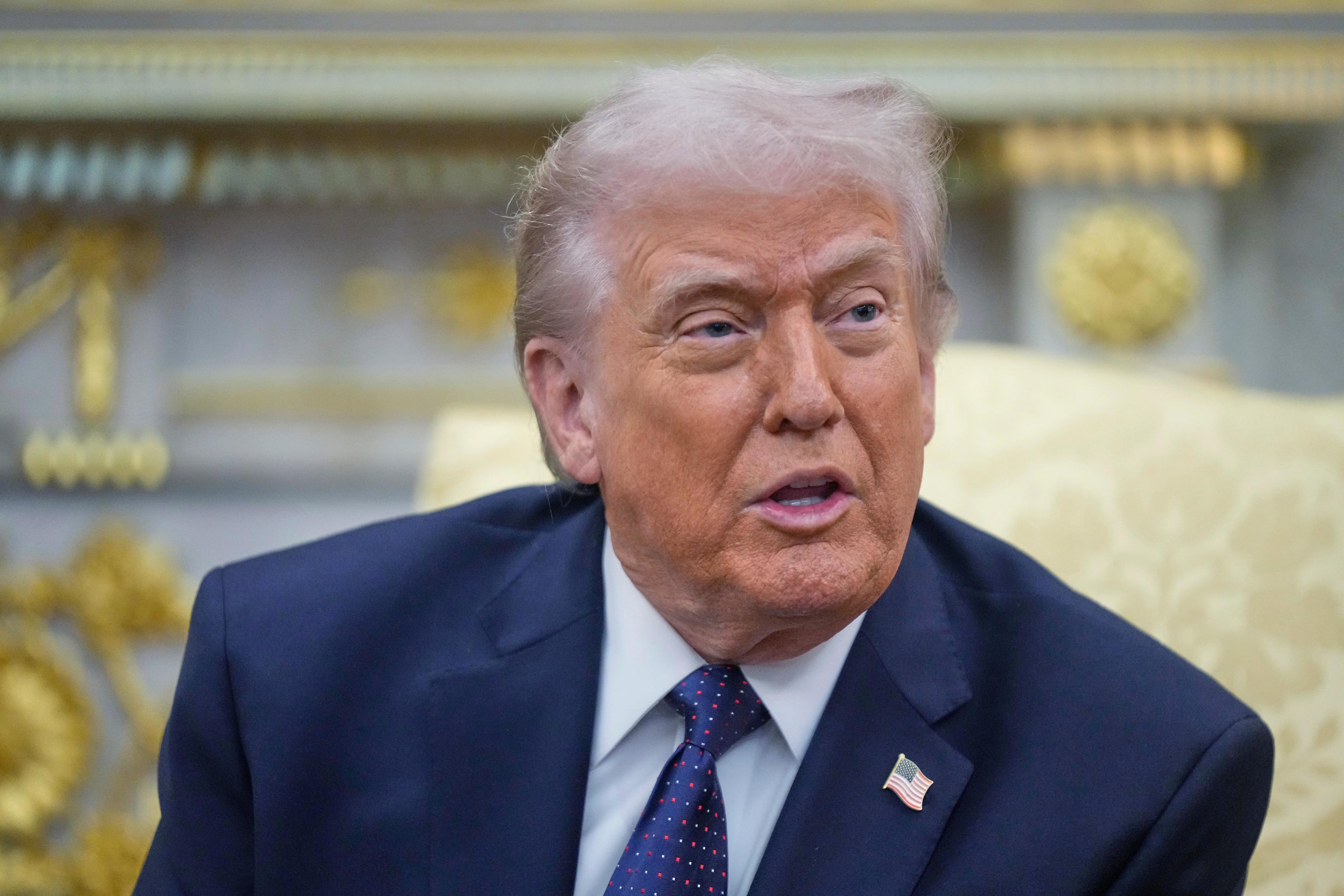
On Tuesday, the President of the United States lashed out more forcefully and angrily than ever against Spain and the Pedro Sánchez Government, threatening to "break all deals" or "relations", depending on how his statement is translated, with our country. "We don't want to have anything to do with Spain," he said, even mentioning a possible "embargo" on a "terrible" and "hostile" ally following the decision of the Moncloa not to allow the use of the U.S. bases in Morón and Rota for Iran bombings.
It's not the first or second time. Since the clash with Sánchez at the NATO summit in The Hague last summer, Trump has talked about "expelling" Spain from the Atlantic Alliance or that Spain was "probably deserving of economic and tariff retaliation." But this time he has been much more aggressive, more assertive, stating that he had already instructed Treasury Secretary Scott Bessent to take the necessary measures to punish. He did not mention retaliation within NATO, although it is by no means ruled out that he will do so in the coming days. Nor did he mention tariffs either. And it's not a coincidence.
During his first year in power, in this second term, Trump used tariffs for everything. To rebalance, at least in his worldview, trade balances with each and every country on the planet (Spain, by the way, has a trade deficit with the U.S., not a surplus). To punish governments he didn't like, to penalize political or judicial decisions against his allies, to impose truces on warring countries. But two weeks ago, the U.S. Supreme Court ruled that those tariffs he incorrectly called "reciprocal" were illegal. It didn't say he couldn't impose tariffs, but that the instrument used, an emergency economic powers law approved by Congress in the 1970s, was not valid and that he exceeded its consequences.
Trump, furious, appeared three hours after the ruling to insult the judges, denigrate the decision, and announce global 10% tariffs, but using another law. The interesting thing about Trump's intervention is that his interpretation of what the law and the Supreme Court allow him to do now applies to Spain, the country with which he may break the ice. "I can cut off all trade with a country, I can destroy it, I can ruin it with an embargo. I can do whatever I want, but I can't charge a dollar. I can't charge them anything," he lamented in front of the cameras that Friday.
Those phrases quickly went viral on social media, and many people interpreted them as the president announcing that he was going to destroy something, or that he was revealing his plans. But in reality, he was expressing his frustration, because according to his interpretation, the Supreme Court was telling him that he could do all those things, and that he was even allowed to do so, but that the legislation did not allow him to impose and collect a simple tariff. This Tuesday, at the White House, he said something similar. And in that sense, he used the term "embargo", a tool he has only used against enemies like Iran, Cuba, or North Korea, and opened the possibility of cutting economic ties with our country.
"We have to take care of nations that have been good and fair to us, and we will take care of other nations (...) but we have the right... for example, we talk about Spain. I could stop trade tomorrow or today. Even better, stop everything related to Spain. I have the right to stop all business related to Spain. An embargo. I could do whatever I want with them, and we could do it with Spain," he said before handing over to his Treasury Secretary, Bessent, who did not delve into the Spanish issue but spoke in general terms about the economic coercion tools available to the administration.
In the past, Trump has not specified threats against Spain. He has increased pressure and sought allies to do so, as he did yesterday. The first time he mentioned the option of kicking our country out of NATO was with the president of the second newest country in the Alliance, Finland. Yesterday he sought the complicity of the German Chancellor. And in Egypt, that of other world leaders, urging them to "work on" the Spanish president. But just because he hasn't done it until now doesn't mean he won't do it.
Any trade measure is problematic because the European Commission has the negotiating competencies. It can be a nuisance, and in his first term, we saw measures against products that were particularly harmful to the Spanish economy. But an embargo, in capital letters, is a very serious matter. Impossible for the EU to swallow, very difficult to justify politically and legally due to the decision not to allow the use of the bases for a specific operation, and invoking the agreements signed by both countries.
But the president has hundreds of options to penalize. In these first 13 months, he has used his discretionary powers to go after universities, law firms, and neighbors. And just yesterday he said that if he decided to use the Spanish bases, no one would be able to stop him. He is the most powerful country on the planet, economically and militarily. NATO does not contemplate the expulsion of members, but the U.S. is the heart of the Alliance and can find endless resources to make life difficult for the Spanish within its framework.
Similarly, Spain buys gas from the U.S., its main supplier. And just as it has decided to oppose many renewable energy projects, it could pressure the suppliers.