Ahmad Ayami escaped from the Syrian city of Aleppo to avoid the fratricidal conflict in his country. But violence followed him. His restaurant, Al Maalem (The Master), was almost destroyed when Israel launched its general offensive against the Hizbulá group in the fall of 2024.
"I spent $6,000 to rebuild it. Hizbulá gave me $1,800, but I paid the rest from my own pocket. I was going to reopen it in a few days," he says, pointing to the partially collapsed ceiling and glass scattered on the floor.
The Syrian is now part of that endless group of Lebanese trapped in the routine of rebuilding only to see their homes or businesses destroyed shortly after in yet another war against neighboring Israel.
Ayami's restaurant was one of those partially damaged on Monday in the large shopping center at the entrance of the Lebanese city of Tiro, which suffered several Israeli air attacks in the new conflict between Tel Aviv's troops and Hizbulá irregulars.
The Israeli missiles' target was one of the headquarters of the Al Qard Al Hasan Association, Hizbulá's financial arm. The building was completely flattened. Customers' documents, thousands of papers, could be seen scattered on the asphalt among debris and shattered glass.
"We are pawns in a game of chess. They play with us," said Salah Jalil, an employee of a nearby furniture store, who was busy replacing the shattered storefront with wooden boards, as he had to do during the last conflict as well.
The demolition of the Al Qard Al Hasan facilities is part of the broad plan that Israel has designed to confront the Lebanese irregulars led by Naim Qassem, taking advantage of the terrible regional war initiated by Tel Aviv and the United States in the Middle East.
Israel has decided to expand its occupation along the border between the two countries and on Tuesday advanced its forces in the border area, exacerbating the human exodus witnessed by Lebanon.
The top Israeli military chief, General Eyal Zamir, already announced on Monday the start of the ground offensive by stating that his forces were "going on the offensive." "We need to prepare for many long days of combat ahead," he added.
The Israeli Chief of Staff estimated that the offensive in Lebanon will not end until Hizbulá has been "eliminated", suggesting a campaign that could extend for months or even years, as despite being weakened, the paramilitary group's capabilities remain superior to those of many armies in the Arab region.
The Alma Research Center, an Israeli think tank specialized in Hizbulá, believes that the Party of God has around 30,000 militants and several tens of thousands more in reserve.
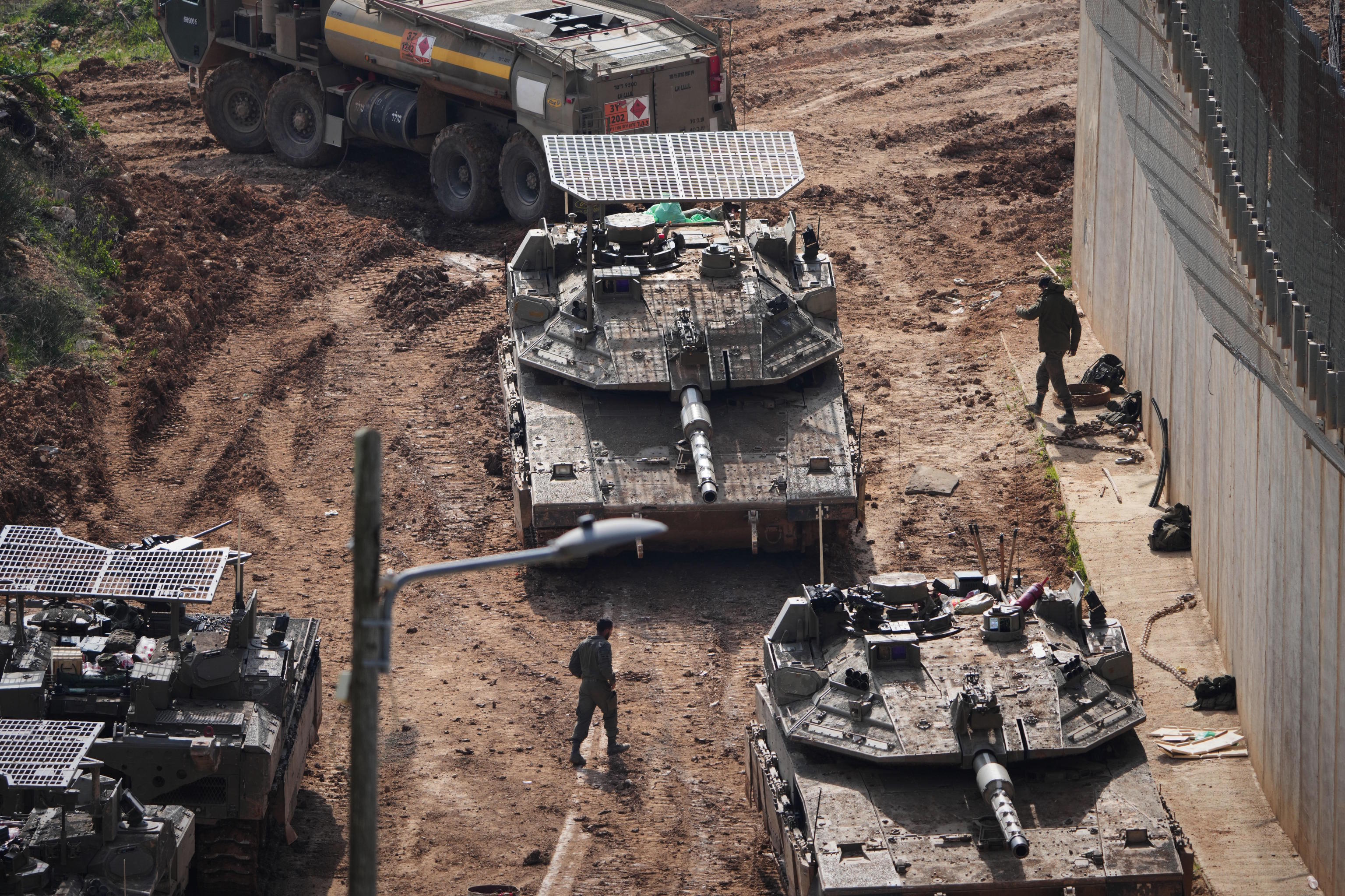
During the last war, Israel occupied a portion of Lebanese territory near the border between the two countries, where they built five bases that now house a large contingent of tanks, while clearing the area of all vegetation with chemical weapons in anticipation of this offensive.
In this new era where language is twisted to alter its meaning, the Israeli army announced that it was extending the invasion of Lebanese territory by stating that they are actually carrying out "advanced defensive operations".
According to a military spokesperson, their troops have "taken dominant control (adjacent to their five bases) and are creating" a security zone along the border, repeating a tactic they have used countless times since the first large-scale invasion of the Lebanese state in 1978.
An Israeli army tank and infantry fighting vehicle deployed along the border between northern Israel and southern Lebanon.AFP
The Lebanese newspaper Al Modon reported that Tel Aviv has demanded the evacuation of at least 122 villages in the south of the country.
Throughout the day, Israeli planes also bombed several Hizbulá-related facilities in Beirut, such as their television and radio headquarters -a huge column of smoke rose in the late morning from the southern suburbs of the capital, where these media outlets were located-, a meeting of Hizbulá "commanders" in the same locality, and other locations in the south of the country. The so-called Party of God responded by firing rockets and drones at various locations in northern Israel.
"The era of patience is over. We have no choice but to return to resistance," commented a senior official of the Shiite movement, Mahmoud Qmati.
Fleeing once again from armed clashes, hundreds of thousands of Lebanese continued heading north on Tuesday.
The endless lines of cars and equally monumental traffic jams multiplied at the exit of Beirut and on the access roads to the southern town of Sidon.
Columns of civilians could also be seen carrying bags and belongings, slowly advancing along the roads from the south towards the capital.
The Lebanese Disaster Management Unit said that at least 171 shelters have been set up -mostly schools and municipal buildings- throughout the country, but the statistics remain very provisional given the human tide moving north, replicating the massive movement witnessed in September 2024.
Tens of thousands were also heading towards the mountains, which already housed 120,000 displaced people that fall, according to official records.
Those fleeing were easily recognizable. Their vehicles were packed with passengers, bags, and many carried mattresses precariously tied to the roof.
The human crowds disappeared as the vehicles approached Tiro. The villages in this region were partially deserted, with most businesses closed. The few gas stations still open were crowded with cars and groups of individuals who at times resorted to physical altercations to secure fuel supplies.
In the afternoon, the skies of Tiro were dominated by Israeli planes flying overhead and explosions shaking the surrounding territories. At four in the afternoon, one of the planes launched a barrage of missiles that exploded a few kilometers from the port of Tiro, in the nearby hills, from which another huge plume of smoke rose.
Yussef Shamimi, the mayor of Majdal Zoun -a small village not far from the border with Israel- was forced to flee during the early hours of Monday along with the entire population of the area.
They spent the night and the entire following day outdoors. On Tuesday, he was able to settle in one of the schools that have been reopened in Tiro as an improvised residence for those who have left their homes.
"Here we are, 260 people from Majdal Zoun, but there are many from other places. The planes attacked the village in the early hours. They killed three people. We ran out with just the clothes on our backs," he said while attending to new arrivals.
The municipal chief clarified that hours before the aerial assault, numerous residents of the village received SMS messages with a recorded voice saying something like "you are located near Hizbulá facilities and interests, which we are going to attack, your life is in danger, leave the area." "It sounded like a recording," he added.
For the Lebanese, who can't even remember how many wars with Israel they have had to endure, this new conflict has a clear motivation: "It's the idea of Greater Israel, they want to expand their territory".
Shamimi's reference is an allusion to the almost messianic statements made last August by Israel's Prime Minister, Benjamin Netanyahu, in which he stated that he is on "a historic and spiritual mission" linked to the vision of "Greater Israel and the Promised Land."