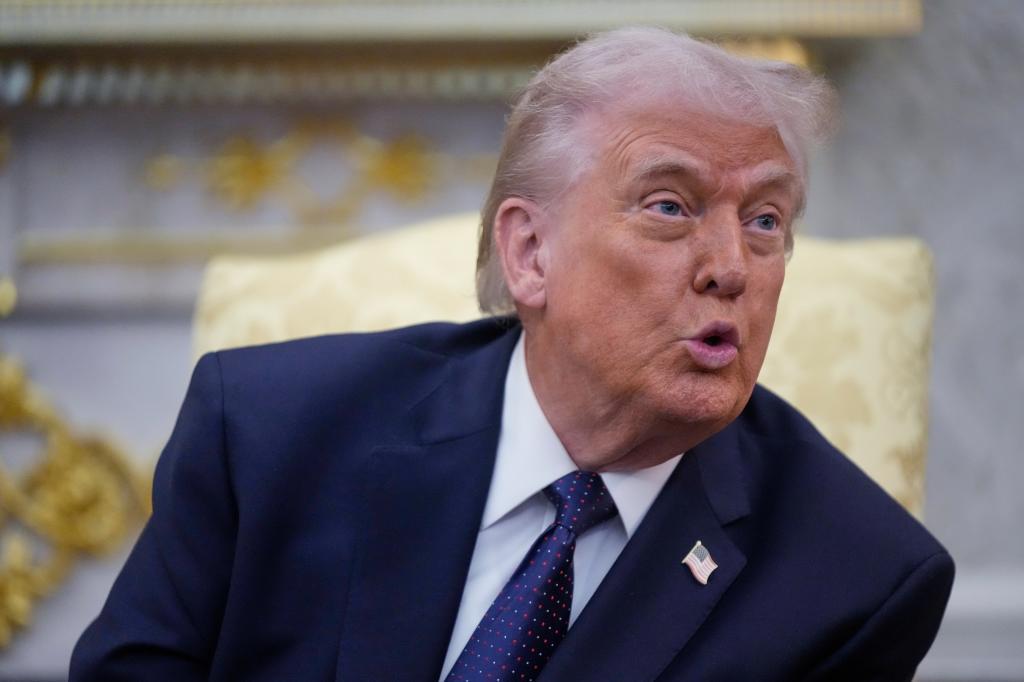
The U.S. President, Donald Trump, threatened on Tuesday to "cut all trade with Spain" over its position regarding the offensive against Iran and to impose a commercial embargo on the country after the Spanish Government's refusal to authorize the use of the Morón and Rota bases in military operations against Tehran.
"I could stop everything related to Spain, all businesses related to Spain; I have the right to stop it. Embargoes. I do what I want with them, and we could do it with Spain. We are going to cut all trade with Spain (...) Spain has absolutely nothing that we need, except great people. They have great people, but they lack great leadership," he said during a meeting with the German Chancellor, Friedrich Merz, at the White House.
What does a commercial embargo imply?
Imposing a commercial embargo on a country involves an official prohibition or restriction that limits the exchange of goods, services, or investments with a country. It is generally applied as a political or economic sanction to pressure behavioral changes, punish human rights violations, or as a measure of national security. In practice, it would translate into an explicit prohibition for U.S. companies, which would not be able to buy any products or contract any services from Spain, nor sell their own to our country.
The Ministry of Economy explains, in the context of EU trade policy, that total commercial embargoes "are not very common and most trade sanctions usually affect a selected basket of various products." They can target both imports and exports of the sanctioned country. The objective of limiting imports from the sanctioned country is usually to reduce its foreign sales and limit its ability to obtain foreign currency; and the reason for the sanctioning country to limit its own exports is usually to restrict or increase the cost of access to essential products for the sanctioned country. Among these products are usually weapons and all types of military equipment, as well as goods and technologies with dual use (products that can be used for both civilian and military activities).
Which countries has the U.S. imposed commercial embargoes on?
Among the countries to which the U.S. has applied this type of trade policy are Cuba, Iran, North Korea, Syria, Russia, Venezuela, and the occupied areas of Ukraine, but so far it has not been used with any EU country.
Can the United States impose a commercial embargo on Spain?
In theory, no. Commercial embargoes are intended for countries that systematically violate human rights or pose a threat to the ordering state. Spain does not fit into either of these scenarios. In fact, far from it, Spain is a member of the European Union and a NATO ally of the United States. Donald Trump already threatened Spain with raising tariffs when the government of Pedro Sánchez refused to increase military spending to 5%, and it all came to nothing. The tariffs applied in Spain are the same as those applied in the rest of the European Union, so the announcement could remain a threat.
All U.S. presidents of the last 50 years have signed executive orders involving embargoes. The legislation that supports them is the International Emergency Economic Powers Act (IEEPA), which authorizes controls in circumstances affecting national security. The president can apply it without going through Congress, although he must notify afterward. It is the law that was applied in the Iran crisis of 1977. The other legal framework is the Cuba Liberty and Democratic Solidarity Act, also known as the Helms-Burton Act, which is the one that enforces the total embargo on Cuba. In any case, the United States has a legislative arsenal to embargo products totally or partially. It is unthinkable that Spain fits into any of them.
What could Trump resort to if he decided to sanction Spain commercially?
He has few tools, although he could use some temporarily. On the one hand, he can take emergency measures for considering Spain a threat to its national security. It is an extremely unlikely possibility, but the White House can interpret Spain's refusal to use its bases as a hostile action that undermines the security of its citizens. On the other hand, he can impose export controls on U.S. companies to Spain under the same pretext. It is a measure used with China. All companies selling products to the Asian giant must have a specific license that hinders processes. Again, it is a very difficult option to apply, but if done, it would reduce Spain's access to some critical goods and services.
Has the Spanish Government reacted?
Yes, government sources have pointed out that Spain is a key member of NATO, fulfills its commitments, and contributes significantly to the defense of European territory. It is also a major exporter in the EU and a reliable trading partner for 195 countries worldwide, including the U.S., with whom we maintain a historical and mutually beneficial trade relationship. "If the U.S. administration wants to review it, it must do so respecting the autonomy of private companies, international law, and bilateral agreements between the EU and the U.S. Our country has the necessary resources to contain possible impacts, assist affected sectors, and diversify supply chains. In any case, the will of the Spanish Government is and will always be to work for free trade and economic cooperation between countries, with mutual respect and compliance with international law. Because what citizens ask for and deserve is more prosperity, not more problems."
Would U.S. companies be in favor of excluding Spain from their trade relations?
Surely not. Spain is a market of 50 million inhabitants within a larger one of 400 million. Some U.S. companies have shown a preference for investments in Spain, especially in critical aspects related to new technologies, such as data centers. Amazon, for example, has recently invested 33.7 billion in data centers in Aragon, while Microsoft has investments of around 10 billion in the same community. In a time of deep market fragmentation and supply chains, no American supplier would be pleased to lose a reliable and currently growing market like Spain.
What is the current trade between both countries like?
In 2025, Spain exported goods to the U.S. worth 16.716 billion euros, accounting for 4.3% of the total sales of our country abroad. Highlights include the sale of oil and derivatives, chemicals, oils, and fats. In that year, they had already decreased by 8% year-on-year due to the tariffs imposed by Trump.
Regarding imports, Spain bought U.S. goods worth 30.174 billion euros, 6.8% of our total external purchases, representing a 7% year-on-year increase. The acquisition of gas, medicines, and food stands out.
This means that our country maintains a trade deficit with the U.S. of 13.458 billion euros, which has worsened compared to the previous year due to the decline in exports.