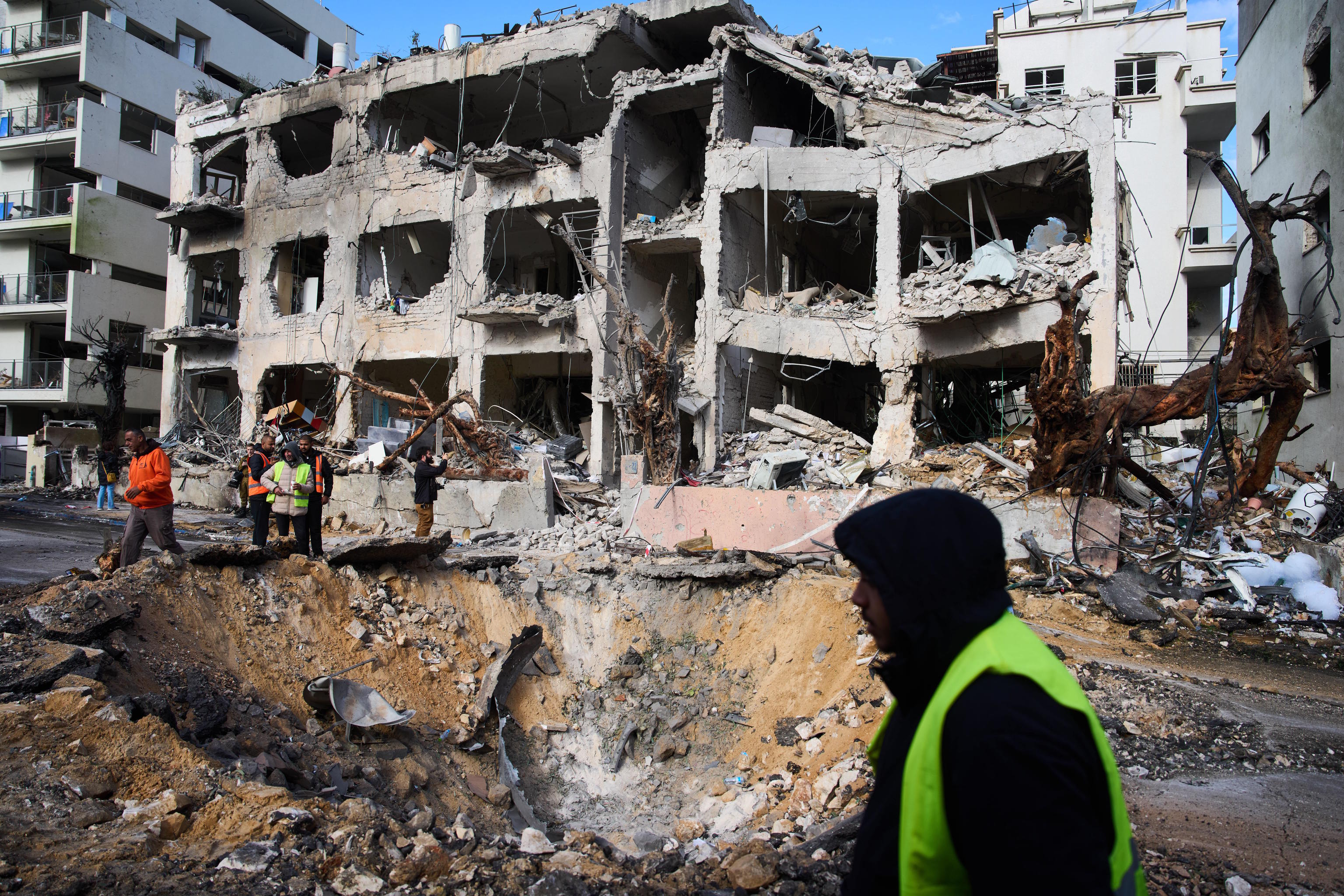
For the fourth consecutive day, attacks between the United States and Israel against Iran have been ongoing. The war between Washington and Tehran began on Saturday, February 28, and by the second and third day, the conflict had already spread throughout the Middle East. According to the Red Crescent, the death toll in Iran alone has reached 787 people.
In Iran, the bombings by the United States and Israel have mainly targeted Tehran, hitting residential neighborhoods, command centers, state service offices like the Iranian Ministry of Intelligence, emergency infrastructures, and even a hospital. On the same Sunday, President Donald Trump announced the death of Ayatollah Ali Jamenei, the Supreme Leader of Iran, leaving a regime in turmoil to be replaced by Ayatollah Ali Rerza Arafi as interim Supreme Leader.
The attacks have also spread to other Iranian cities such as Sanandaj and Kermanshah, with impacts on residential buildings, and a girls' school in the city of Minab, in the south of the country on the first day of the conflict. Additionally, a new attack on a nuclear facility in Natanz, which Tehran directly attributes to the joint action of Washington and Tel Aviv.
US and Israel Strike the Heart of Tehran
However, the offensive by the United States and Israel has not been limited to Iranian territory. In Iraq, the base of Jurf al-Nasr, a stronghold of the pro-Iranian group Hezbollah, was bombed. In Lebanon, Israel launched a wide aerial campaign against over seventy targets of the Islamic group, including weapon depots and launch platforms, with attacks from southern Beirut, as well as the south and east of the country. One of these bombings resulted in the death of a senior official of the military wing of the Islamic Jihad in Lebanon. The official Lebanese toll speaks of dozens dead, over a hundred injured, and tens of thousands displaced.
At the same time, Tehran launched a new wave of drones and missiles against Gulf countries hosting forces and infrastructures linked to the United States, targeting objectives in Kuwait, Bahrain, and United Arab Emirates.
Iranian attacks have also targeted strategic and economic infrastructures in the region. In Saudi Arabia, a drone caused a fire at the Ras Tanura refinery, one of the largest in the world, and in the UAE, a fire broke out at a fuel storage facility in Abu Dhabi. In the technological realm, three Amazon data centers in the UAE and Bahrain were severely damaged, leading to service interruptions. In the maritime domain, Iran attacked tankers and commercial vessels in the Gulf of Oman and the Straits of Hormuz, one of the world's most important energy routes.
The escalation also reached diplomatic headquarters and foreign bases. An Iranian drone struck the US embassy in Riyadh, and Washington announced the indefinite closure of its embassy in Kuwait. Additionally, a British base in Cyprus was attacked with Iranian-made drones launched from Lebanon, in an operation attributed to Hezbollah, causing damage to a runway and other facilities, prompting the UK to respond with attacks against those responsible.
Overall, between Saturday and this Tuesday, Iran has directed its strikes mainly against Israel, bases, embassies, infrastructures, and American assets in the territories of its neighbors in the Gulf. Meanwhile, the United States and Israel have focused their offensive on Iranian territory - with particular intensity in the capital and the Natanz nuclear facility - and on Tehran's main allied groups in Iraq and Lebanon.
Support and Confrontation: What is the stance of each Middle Eastern country regarding the conflict?
The Middle East is divided into several blocs based on their stance following the continuous attacks. While most countries declared neutrality in June 2025, Iran has extended the conflict in the region by targeting US military bases established in neighboring countries, although Tehran (backed by militias in some regions) claims it is not attacking its neighbors but rather the US presence.
One of the blocs is the Gulf Cooperation Council (GCC), established in 1981, which includes Saudi Arabia, Bahrain, United Arab Emirates, Kuwait, Oman, and Qatar. All are allies of the US and Israel and have been targeted by Iranian attacks.
The Iranian offensives have affected ships off the coast of Oman, refineries in Saudi Arabia, and Amazon offices in Dubai. In Abu Dhabi, a drone caused a fire at a fuel storage facility. Faced with this escalation, the GCC countries have warned that they reserve the right to legitimate defense.
On the other hand, Jordan and Egypt have declared neutrality, although aligned with Trump and Netanyahu. They were the first to normalize relations with Israel and maintain security agreements with Washington. Egypt has not faced reprisals, while Jordan reported the downing of dozens of Iranian projectiles since Saturday.
Who's Who: Regional Actors Affected by the War against Iran
Meanwhile, Syria, Lebanon, Iraq, and Yemen remain unstable hotspots with the presence of pro-Iranian militias. Syria has been at war for 14 years, and Iranian influence has decreased, in addition to Israeli occupation in the country's south. In Lebanon, Hezbollah, an Iranian ally, holds even more power than the government itself. In Yemen, with a very weak government, the Houthi rebels, also Iranian allies, have not yet announced retaliations, and Iraq faces a fragile political situation: on one hand, they aim to form a government, but face US pressure to prevent pro-Iranian parties from entering power, while there are also Iranian-aligned militias in the region.
Threat to the Global Economy: How does the conflict affect the energy and fuel market?
The rise in gasoline and electricity prices in Europe is already a direct consequence of the escalation in the Middle East. The gas price surged over 45% after Qatar announced the suspension of production at the world's largest export plant following drone attacks, leading to a drastic increase in gas prices. This was compounded by Iran's announcement of the closure of the Strait of Hormuz, while Brent crude oil rose over 7% and surpassed $77 per barrel. In this scenario, the price of gasoline in Spain could reach around 1.8 euros in a matter of days, as the market began anticipating a higher tension in the Gulf over the weekend.
In the case of electricity, analysts agree that the increase is certain, although not immediate. The impact will depend on how long the conflict lasts and how far it escalates, as gas sets the price of electricity for many hours of the day: for every euro that gas goes up, electricity tends to increase by about two euros. This Tuesday, the European gas index TTF went from around 38.5 to 44.5 euros per megawatt hour.
Beyond energy, the escalation is already starting to affect the entire economy. The war has disrupted much of the air transport in the Middle East, particularly affecting the Gulf States, and is disrupting both the oil industry and the commercial flow of the region. In addition, the commander of the Iranian Revolutionary Guard has stated that the Strait of Hormuz is closed and that Iran will set fire to any ship that tries to cross it, according to information disseminated by Iranian media and reported by Reuters, a message that has intensified pressure on the markets and has caused drops in the stock markets along with new increases in gas and oil.