A U.S. submarine launched a torpedo that sank an Iranian frigate off the southern coast of Sri Lanka, in an attack confirmed by U.S. Secretary of Defense, Pete Hegseth. The action - the first of its kind since World War II, according to Washington - took place in the early hours of Wednesday and expands the Middle East war into the international waters of the Indian Ocean.
"A U.S. submarine sank an Iranian warship that it believed was safe in international waters," Hegseth stated. The attack reportedly left at least 87 confirmed dead.
The Iranian-made ship that was sunk represented the Islamic Republic's ambition to project power beyond the Persian Gulf and to demonstrate that, despite international sanctions, its military industry is capable of sustaining long-range deployments. Hegseth, emphasizing the military symbolism of the operation, reiterated that it was the first sinking of an enemy vessel by torpedo since World War II. "As in that war, we are fighting to win," the American expressed.
The operation has shaken Sri Lanka, a country accustomed to navigating between powers without fully aligning with any. Its Foreign Minister, Vijitha Herath, informed Parliament that the coast guard received a distress call at 5:08 a.m. on Wednesday from the Iranian ship, identified as the IRIS Dena. The crew described the incident as an explosion on board.
Before 6:00 a.m., Sri Lanka had dispatched a first naval vessel to the area and a second shortly after. "It was a rescue in compliance with obligations as a signatory country to the international convention on maritime search and rescue," local authorities assured. The frigate had completely sunk, leaving only an oil slick when the rescue ships arrived.
Authorities in Sri Lanka believe there were 180 people on board, although the exact number of missing is unknown. Local officials initially stated that around 140 people were missing.
The attack took place 81 kilometers off the coastal city of Galle, within Sri Lanka's exclusive economic zone but outside its territorial waters. The navy of this South Asian country reported rescuing 32 people after receiving the distress call.
"Although the incident occurred outside our waters, it was within our search and rescue area. Therefore, we were compelled to respond in accordance with international obligations," explained Budhika Sampath, military spokesperson for this South Asian country. "We found people floating in the water, rescued them, and later, when we inquired, discovered they were from an Iranian ship."
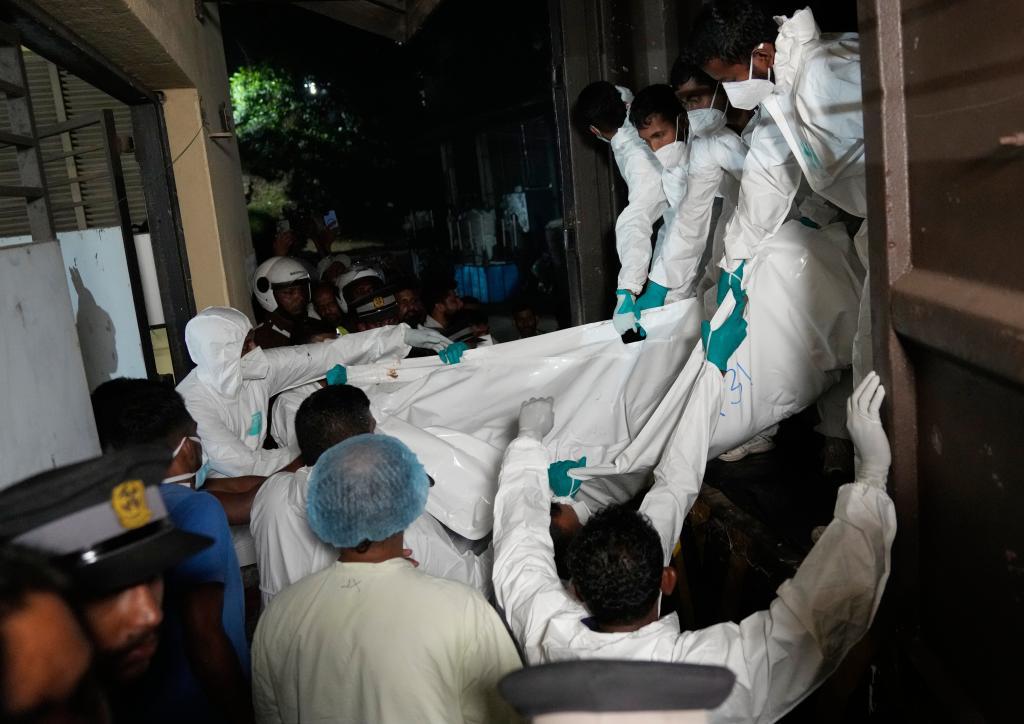
On land, the injured were taken to the National Hospital of Galle, where images showed an unusual deployment of security: ambulances coming and going under the watch of armed personnel and a cordoned perimeter at the southern naval headquarters of the country. Sri Lankan authorities justified the secrecy surrounding the rescue images by stating that the operation involved military resources from a third country.
Galle is a historic port city in the south of the country, strategically located on one of the world's busiest maritime routes, through which a substantial portion of global energy trade flows.
"U.S. Navy Ohio-class submarines routinely patrol the Indian Ocean from the U.S. military base in Diego Garcia (a strategic island facility under British control used for operations in the Middle East and Asia). We are examining sightings and maritime tracking data," a senior Sri Lankan official told The Indian Express, an Indian newspaper with an English edition.
The IRIS Dena frigate was returning to Iran after participating in military exercises in Visakhapatnam, on the east coast of India, along the Bay of Bengal, where it operated alongside warships from 74 nations. The exercise concluded on February 25, and just three days later, the United States and Israel carried out the so-called Operation Epic Fury against Iranian targets.
The IRIS Dena, commissioned into the Iranian navy in 2021, is a domestically manufactured ship that was part of the regime's efforts to expand its operational range. It displaces approximately between 1,300 and 1,500 tons and is equipped with a range of anti-ship missiles, naval cannons, and torpedo launchers. It also includes a helicopter landing platform and radar systems capable of tracking multiple targets.
An Indian military analyst consulted highlighted that the frigate would have, among other systems, Qader anti-ship missiles, a 76-millimeter cannon, and torpedo capability, indicating that it was a fully operational asset.
In recent years, Tehran has intensified its deployments in distant waters — including the Atlantic and the Indian Ocean — as a symbolic challenge to the United States and Western powers.