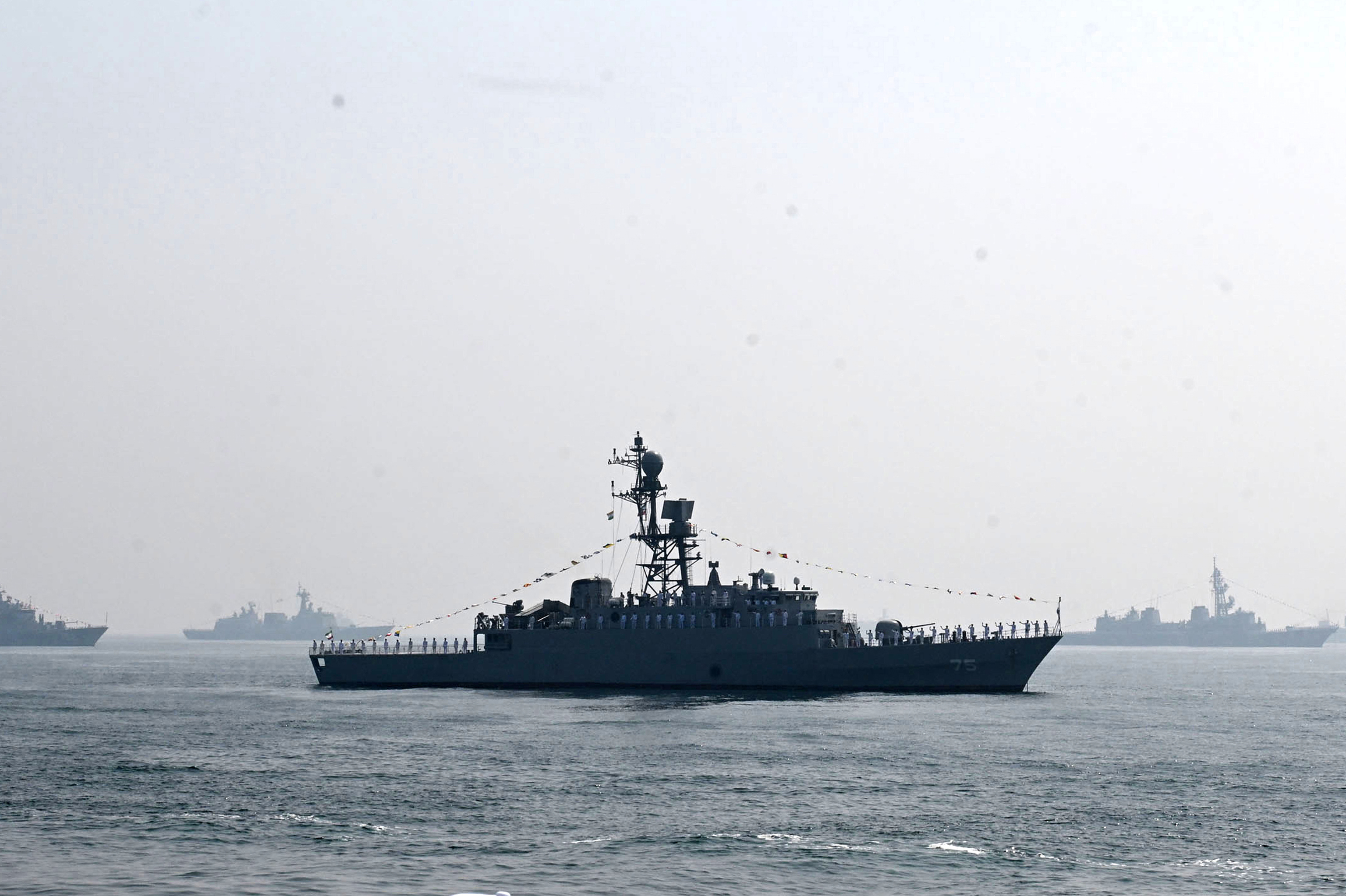
Probably the last thing the 180 crew members of the Iranian frigate Dena expected when they joined the Milan maneuvers on February 15, coordinated by the Indian Navy, was that their ship would never return to their country. And even less that several dozen of them would not survive the journey.
Even more incredible is that the Dena was sunk by the Navy of one of the countries participating in the exercises, the United States, in a war where Iran was also going to have another country from the maneuvers, Saudi Arabia, as an enemy. This is a paradox emphasized by the name of the exercises: Milan, which in Hindi means "unification."
The sinking of the Dena, on the edge of Sri Lanka's territorial waters, is a historic event. It is the first time in 80 years that a US submarine has sunk a ship, six months, three weeks, and one day. The last time was on August 14, 1945, in Japan. On that day, the Japanese light destroyer CD-13 of the Kaibokan class was sunk by the Torsk submarine, just hours before the armistice that laid the groundwork for the end of World War II between Japan and the Allies (although the Soviet Union did not respect it and continued attacking Japan for another 15 days).
It is also the fourth ship sunk by a submarine in the 80 years since World War II. In 1971, India lost the frigate Khukri to a Pakistani submarine during the Bangladesh War of Independence. In April 1982, during the Falklands War, the Argentine cruiser General Belgrano was sunk by another nuclear submarine, the British Conqueror, resulting in the deaths of 323 sailors, which is, in essence, the last such action to date.
There is another case, but it is more difficult to classify: in 2010, the South Korean corvette Cheonan was destroyed by a North Korean mini-submarine, although this case could be considered an act of sabotage or state terrorism rather than war. Despite the proliferation of missiles on submarines, all these sinkings were carried out with torpedoes.
The Dena was attacked yesterday morning (local time) off the coast of Sri Lanka, when it had completed half of the 3,700-kilometer route from the Indian port of Visakhapatnam to the entrance of the Strait of Hormuz, which could be the scene of a historic aerial-naval battle between the US and Iran in the coming days or weeks. Sri Lankan authorities confirmed that 32 sailors from the ship were alive and 87 had been declared dead. The ship's crew numbered around 180 soldiers, with another 70 presumed missing.
The Dena was one of the 'jewels' of the Iranian Navy. Its sinking is another episode in the destruction of the Tehran Navy. Iran seems to have suffered huge losses since the US and Israel launched the war, including the loss on Saturday, at the hands of the US naval aviation, of the drone carrier, the Shahid Nargeri, which should have played a key role in the battle of the Strait of Hormuz.
Teheran's plans for the Dena
The frigate was following the world's busiest commercial route, connecting the Red Sea and the Persian Gulf with China. It was evident that the US was monitoring it. And if it approached the Strait of Hormuz or Washington discovered it trying to interfere with merchant traffic in the area, it wouldn't last five minutes. US Secretary of War, Peter Hegseth, simply stated that the destruction of the ship is part of the plan of the US and Israel to annihilate all of Iran's military capabilities.
The US stated that the attack was carried out with an attack submarine. This is logical, given that the other submarines the US has are ballistic, meaning they are designed to launch 22 Trident intercontinental nuclear missiles (each with eight atomic bombs) in the event of a large-scale atomic war, or they belong to this latter group but have been adapted to launch 154 cruise missiles. One of these, the Georgia, appears to be participating in the bombing of Iran.
Attack submarines are smaller, faster, and more maneuverable than ballistic submarines, and their main mission is to protect ballistic submarines and surface fleets from the actions of other ships and submarines. The US has three classes of such ships, but no details of the one involved in the operation have been made public. It was a nuclear submarine because the US does not have conventionally powered ones.
The weapon used was an MK-48 torpedo, as reported by the US Chief of Staff, Air Force General Dan Caine. The Mark-48 is the standard torpedo for US attack submarines. The MK-48 does not explode upon contact with the target but underneath it. This generates an expansive wave on the keel that often splits the target in two and sinks it immediately. The video of the action released by the Pentagon shows how the Dena rises above the sea and literally disintegrates.