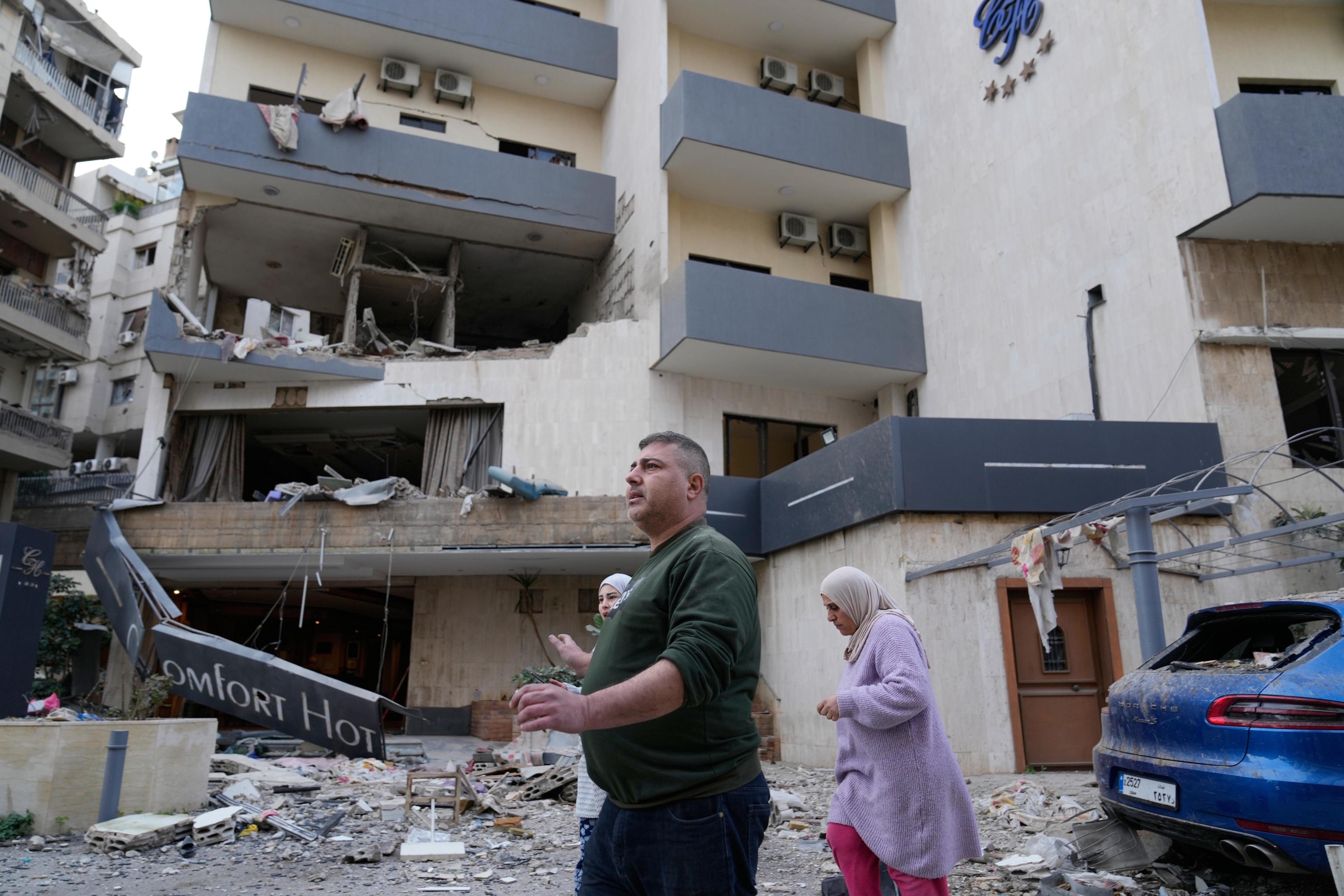
The destruction of the Comfort hotel in Beirut could be a metaphor for the absolute chaos generated by the war initiated by USA and Israel in the Middle East. The projectile hit the fourth floor, tearing part of the facade. None of the witnesses of the incident, which left at least five injured - one of them seriously, the hotel receptionist - could understand the objective or clearly assign responsibilities.
The Comfort is located in the capital's Christian-majority neighborhood, very close to facilities such as the Presidential Palace, the Ministry of Defense, or Spain's embassy, unrelated to the conflict between Hezbollah and Israel. "We were woken up by a huge explosion shortly after four in the morning. We went down, and everything was filled with smoke. People were screaming. It was all chaos. There is no one from Hezbollah here," recalled Sama Shubli, one of the tenants of the building sitting a few meters away from the pile of rubble.
One of the affected municipality members, Sami Muamaly, joined the perplexity of the dozens of people gathered nearby. "This was considered a safe neighborhood. We don't allow armed people here. But this is what happens when you start a war. You can't control what happens," he said.
The confusion - and frustration - that reigned at the scene of the incident was a shared feeling yesterday by millions of people in the Middle East, facing a conflict that instead of being limited to Iran or its neighboring countries is increasingly spreading geographically without a clear plan presented by the USA or Israel beyond their declared intention to overthrow the Iranian regime.
Faced with the obvious fact that history has never seen a war won solely by the air force - a fact reiterated by all experts - Washington and Tel Aviv have decided to turn to Iranian Kurdish groups opposed to Tehran, which have a few thousand fighters and bases in Iraqi Kurdistan, to be "their boots on the ground."
According to various Western media outlets like CNN, the CIA is supplying weapons to Kurdish factions that recently announced the creation of the so-called Coalition of Political Forces of Iranian Kurdistan (CFPKI) with the aim of promoting their entry into the western part of the country, where this community is the majority.
One of the oldest Iranian Kurdish formations, the Iranian Kurdistan Democratic Party (KDPI), stated that Donald Trump himself had communicated by phone with its leader, Mustafa Hijri, to seek support in the assault against Tehran's forces. Local media reported that Trump also met with the leaders of the two main Iraqi Kurdish parties, Masoud Barzani and Baef Talabani, who jointly control the northern autonomy that Washington intends to use as a platform for a ground offensive against Tehran.
Kurdish media have reported a wave of airstrikes against positions of the Iranian Islamic Revolutionary Guard Corps (IRGC) in provinces bordering Iraqi Kurdistan, with the aim of facilitating any Kurdish action.
Meanwhile, Iran has intensified its missile and drone attacks against the two main towns in Iraqi Kurdistan, Erbil and Sulaymaniyah, and against the quarters of the groups linked to the CFPKI. On Wednesday, two Iranian missiles killed a fighter from the Kurdistan Freedom Party (PAK) and injured three other militants, as reported by the faction itself.
On Monday, Iraqi Foreign Minister Fuad Hussein estimated that only the town of Erbil - where a significant contingent of US troops is also stationed - had been attacked up to 70 times by rockets and drones from Iran since the start of the war.
Washington's new turn, which seems more like an improvised plan than one designed in advance, faces numerous challenges starting with the Kurds' distrust towards the Americans. Just last January, the government of Donald Trump decided to sacrifice the existing Kurdish autonomy in northwest Syria in favor of the new authorities in Damascus, despite the Kurds' decisive participation in the fight against the Islamic State for over a decade.
Furthermore, another focus of opposition to the Iranian regime, which gathers around Reza Pahlavi, the son of the former autocrat who ruled the nation until 1979, strongly opposes any aspirations of the Kurdish community, whom Pahlavi labeled as "separatists." In several interviews this newspaper held with Kurdish formations in January, all their leaders rejected accepting Pahlavi as an alternative to the power of the ayatollahs.
Iranian history recalls that the Kurds have militarily confronted Tehran's army on multiple occasions for decades, reviving the specter of the fratricidal conflict that destroyed Iraq after the 2003 US invasion. Ultimately, any attempt by Kurdish groups to establish an autonomous political entity in western Iran could provoke a military response from Turkey, which has also been in conflict with that community for decades.
Within Lebanon, Israel has continued to expand the territory it occupies in the southern part of the country, and its forces have begun to invade towns like Jiam or Mays al-Jabal. Hezbollah responded by launching drones and rockets against facilities such as the naval base in Haifa.
The possibility of the immense crisis overflowing the geographical framework that Washington and Tel Aviv intended to confine it to is becoming increasingly real, given that countless nations in the region consider what is happening a threat to their strategic interests. For example, Syria has decided to deploy thousands of soldiers on the border with Lebanon.
A statement from the Syrian Ministry of Defense justified this determination to "protect and control the borders as the ongoing regional war intensifies." The new authorities in Damascus have maintained a tense relationship with Hezbollah militias, which actively participated in the nation's civil war supporting dictator Bashar al-Assad.