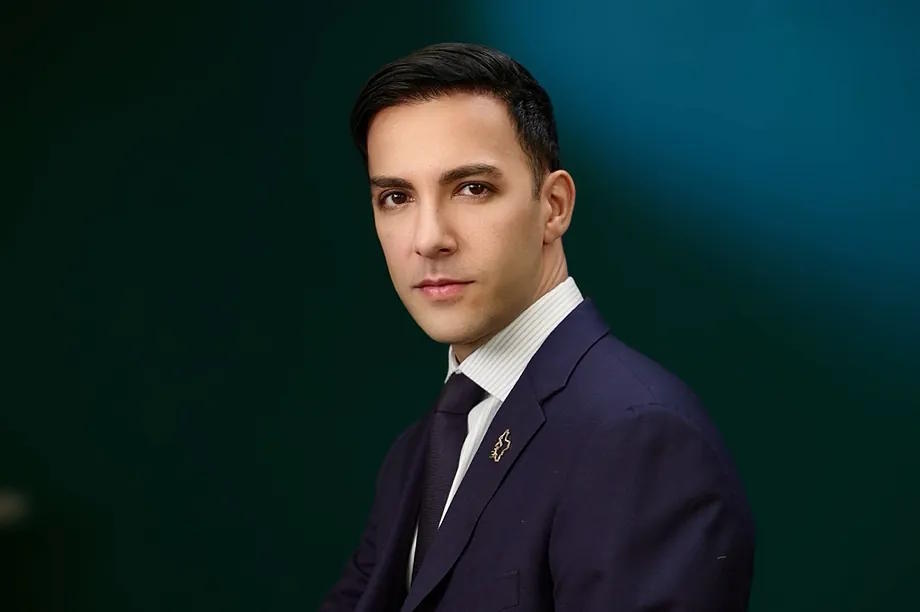
In 2009, when Ali Vaez arrived in Washington and the ayatollahs' atomic program began to raise suspicions, he thought: "This is going to end in disaster." He had landed in the U.S. capital after earning a Ph.D. in Nuclear Physics in Iran and furthering his studies in Boston. Although he had always been interested in international relations and politics, his parents had made him see that this was a dangerous matter and that he should stay out of it. He couldn't: the reelection of President Mahmoud Ahmadinejad and the crushing of the Green Revolution encouraged him to ignore his parents' advice.
Today, he works as a security analyst at the Crisis Group think tank from Geneva, teaches at Georgetown University, and collaborates with Johns Hopkins University. Eleven years ago, he participated in the historic agreement that limited the Iranian nuclear program in exchange for the lifting of economic sanctions. From afar, he watches with frustration and sadness the definitive demolition of that pact and the attacks by the United States and Israel against his country. With the regime's internet blockade and military actions, he has no way of knowing how his family is doing.
Question. Iran has been launching missiles and drones against US military and civilian targets in the Middle East since last Saturday, as well as against local energy infrastructures in Bahrain, Kuwait, Qatar, the United Arab Emirates, Oman, Saudi Arabia... Did you expect such an escalation in the region?
Answer. Yes, I expected the war to escalate very quickly. The Iranians were caught off guard in the Twelve-Day War [June 13-24, 2025] and were now aware that they were facing an existential threat: Israel and the United States did not want to weaken them and reduce their capabilities, but rather to bring about a regime change. They understood it as a battle for the survival of the Islamic Republic, so it was very likely that they would react as they have. Furthermore, their officials had already issued threats in that regard. They had warned the US through the Swiss embassy - which represents US interests in Iran - that all US bases in the region would become legitimate targets. Supreme Leader Khamenei had also warned Gulf countries that the attack would trigger a regional war. So, the possibility of escalation was not unfounded at all.
Q. President Trump has been accumulating contradictions to justify the attack on Iran. He has said that he intended to trigger a popular uprising that would lead to a regime change, destroy their nuclear program, preempt an Iranian strike... Is it harder to win a war when its promoters can't even explain to their own citizens why they started it?
A. It is difficult to win a war when there is no clear strategy. The US has overwhelming military power and can prevail over almost anyone, especially over a conventional power like Iran. But a tactical victory does not mean that the US has secured its long-term strategic objectives. Trump was pushed into this war mainly for two reasons. The first is Benjamin Netanyahu, who for many years relied on his great ally to do the dirty work for him - weaken his main adversary in the region - and created in Washington the false impression that it was low-hanging fruit ready to be picked, that the Islamic Republic was so vulnerable that its overthrow would be a matter of days. The second reason is his arrogance: he became too confident with recent military successes, such as the removal of Maduro in Venezuela, and thought he could achieve a quick victory.
Q. "Any attack that costs lives and money to the United States could be a potentially significant political blow to Trump," he wrote in his most recent article in 'Foreign Affairs'. Would a troop deployment after the experiences of Iraq and Afghanistan be visible?
A. The US would have to deploy between half a million and a million soldiers to completely neutralize the Revolutionary Guard forces and destroy their capabilities, and do so in a much more complex territory to handle than Iraq or Afghanistan. The risk posed by an incursion for the US military would make Iraq and Afghanistan seem like a walk in the park. A large-scale deployment is highly unlikely. There is a possibility that the US may deploy special forces to carry out specific operations. For example, to neutralize the Iranian contingent on the southern coast and prevent them from attacking ships passing through the Strait of Hormuz, to protect hidden enriched uranium weaponry, or even to assist other militias in gaining control of certain territory and then use it as a launching pad for new operations. There are many reports of the US supplying weapons to Kurdish separatist groups.
Q. 'Epic Fury' is already the largest US military operation since 'Desert Storm' (Iraq, 1991). Trump has stated that the war could last weeks. What is the worst-case scenario for the region, for the US, and for the entire Western Hemisphere?
A. The worst-case scenario is that the war leaves the entire region in flames and without a plan for its reconstruction. Destabilizing a country of 92 million inhabitants would have consequences beyond Iranian or regional borders; it would reach European shores. If Iran becomes a failed state, previous waves of refugees to Europe will seem like a trickle. The risk of radicalization could export terrorism worldwide. The civil war in Libya, for example, provided weapons to militias in the rest of Africa, leading to several wars. And then there are the economic implications, which would also be global... It is very difficult to imagine a soft outcome for this war. The US had plans for day 1 after the war, but they did not withstand the first impact with reality. Trump is improvising.
Q. Trita Parsi, former president of the Iranian-American Council, has stated that "Gulf countries fear the consequences of a regime change in Iran." Do you agree with him?
A. Gulf countries are extremely angry with Iran because they tried to avoid this conflict. Some even mediated tensions between Iran and the United States, such as Qatar and Oman. And yet, Iran has attacked them all... They do not want this to happen again in the future. That means Iran must be reduced to the bare minimum so that it cannot harm their interests or even get rid of the regime. A few days ago, before Iran attacked them, their neighbors preferred a weakened Iran to a defeated Iran. Now they have realized that an out-of-control and cornered Iran poses other risks, as it will not allow them to live in peace, prosperity, and security. On the other hand, they also fear the uncertainty of the future. They do not know what will replace the Islamic Republic. They are trapped: they did not want all this to happen, and they do not have the possibilities or capabilities to influence what will happen.
Q. "Destabilizing a country of 92 million people would have consequences beyond the region, reaching European shores"
A. The 'Shahed' drones are becoming a nightmare for the countries in the region due to the difficulty and cost of shooting them down. Everyone has observed over the past four years what they are capable of in Ukraine, but the US military seems to have discovered them now.
Clearly, it is because they underestimated Iran's capabilities and resilience. They thought that by decapitating the regime with the physical elimination of its supreme leader and military leadership, they would lose their will and power to counterattack. It was a miscalculation that is largely explained, once again, by the impulsive approach to world affairs by the Trump Administration. In this case, it is particularly influenced by Israel, which does not care about the costs or consequences of this conflict as long as it allows them to overcome the last obstacle to achieving full hegemony in the Middle East.
Q. Is Israel's military superiority in the area a deterrent or an incentive for an arms race 'ad infinitum'?
A. There is no doubt that Israel is the hegemonic military power in the region. No one, except Iran and non-state actors like Hamas, the Houthis, or Hezbollah, would dare to challenge it. However, Israel's growing assertiveness and aggressiveness have raised concerns among all neighboring states, Arab and non-Arab. This includes countries like Turkey or Pakistan, which fear having to submit to Israel. This could lead to previously unthinkable coalitions. For example, Turkey and Saudi Arabia have rarely aligned in geographic strategy, but I would not be surprised if the fear of Israeli dominance unites them now. That is why I believe it was a mistake to think that the region was against Iranian hegemony. It is against any hegemony, whether Iranian or Israeli.
Q. Are you surprised by China's lack of response regarding a key ally like Iran?
A. No. China had shown in the past that it is not a strategic ally of Iran, in the sense that it would not be willing to pay a high price to protect it from Israel or the US. It was an economic partner, certainly, but they had not signed a mutual defense agreement. China supported Iran after the Twelve-Day War by providing chemical components for solid fuel missiles that Iran quickly repaired and replaced after the conflict. But they always made it clear that if the war resumed, they would only send their condolences.
Q. You participated in the historic agreement on the Iranian nuclear program in 2015. How painful is this war for those, like you, who have worked for peace?
A. It is very painful that the warlike voices of Tehran, Washington, and Jerusalem prevailed over the diplomatic ones. It is also tragic because the military option does not solve any of the region's challenges. Those nuclear negotiations involved two and a half years of intense and serious discussions with hundreds of high-level diplomats - from the UN to the P5+1 [the five permanent members of the UN Security Council and Germany], Iran, and the European Union - resulting in an agreement that limited the Iranian nuclear program and subjected it to the most rigorous international supervision ever implemented in the world for a decade and a half. All this was achieved at a cost lower than that of a US bomber. Hotel reservations and flights for diplomats over all these years cost less than a B-2. Trump launched the "Midnight Hammer" operation last year and only managed to delay the Iranian nuclear program for a few months. That's why he had to strike again. Iran still has the ability to develop nuclear weapons if it decides to do so because it has the most important thing: technology.
Q. Trump has strongly criticized Spain after it denied him the use of its military bases for flights involved in Epic Fury and has called it a "terrible" ally. How concerned would you be if you were in President Sánchez's shoes?
A. The accumulated experience with President Trump clearly demonstrates that it is impossible to appease a bully. The UK has made every effort to accommodate Trump's wishes and has even allowed US forces access to one of its military bases. However, Trump has also criticized Prime Minister Starmer... Standing up to Trump is impossible unless everyone bows to his whims. But one thing is clear: Spain has defended international norms, which is the only thing that can help us overcome this period where power justifies injustice. The US-Israeli aggression against Iran violates international law and the UN Charter. It is even illegal under US law since it did not have Congressional approval. So, Spain has done the right thing, even if it has a short-term cost. Not standing up to violations of international norms and giving in to Trump's pressure is like falling down a slippery slope with no end.