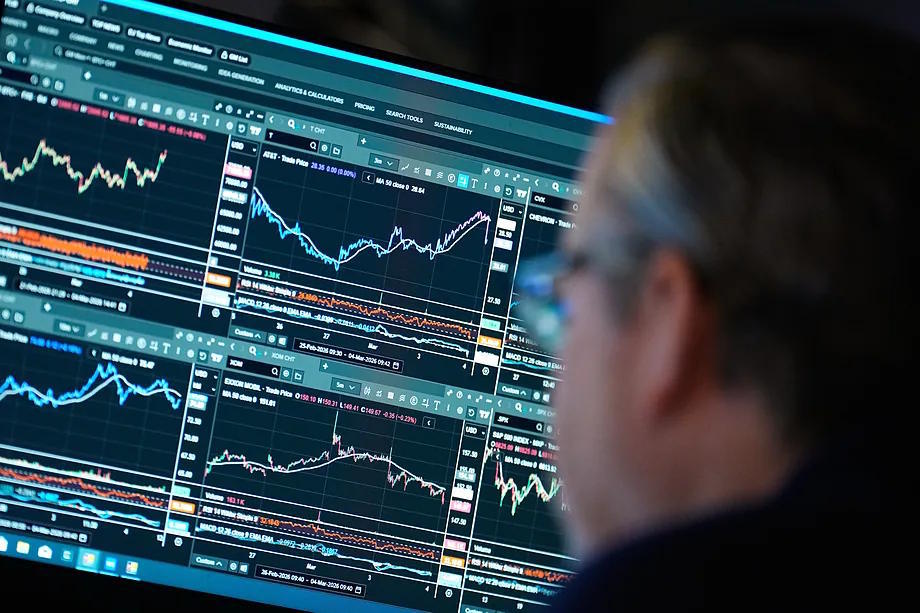
Tensions rise in the European market as the price of gas and oil has risen again on Thursday, amid escalating attacks in the Middle East.
The Brent barrel, which closed at 80 euros per barrel yesterday, today rises to 83.66 euros at the opening of European markets. Natural gas, measured in the Dutch TTF index, has rebounded by 8.82% to 55.66 euros per megawatt-hour. Renta 4 analysts attribute these increases to the decisions of two of the most oil-dependent countries that pass through the Strait of Hormuz, which remains besieged: China has instructed its major refineries to halt diesel and gasoline exports, and Japan has asked the government to release its strategic oil reserves.
So, uncertainty remains high on Thursday, and the market moves quickly with expectations. Investors now hesitate, after discounting a quick end to the war yesterday, and energy prices were considered certain following rumors of negotiations between the US and Iran, which have been denied by the former in recent hours. Meanwhile, bombings and attacks continue in the Middle East.
At the European closing bell, the Ibex opened nearly flat, with just a 0.05% increase that quickly turned into a 0.46% decline. The most affected were IAG (-3.4%), due to air restrictions in the Middle East, and ArcelorMittal (-1.63%) due to US threats against Spanish companies. On the other hand, driven by the rise in oil prices, Repsol surged by 3.18%.
In the rest of Europe, stock markets struggled for a good opening, although there was a general downturn. The German DAX and the French CAC started the session with slight declines of 0.6% and 0.5% respectively, while the London Stock Exchange fell by 0.3% and Milan by 0.7%. The biggest drop, over 1%, was seen in the Euro Stoxx 50, which includes the most representative companies in the Old Continent.
All of this occurs within another day of war in Iran, with new attacks and more difficulties in crossing the Strait of Hormuz, through which around a fifth of the world's oil and gas flows. Nevertheless, the movements are not as abrupt as in previous days, analysts note, expecting some stability in the coming days.
"The fear of a prolonged energy crisis due to the conflict in the Middle East and its implications on inflation, growth, and interest rates continues to dominate the scene. The most likely scenario is a limited and controlled escalation (without a sustained closure of the Strait of Hormuz, without permanent damage to regional energy infrastructure, without an extension of the conflict,...)," evaluate analysts at Bankinter. "When systemic risk increases (global energy shock), the pressure for a rapid de-escalation of the conflict also increases," they conclude before pointing out that caution prevails on Thursday but possible setbacks in the stock markets are also possible.
The situation must be closely monitored: "No significant damage has occurred to energy infrastructure, Iran's military strength appears to be weakening, and a solution to unlock trade in the Strait of Hormuz while safeguarding maritime transport remains feasible," assesses the Julius Baer firm.
At the European opening, the VIX index, known as the fear index for measuring market volatility, has risen by 1.3% to reach 21 points. Yesterday it fluctuated between 20 and 22 points; in other words, it is moving away from high volatility levels (starting from 25 points) but still reflects an unstable situation where trend changes are highly probable.
This morning, analysts have highlighted that in the fixed income market, bond prices are falling while the yield (return) on these government debt securities is soaring again, as today there is renewed speculation that countries will face significant inflation.
Asia experienced a rebound in its stock market session on Thursday: the main Japanese index, the Nikkei, rose by 1.9% driven by the technology sector; in the Seoul Stock Exchange, the Kospi index closed with gains of 9.63%, a significant recovery after the historic 12% plunge the day before. And the Hang Seng in Hong Kong closed with a slight increase of 0.35%. In the previous session, index declines ranged from 2% to 12%.
At this time, futures on the main Wall Street indicators also indicate slight declines, despite yesterday's session closing with all indices in the green.