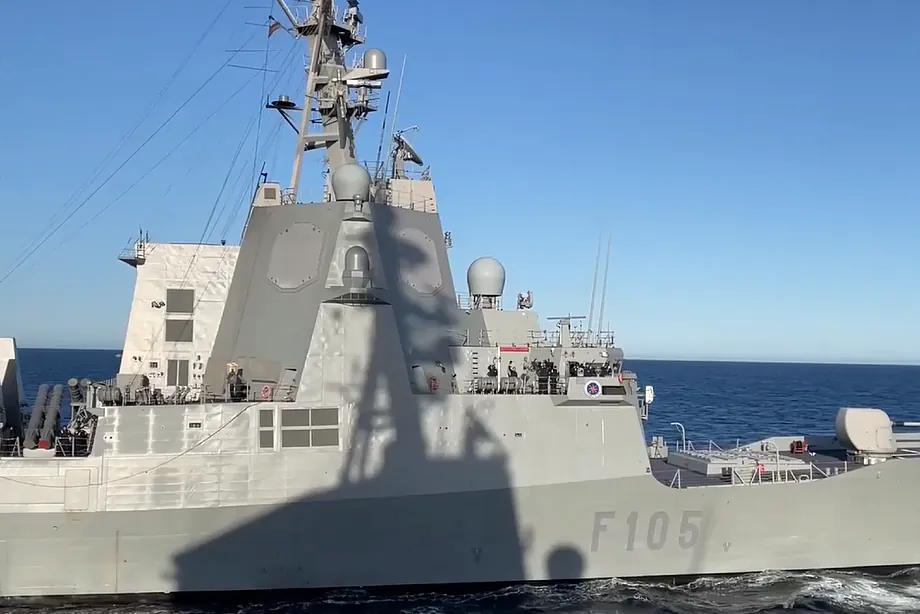
The Government will send the frigate Cristobal Colón to Cyprus integrated into the group led by the French aircraft carrier Charles de Gaulle. This was confirmed by the Ministry of Defense in a statement after the Minister, Margarita Robles, stated that they would provide capabilities if requested by the European Union. "There is a difference between attack missions and defense missions," Robles pointed out in an interview on Ser radio, emphasizing that Spain is a "strongly committed ally" to the United Nations, NATO, and the European Union.
She stressed that Spain will always stand with the European Union defending the basic principles of coexistence and peace, and if "the EU or EU members decide on missions to protect Cyprus," the Government "will take it into account and assess it." Less than two hours after these statements, the Government decided to send this frigate.
According to Defense reports, the Cristóbal Colón joined the Naval Group of the Charles de Gaulle on March 3 to carry out escort, protection, and advanced training tasks in the Baltic Sea. Now, the group will head to the Mediterranean to reach the shores of Crete around March 10.
The replenishment ship Cantabria will also briefly set sail to supply fuel and provide logistical support during the Naval Group's transit through the Gulf of Cadiz.
The Cristóbal Colón is the most technologically advanced frigate. Its mission in the Mediterranean will be to offer air defense and protection, complementing the capabilities of our Patriot battery deployed in Turkey. It will also be ready to provide support for any civilian evacuation that may be affected by the conflict.
Cyprus is not a NATO member but is part of the European Union, and this semester holds the rotating presidency of the EU Council. In the early hours of last Monday, it was targeted by an Iranian-produced drone attack on the British military base of Akrotiri in the south of the island. Following this, the United Kingdom, France, and Greece committed to sending frigates, missile defense systems, and anti-drone systems to this country.
Robles has refuted U.S. President Donald Trump when he repeatedly stated that Spain does not collaborate on defense issues, recalling that Spain does so within the framework of NATO in Turkey, in Lebanon with the UN, or in Operation Atalanta. Regarding Turkey, the minister mentioned the incident that occurred this Wednesday when the Alliance's defenses in that country intercepted an Iranian missile over the eastern Mediterranean, with its remnants falling in the country's southern end, as confirmed by the Ankara government.
In this specific case, Robles pointed out that the Spanish forces stationed in that country were not the ones that shot down the missile launched by Iran, but they provided "sufficient information" for it to be destroyed: "The Spanish battery in Turkey did not shoot down the missile, but it did provide enough information for it to be shot down."
Currently, Spain has 1,000 troops in Lebanon "under difficult conditions," in Iraq, and they are also in Turkey, where "we have a Patriot battery monitoring the situation," the minister summarized.
"We are doing the right thing"
On another note, Robles categorically denied the statement made yesterday by the White House spokesperson, Karoline Leavitt, regarding Spain's openness to militarily collaborate with the U.S. offensive against Iran. When asked about the possible source of the White House spokesperson's statements, Robles emphasized that "they know it's not true," while reiterating that Spain "will not authorize the use of the Rota and Morón bases for these actions in the context of the 'unilateral' attack on Iran, which does not have the umbrella of international legal order."
For the Defense Minister, the position of the Spanish Government "has been crystal clear from day one" and she pointed out that it is due to "a simple reason," because "we believe that ethically and legally we are doing the right thing."
Foreign Affairs Minister, José Manuel Albares, also stated in an interview on RNE that "the option of participating in an operation to defend a European partner can be considered," as Spain has done on other occasions, but it is different from the U.S. and Israel's military operation against Iran.
However, he assured that at the moment "there is no consideration" on this matter.
He also ruled out the possibility that the Prime Minister, Pedro Sánchez, might be thinking of calling for elections, stating that he is "focused and concentrated" on addressing this global crisis, defending the interests of Spaniards, and ensuring "the defense of our values."
He reiterated "categorically" that Spain has not agreed to cooperate with the U.S. military following Donald Trump's threats: "Spain's position is clear, sharp, and firm," he emphasized.