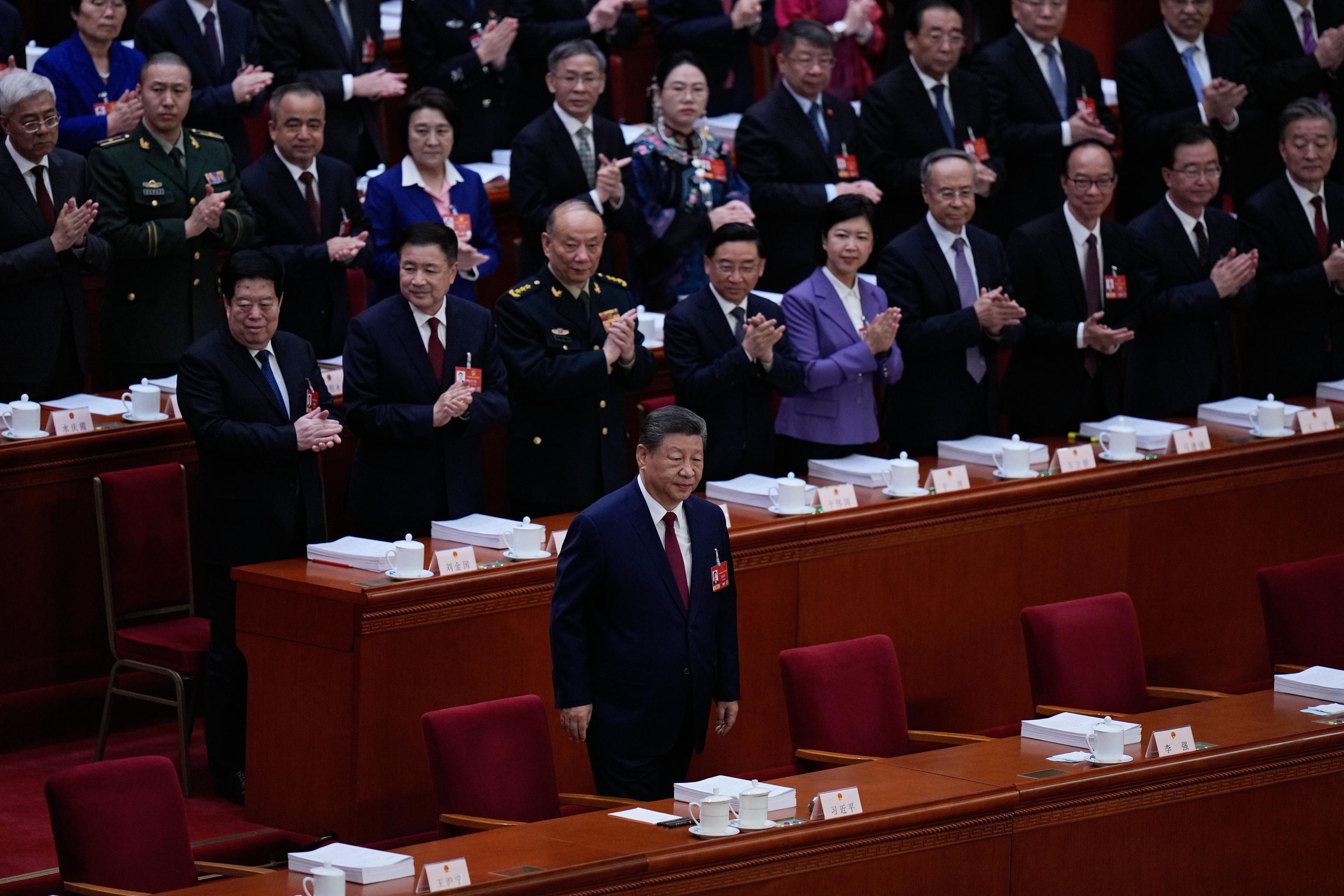
Under the chandeliers and Soviet-inspired golden ceilings of the Great Hall of the People, the mammoth building overlooking the western flank of Tiananmen Square, China staged its annual political ritual on Thursday. Nearly 3,000 delegates, dressed in dark suits, military uniforms, and colorful attire of ethnic minorities, took their seats in the main auditorium to inaugurate the opening session of the National People's Congress (NPC), the legislative body that, in theory, embodies popular sovereignty and, in practice, ratifies decisions already made behind the scenes of power.
For about an hour, Prime Minister Li Qiang read the work report, a document that sets the tone for the economic, military, and diplomatic pulse of the Asian giant. The most anticipated announcement was the growth target: between 4.5% and 5% for 2026, the lowest since 1991, a percentage below the 5% threshold that Beijing had defended in recent years as a sign of resilience. The downgrade is not just a technical adjustment; it is an implicit acknowledgment that the world's second-largest economy is moving forward with the brakes on. Leaders recognize that the era of runaway growth is behind them and that the country must get used to a more modest expansion in a more fragmented world.
"Over the past year, the Chinese economy has proven to be remarkably resilient, advancing despite headwinds," Li argued. "Rarely have we faced such a serious and complex landscape, where external shocks and challenges intertwined with internal difficulties and tough policy decisions."
Chinese lawmakers express concern over the attacks by the United States and Israel on Iran, which have jeopardized the country's energy security. China is one of the major Asian economies that depend on the vital Strait of Hormuz for its energy supply. According to the analysis firm Kpler, the Middle East was the source of 57% of Beijing's direct crude oil imports by sea in 2025. On Thursday, Chinese authorities instructed their major refineries to suspend diesel and gasoline exports. "Refineries were asked to stop signing new contracts and to negotiate the cancellation of previously agreed shipments," a government source told Bloomberg.
The Asian giant remains the leading exporting power, supported by its industrial muscle and dominance in strategic sectors such as batteries, solar panels, or electric vehicles. But the domestic engine is sputtering. The real estate sector, which for two decades was the savings account for families and the engine for local governments, continues to digest after the bubble burst.
Domestic consumption is not taking off as strongly as the government had hoped, caught between job uncertainty and falling home values. And on the horizon, the demographic winter: fewer births, more aging, and a shrinking workforce that threatens the growth model.
Faced with this scenario, Beijing has insisted on selective relief policies: more fiscal stimuli for strategic infrastructures, credit support for small and medium-sized enterprises, a more proactive fiscal policy, maintaining its budget deficit at around 4% of GDP, incentives for durable goods consumption, and a renewed commitment to technological self-sufficiency in the face of Western restrictions. Li announced that 250 billion yuan (31 billion euros) in special bonds will be allocated to finance a consumer goods exchange program.
The Prime Minister also spoke of "high-quality development," a formula that combines budget discipline with targeted injections to avoid a rough landing. The motto is, above all, to maintain stability. Grow less, but grow better; sustain urban employment and avoid a financial shock. Li also announced an urban unemployment target of 5.5% and pledged to create more than 12 million new urban jobs, goals in line with those of previous years.
This year's meeting is particularly relevant because delegates will approve the Fifteenth Five-Year Plan, the roadmap that will define the strategy until 2030 and aims to position China as a technological superpower that can rival the United States. The challenge is not small: how to sustain growth in an increasingly volatile environment of trade wars and fierce technological competition.
During Thursday's session, another highly anticipated figure was the defense budget: a 7% increase, below the 7.2% rise in previous years. Three decades ago, China was the ninth country in military spending. Today it is the second, behind only the United States. Its expenditure is around 1.7% of GDP, a modest proportion compared to Washington, but on a gigantic economic base. Many international defense analysts routinely point out that China's defense spending is actually at least three times higher than what Beijing publicly declares because it does not include investment in innovation and military development.
China boasts having the world's largest navy by the number of ships, over two million personnel in its armed forces —about a million on active duty—, around 340 warships and submarines, 2,800 combat aircraft, and about 400 nuclear warheads. Still far from the over 3,700 operational ones of the US or the over 4,000 of Russia, but clearly expanding.
The military buildup is not understood without the geopolitical backdrop. While in Beijing there was talk of stability and development, the world holds its breath after the coordinated US and Israel attack on Iran. To China, the world's top crude oil importer and a key economic partner of Tehran, a prolonged conflict in the Middle East is worrisome. Even more so at a time when its economy needs cheap energy and clear trade routes.
This year's legislative meeting is also marked by the anti-corruption campaign personally sponsored by Xi Jinping, which has taken down senior military leaders in recent months. Last week, nine generals were removed from the list of delegates participating in the NPC. Earlier this year, all kinds of rumors intensified about an investigation into alleged irregularities against Zhang Youxia, the country's highest-ranking military official and a key figure in the military leadership. A recent report from the Center for Strategic and International Studies, based in Washington, estimates that over a hundred high-ranking officers have been purged since 2022.
"China will maintain the absolute leadership of the Communist Party over the People's Armed Forces," said the Prime Minister. Referring to the anti-corruption campaign, he assured that the "political rectification" of the military "will continue to deepen." Li added that the People's Liberation Army (PLA) will "constantly advance military training and war preparedness, and accelerate the development of advanced combat capabilities."
All of this takes place within a system where real power is not aired in the plenary. The Communist Party is the epicenter of every decision. At the top is Xi Jinping, the party's general secretary and the true axis of the system. Below him are the 364 members of the Central Committee; further up the chain of command are the 24 members of the Politburo; and at the operational peak are the seven members of its Standing Committee. Li, as Prime Minister, is the economic face of that architecture, but the strategic direction emanates from the core surrounding Xi.