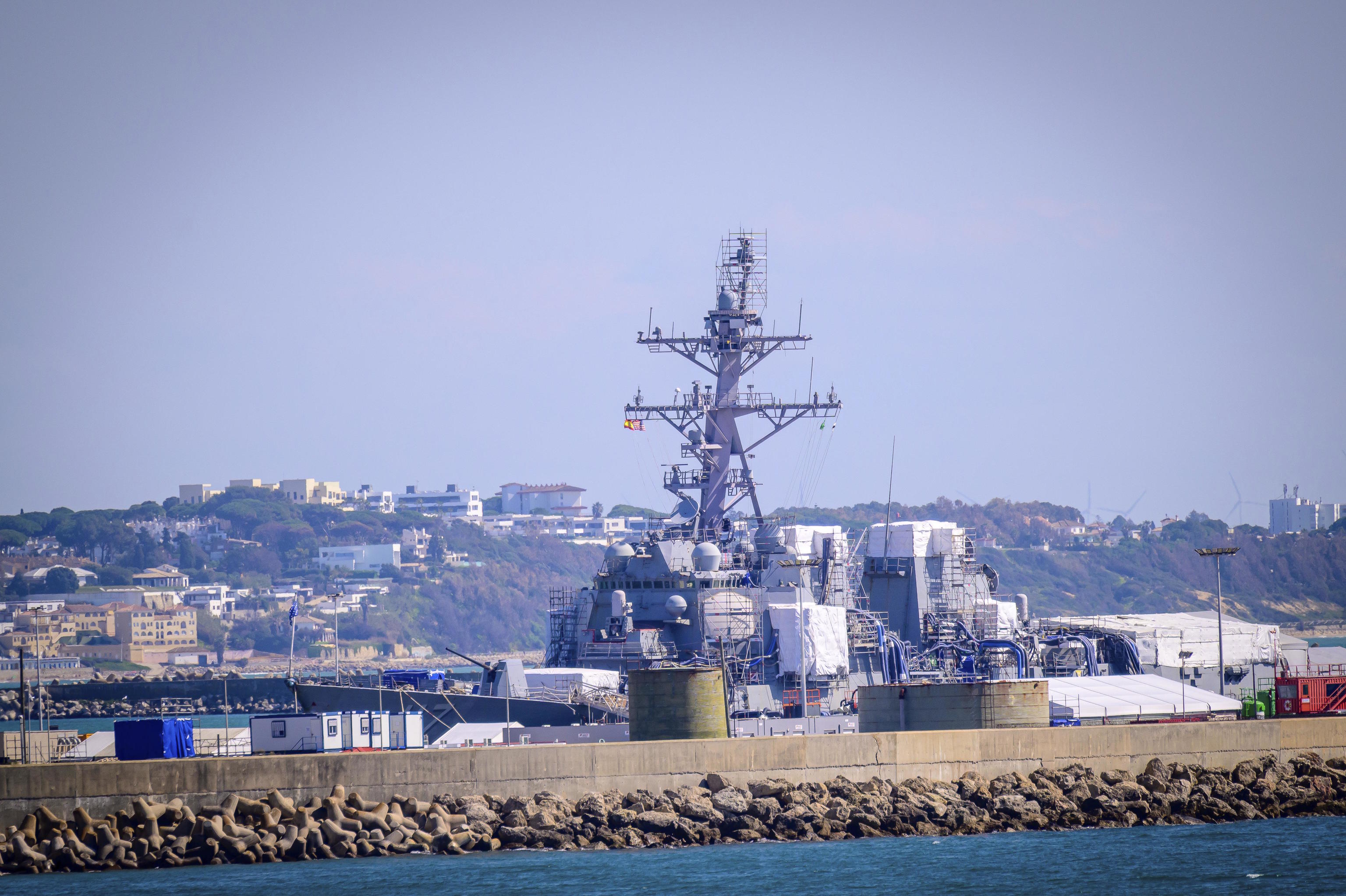
"We could use their base if we wanted to. We could simply fly there and use it. No one is going to tell us not to use it." The words that Donald Trump uttered alongside an unflappable Friedrich Merz last Wednesday at the White House seemed like just another provocation from the U.S. president, however, they held some truth. Although the government insisted from day one that the United States does not use the Rota and Morón bases for the attack on Iran, the reality is that these two enclaves are essential and strategic in the offensive. They are needed as a gateway to the Mediterranean, and they are being used. Also in this war against Iran that began last Saturday, February 28, in the morning.
According to information gathered by EL MUNDO, between February 27 - 24 hours before the attack - and March 5 at seven in the evening, there were no fewer than 40 flight movements to and from Morón and Rota. These include five landings and take-offs of a Beech aircraft that used the two bases in Andalusia and Torrejón for round trips to/from Morocco. Particularly noteworthy are 24 combat aircraft take-offs - some aircraft on multiple missions - to operate in the attacks on Iran with a prior stopover in Germany and Italy.
Over the 7 monitored days, there are repeated flights of strategic transport aircraft - the C-17 Globemaster, C-130 Hercules, and C-5 Super Galaxy - along with several KC-135 Stratotanker tanker aircraft, essential for in-flight refueling operations and crucial in 2003 for the offensive against Iraq. The activity pattern shows clear peaks on three days - February 27, March 1, and March 5 - with up to eight daily movements, indicating a relatively intense logistical bridge activation. The reason? The United States' strategy to be able to use the Spanish bases without directly exploiting them.
Because all monitored flights depart from Morón or Rota to U.S. Italian bases - mainly Aviano and Sigonella - as well as those located in Germany, and finally, some flights go to the base in the Azores, under the Portuguese flag. Portugal, Italy, and Germany, along with the United Kingdom, are the European countries that have authorized Donald Trump to use bases for the offensive against the ayatollahs.
If the movements on February 27 were striking, the next day, the departure of 8 Stratotankers to Germany was revealing. The movements of these tanker aircraft are a pattern in U.S. actions in the Middle East. During the Iraq campaign, they allowed for maintaining long-range air routes for fighters and transport aircraft crossing the Atlantic or heading towards the target. On the following day, March 1, 8 Globemasters took off for Germany. That Monday, the first reports circulated about the Spanish veto on the use of bases in offensive actions. This explains why Donald Trump publicly thanked Merz, during their meeting at the White House, for his help while criticizing Spain and the United Kingdom.
Trump's praises simultaneously triggered an alert in Berlin. Those statements were interpreted as confirmation of what experts in military aviation and security had been detecting for weeks: unusual activity at U.S. bases in Rhineland-Palatinate, especially in Ramstein.
This base hosts the largest U.S. Air Force installation outside its territory and is the headquarters of its air command in Europe. Along with the Spangdahlem base, also in Rhineland-Palatinate, it forms one of the main logistical nodes of its global military system.
Among the movements recorded at the Ramstein base, one stood out. On January 25, an EA-37B Compass Call landed, the most modern system of the U.S. Air Force for electronic warfare. This aircraft, based on a Gulfstream G550 and intended to replace the EC-130H, is designed to interfere with enemy radar, communication, and navigation systems. Its presence was significant: any attack on Iranian nuclear facilities - such as Fordow, Natanz, or Isfahan - would require neutralizing the country's air defenses beforehand. The arrival of the EA-37B was seen as an indication of operational readiness for a possible campaign in the Middle East.
Although on Monday, most flights departing from the Spanish bases headed to Germany, the most used route this week to participate in the attack on Iran is the one linking Rota with Sigonella, as the aircraft take off eastward, make a brief stopover, and continue towards the Middle East in their attacks on Iran. "This way, they achieve a dual objective: trying to arrive in the area earlier and not having to explain to Spain, as in practice, they only communicate a flight plan between European bases, not participation in a unilateral offensive," explains a source from the Air Force to this newspaper. They do not violate the agreement with Spain, which prohibits the use of the bases in unilateral actions, but the United States does not give up their use as a launchpad, as the only condition for take-offs and landings of their aircraft is to comply with air legislation. In Cádiz, around 3,000 U.S. soldiers are deployed.
In addition to the 40 aircraft movements and no fewer than 24 take-offs towards Iran with stopovers, there are the two destroyers based in Rota, which were prepositioned near Iran before the attack. They will return to Cádiz, where they are stationed as part of NATO's shield