Are we on the path to a new tanker war, like the one that involved Iran, Iraq, and the United States between 1981 and 1988? During the almost seven years of war between Tehran and Baghdad, both countries attacked around 450 oil tankers. Approximately 15% of them sank.
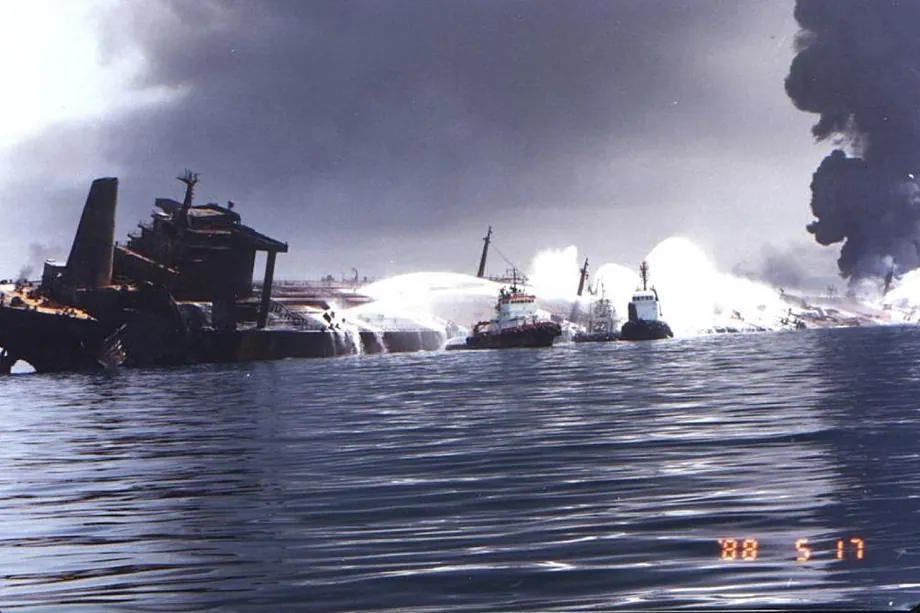
One of them was Spanish, the Barcelona. It sank when hit by two French Exocet missiles while loading oil at the Iranian terminal of Larak in the Strait of Hormuz in May 1988. Four Spaniards died.
Iraq was the main culprit of those actions. However, in a sign of the convoluted politics of the Middle East, all Gulf countries supported Iraq. When in 1987 Iran managed to close off Iraq's access to the sea, and the Kurdish guerrillas - supported by Iran, following the principle of "the enemy of my enemy is my friend" - closed the only pipeline through which the regime of Saddam Hussein could export its oil, Iraq was on the brink of economic collapse.
The solution was to export oil through Kuwait. Iran then began attacking refineries and tankers of Kuwait and other Gulf countries, especially Saudi Arabia. This, in turn, led nine Kuwaiti ships to sail under the American flag and three under the Soviet flag. The navies of both countries escorted them, triggering a series of naval battles between Washington and Tehran that culminated in the downing, by the USS Vincennes, of an Iranian passenger plane in July 1988, resulting in the death of all 290 people on board. After that, Iran and Iraq reached a permanent ceasefire.
The succession of attacks, counterattacks, and forced alliances from four decades ago bears some resemblance to the current situation. In the 80s, Saddam Hussein's Iraq was aligned with the USSR and did not have Islam as its official religion. Nevertheless, fearing a Shiite Iran, all fundamentalist petro-monarchies of the Gulf, along with the UK and the US, supported Iraq. France also joined in, mainly to sell weapons.
Now, Iran's attacks on tankers and infrastructure, as well as its closure of the Strait of Hormuz (which it also did in the 80s, but only for a day or two), have put the petro-monarchies - now less religious, closer to Israel, and interested in becoming global economic and political centers - in a situation they never wanted: actively supporting a US and Israeli attack on Iran. The same has happened to the three main European countries, Germany, the UK, and France. Trump, who six weeks ago said "NATO has never done anything for the United States," is now seeking help from NATO countries while using their bases to increase the force with which to bomb Iran.
One of the most curious aspects of the tanker war and the destruction of Iran and Iraq's infrastructure is that it had a very limited impact on oil prices. In reality, it only increased crude oil volatility. In fact, in the midst of the conflict in 1986, Saudi Arabia opened the floodgates of crude oil production and export. Immediately, the price per barrel plummeted to $12, less than a third of what it had reached in 1981 when the market was under the triple shock of a cohesive OPEC, the Soviet invasion of Afghanistan, and the Iran-Iraq war, which occurred in the main oil-producing region of Iran with a series of devastating bombings on what was then the world's second-largest refinery, Abadan.
Now, the oil market seems to be experiencing a sequel to that, but on a much larger scale and with much more technology. At its peak intensity, the war between Iran and Iraq barely raised the price of a barrel by 12% to 14%. It is a significant figure but not catastrophic. Since January, the price of Brent crude oil, used as a reference in Europe, has risen by 30%, with almost half of that increase in the last six days as Israel and the US have been pounding Iran, and Iran has been responding by attacking the petro-monarchies.
However, for now, the oil market is relatively calm. The British bank HSBC estimates that the price could remain at this level if the closure of the Strait of Hormuz lasts for a month, which is exactly the "four or five weeks" that Donald Trump has announced the war would last. It is, like everything in a crisis situation, a gamble. It is not enough for the strait to reopen; Saudi Arabia also needs to continue diverting part of its production to the Red Sea, out of Iran's reach, and the Houthis from that area, allies of Tehran, must not intervene to close that alternative route. Additionally, the refining and export facilities must not suffer severe damage. As a political risk analyst from the City of London said yesterday, "For now, the game is about holding on."