In Madrid, Sydney, Washington, or Seoul, the pulse of politics is felt in the halls of their respective legislative temples. Cameras broadcast live squabbles from inside the Congress, deputies improvise statements as they exit the chamber, and presidents appear before a cloud of microphones without prearranged questions. In Beijing, this ritual is condensed, in its own way, into a single week each year. Every March, Chinese power slightly draws back the curtain and allows the press to peek inside its machinery.
For foreign journalists, covering the National People's Congress (NPC) is accessing the only unfiltered window to question some of the nearly 3,000 deputies who descend on the Great Hall of the People, which stands as a secular sanctuary of the State. Its facade is covered by an endless row of columns, and inside, there are red carpets, enormous lamps suspended over rooms with very high ceilings, and uniformed ushers moving with millimetric choreography.
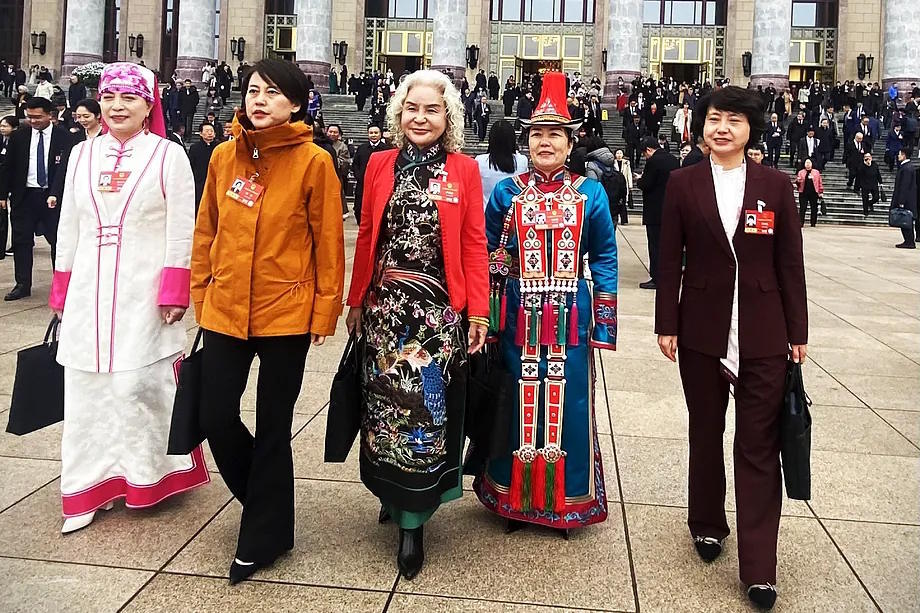
On Thursday, the inaugural session of the political conclave began. In the Parliament of the Asian superpower, a sea of dark suits, military uniforms, and traditional dresses of deputies from minority ethnic groups can be seen, whose colorful embroideries burst like brushstrokes in a painting dominated by gray. From the press gallery, rows and rows of delegates can be seen listening in silence to the Government's work report, taking notes with martial discipline.
The deputies arrive in Beijing with folders full of proposals and the sincere emotion of being designated in their local assembly to represent their province, company, or village. Like any tourist stepping into the heart of the capital, many take photos in front of the giant portrait of Mao Zedong. But the major national policies - growth targets, defense budget, structural reforms - have been decided beforehand by the Communist Party leadership.
When the first session ends, the delegates leave euphoric, with their accreditation hanging from their necks, and descend the marble staircase leading to Tiananmen Square. It is the moment to approach them and ask about the most current geopolitical issue: What is your assessment of the current conflict in the Middle East?
"The United States may choose the timing to intervene in a war against Iran, but not when to withdraw, as Tehran has declared its intention to engage in a prolonged conflict. If the US gets stuck in a long war in the Middle East, its room for maneuver in the Taiwan Strait will be significantly reduced. A prolonged war would entail a heavy consumption of US military resources, particularly ammunition, at a time when the country's arsenals are already under pressure since the start of the war between Russia and Ukraine," says legislator Li Yuhi, director of the Taiwan Studies Institute at Peking University.
"The conflict could force Washington to redistribute military resources from East Asia to the Middle East, leaving US forces in a more vulnerable position in this region, and therefore they would seek to strengthen the security alliance with Japan, South Korea, and the Philippines," Li continues. "The current global map is characterized by chaos in the West and stability in the East. China has become a stabilizing and constructive force in the international community," he concludes.
"China always advocates dialogue and a political solution," responds cautious Ma Hui, delegate from the southern province of Guangdong, echoing Beijing's official discourse. He speaks of a ceasefire, respect for Iranian sovereignty, and the need for the international community to act responsibly.
Many deputies express a preference to avoid commenting on issues not directly related to the NPC. "Official spokespersons already provide a daily assessment of the situation in the Middle East, and it would be inappropriate to make any comments that could contradict the country's diplomatic direction," says Holden Chow, representative from Hong Kong. The assembly's official spokesperson, Lou Qinjian, referring to the US, stated in a press conference that "no country has the right to control international affairs, dominate the destiny of other nations, monopolize the benefits of development, and even less to act arbitrarily in the world."
Another legislator from Hong Kong, Kenneth Fok, elaborates a bit more. "Everyone knows how turbulent the international situation is today. Coming to Beijing as a deputy to participate in these sessions, I sincerely feel from the bottom of my heart that China is a very safe place," he emphasizes. One of the business sector representatives in the assembly is Zhou Yunjie, chairman and CEO of the Haier Group, one of the world's largest appliance manufacturers. Zhou points out that his company is evaluating the impact that Iran's announcement to block the Strait of Hormuz could have.
The opening session in the Chinese Parliament concludes by mid-morning, and Tiananmen Square slowly empties, allowing the Great Hall of the People to regain its solemn silence. Delegates return to their hotels, journalists send their reports, and Beijing closes ranks again until the next meeting, when the world has the opportunity to peek once more into the carefully choreographed heart of Chinese politics.